

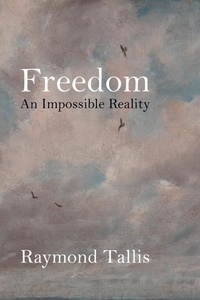
Freedom
An Impossible Reality
Published on 9. September 2021
Book
Hardback
280 pages
978-1-78821-378-3 (ISBN)
Description
The question of free will has preoccupied philosophers for millennia. In recent years the debate has been reinvigorated by the findings of neuroscience and, for some, the notion that we have free will has finally been laid to rest. Not so, says Raymond Tallis. In his quest to reconcile our practical belief in our own agency with our theoretical doubts, Tallis advances powerful arguments for the reality of freedom.
Tallis challenges the idea that we are imprisoned by laws of nature that wire us into a causally closed world. He shows that our capacity to discover and exploit these laws is central to understanding the nature of voluntary action and to reconciling free will with our status as material beings.
Bringing his familiar verve and insight to this deep and most intriguing philosophical question, one that impacts most directly on our lives and touches on nearly every other philosophical problem - of consciousness, of time, of the nature of the natural world, and of our unique place in the cosmos - Tallis takes us to the heart of what we are. By understanding our freedom he reveals our extraordinary nature more clearly.
Tallis challenges the idea that we are imprisoned by laws of nature that wire us into a causally closed world. He shows that our capacity to discover and exploit these laws is central to understanding the nature of voluntary action and to reconciling free will with our status as material beings.
Bringing his familiar verve and insight to this deep and most intriguing philosophical question, one that impacts most directly on our lives and touches on nearly every other philosophical problem - of consciousness, of time, of the nature of the natural world, and of our unique place in the cosmos - Tallis takes us to the heart of what we are. By understanding our freedom he reveals our extraordinary nature more clearly.
Reviews / Votes
... classic Tallis. He deploys his typical analytic dexterity to establishing the reality of free will in opposition to all advocates for materialist reductionism - but it is 'an impossible reality'. By this he means that natural science, and the simplified metaphysics we take from it, are incomplete accounts of the world and, importantly, of human life, and 'to assert the undeniable reality of human agency is not, however, to deny its mystery' ... lucidly accessible to the non-specialist, but with a series of appendices provided for those disposed to delve deeper. -- John Saxbee, Church Times The very title of Raymond Tallis' new book tells us where he stands. Freedom is an 'impossible reality' - impossible according to theory, and yet affirmed by our every action. For Tallis, the experience of freedom is non-negotiable: we cannot but experience ourselves as choosing and deciding, intervening in the world in ways that make a difference to it. Beginning from the reality of this experience, Tallis argues that where our theories appear to contradict free will, it is a sign we have misinterpreted those theories. Scientific theories, far from providing arguments against free will, are powerful evidence for its existence ... Tallis does not suffer from the inhibition of academic philosophers, or share the restraint of their conclusions. This makes for an unusually invigorating treatise, especially in the critical sections. * The New Humanist * There is much to agree with and admire in Raymond Tallis's new book. It presents a fascinating and unusual defence of the reality of human freedom ... It offers an extremely original set of reflections on the concept of causation, casting scepticism on its conceptualization as a kind of constraining force which might negate, or count as some kind of obstacle to, our own agency. Unlike most work on the free will problem, it is a book which takes account not only of much recent work in the analytical tradition, but also a number of ideas from the work of continental philosophers such as Heidegger and Sartre. It is beautifully written and full of interesting examples. -- Helen Steward, Professor of Philosophy of Mind and Action, University of Leeds A compelling case for a compatibilist theory of human freedom. -- Adam Rostowski An excellent read ... [it] does not only offer great insights into the dynamics of scientific research and conditions of freedom but also reveals the importance of other topics such as the philosophy of nature, embodiment and intentionality. -- Jan Halak, Associate Professor of Philosophy, Palacky University, OlumoucMore details
Language
English
Place of publication
United Kingdom
Publishing group
Edinburgh University Press
Target group
College/higher education
Product notice
Laminated cover
Dimensions
Height: 234 mm
Width: 156 mm
Thickness: 15 mm
Weight
594 gr
ISBN-13
978-1-78821-378-3 (9781788213783)
Copyright in bibliographic data and cover images is held by Nielsen Book Services Limited or by the publishers or by their respective licensors: all rights reserved.
Schweitzer Classification
Other editions
Person
Raymond Tallis is Professor of Geriatric Medicine at the University of Manchester and Fellow of the Academy of Medical Sciences. Over the last 15 years he has published extensively outside the field of medicine. There have been three books which mount a critique of post-structuralist theory: Not Saussure: A Critique of Post-saussurean Literary Theory (Macmillan, 2nd edn, 1995), In Defence of Realism (Arnold & University of Nebraska Press, 2nd edn, 1998) and Theorrhoea and After (Macmillan, 1998). He has also published four books in the philosophy of mind: The Explicit Animal: A Defence of Human Consciousness (Macmillan, 1991), The Pursuit of Mind (co-edited with Howard Robinson, Carcanet, 1991), Psycho Electronics (Ferrington, 1994) and On the Edge of Certainty and Other Essays (Macmillan, 1999). Further books include Newton's Sleep: The Two Cultures and the Two Kingdoms (Macmillan, 1995), Enemies of Hope: A Critique of Contemporary Pessimism (Macmillan, 1997) and A Conversation with Martin Heidegger (Macmillan (Palgrave), 2002). An anthology of his theoretical writing - The Raymond Tallis Reader, edited by Michael Grant - was published by Macmillan (Palgrave) in 2000. He was awarded the degree of Doctor of Letters (hon causa) at the University of Hull in 1997 for his non-medical writings and the degree of Doctor of Letters (hon causa) at the University of Manchester in 2003 for 'contributions to literary theory and our understanding of human consciousness'. The Knowing Animal is the final volume in the trilogy of books for EUP which began with The Hand and continued with I Am.
Content
Overture: intention and intentionality
1. The impossibility of free will
2. Bringing the laws on side
3. Unpicking causation
4. Actions
5. The human agent
6. The limits of freedom
Coda
Appendices
1. The impossibility of free will
2. Bringing the laws on side
3. Unpicking causation
4. Actions
5. The human agent
6. The limits of freedom
Coda
Appendices