

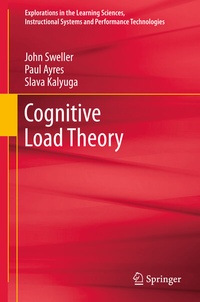
Cognitive Load Theory
Description

Over the last 25 years, cognitive load theory has become one of the world's leading theories of instructional design. It is heavily researched by many educational and psychological researchers and is familiar to most practicing instructional designers, especially designers using computer and related technologies.
The theory can be divided into two aspects that closely inter-relate and influence each other: human cognitive architecture and the instructional designs and prescriptions that flow from that architecture. The cognitive architecture is based on biological evolution. The resulting description of human cognitive architecture is novel and accordingly, the instructional designs that flow from the architecture also are novel. All instructional procedures are routinely tested using randomized, controlled experiments.
Roughly 1/3 of the book will be devoted to cognitive architecture and its evolutionary base with 2/3 devoted to the instructional implications that follow, including technology-based instruction. Researchers, teachers and instructional designers need the book because of the explosion of interest in cognitive load theory over the last few years. The theory is represented in countless journal articles but a detailed, modern overview presenting the theory and its implications in one location is not available.
More details
Other editions
Additional editions
Content
<P>Introduction to the issues addressed by cognitive load theory.- Categories of information: What is learned based on an evolutionary perspective.- Human cognitive architecture.- Categories of cognitive load and measuring cognitive load.- Instructional effects associated with intrinsic cognitive load. -Instructional effects associated with extraneous cognitive load.- The consequences of cognitive load theory for debates on the advantages and disadvantages of minimal guidance during instruction.- Future directions and unresolved issues.</P>
