

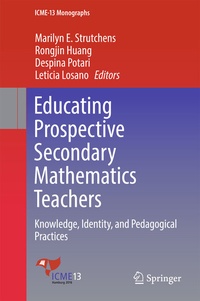
Educating Prospective Secondary Mathematics Teachers
Description

This book highlights innovative approaches to preparing secondary mathematics teachers. Based on empirical findings gathered in several countries on five continents, it provides a wealth of best practices for preparing secondary mathematics teachers, and discusses issues related to their professional and personal growth, such as identity, content knowledge, and pedagogical content knowledge which also includes knowledge of integrating technology into teaching and learning mathematics.
Divided into four parts, the book focuses on field experiences, technologies, tools and resources, teacher knowledge, and teacher professional identities. Some of the main threads running through the book are: the importance of university and school partners working together to ensure preservice secondary mathematics teacher' success in developing pedagogical strategies that lead toward students' mathematical engagement and achievement; the critical need for preservice secondary mathematics teachers to develop strong content knowledge and pedagogical content knowledge; and the importance of providing opportunities, during pre-service education, for developing prospective teachers ´professional identities.
More details
Other editions
Additional editions
Content
Introduction.- Section I. Field Experience.- The Structure of Student Teaching Can Change the Focus to Students' Mathematical Thinking.- Transforming Secondary Mathematics Teacher Preparation Via a Networked Improvement Community: Focus on Clinical Experiences .- Pre-Service Teachers' Reflections on Their Teaching.- Gaining Valuable Field Experience Through the Use of Informal Learning Environments.- Diagnosis-based Adaptations of Mathematics Lessons.- Section II. Use of Technologies and Tools.- Contemporary Framing of Technology in Mathematics Teaching.- Prospective Mathematics Teachers' Perspectives on Technology.- Preservice Mathematics Teachers' Effective Use of Technology: Analyzing the Cognitive Demands of Technology-Based Instructional Activities .- Section III. Mathematics for Teaching .- Prospective Mathematics Teacher Argumentation While Interpreting Classroom Incidents. .- Designing a Competence-based Entry Course for Prospective Secondary Mathematics Teachers.- Nurturing Knowledge of Mathematical Modeling for Teaching.- Future Teachers' Use of Multiplication and Fractions When Expressing Proportional Relationships.- Marking Mathematics Exams as a Tool for Secondary Teacher Training.- Section IV. Professional Identity and Disposition .- Prospective Mathematics Teachers' Professional Identity.- Exploring Pre-service Teachers' Self-perceptions of Mathematical Knowledge for Teaching.- Exploring the Initial Convictions and Mindset of Prospective Mathematics Teachers Towards Modelling.- Conclusion.
