

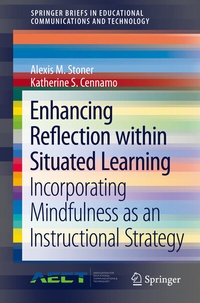
Enhancing Reflection within Situated Learning
Description

This innovative brief provides guidance on promoting reflection in situated learning by incorporating mindfulness strategies, tapping into a surge of research interest in exploring mindfulness as an instructional strategy associated with positive learning outcomes. It illustrates the benefits of continuous reflection within situated learning and how mindfulness can be incorporated before, during, and after the learning experience to enhance the reflective experience. Critically, the authors present a new conceptual model that synthesizes theories and methods from three different areas of study-mindfulness, situated learning, and reflection- to provide a new perspective and instructional approach that has great potential to positively impact outcomes in situated learning.
Among the other topics covered:
Strategies for reflection in situated learning.
Strategies for reflection-in-action in situated learning.
Mindfulness strategies for situated learning.
A conceptual model incorporating mindfulness to enhance reflection.
Enhancing Reflection within Situated Learning is an exciting and pioneering resource that offers practical guidance to educators and instructional designers interested in incorporating methods and approaches for integrating mindfulness and reflection across instructional environments.
Reviews / Votes
"This volume represents a valuable and useful reading for any educator interested in expanding their knowledge of instructional design of situational learning, as well as a foundation for those wanting to incorporate mindfulness and reflective practices into their teaching." (Sarah Traversin, Idee in form@zione, March, 2020)
More details
Other editions
Additional editions
Persons
Katherine Cennamo is a Professor of Learning Sciences and Technologies at Virginia Tech. She has a Bachelor's degree in Elementary Education from Virginia Tech, a Master's degree in Educational Media from the University of Arizona, and a Ph.D. in Instructional Technology from the University of Texas at Austin. Throughout her career, Dr. Cennamo's work has focused on the application of learning theories to the design of technology-based instructional materials. Through numerous funded projects, publications, presentations, instructional materials, and teaching activities, she has disseminated knowledge of instructional strategies based on established of theories of learning, illuminated the nature of instructional design practice so that scholars and designers alike better understand their work, and applied this knowledge to the preparation of future instructional design professionals. She has synthesized much of this work in her textbooks, Real World Instructional Design, co-authored with Debby Kalk, and Integrating Technology for Meaningful Classroom Use, co-authored with John Ross and Peggy Ertmer. Currently, her research and service activities focus on developing and sustaining a classroom culture that fosters critical and creative thinking skills in K-12 and higher education environments.
