

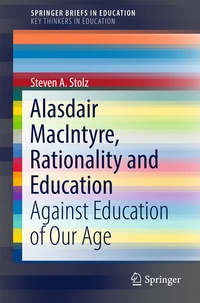
Alasdair MacIntyre, Rationality and Education
Description

Despite Alasdair MacIntyre being known as an academic who has made many notable contributions to a range of areas in philosophy, his thinking on education is not as well-known and/or properly understood by most audiences and readerships that predominantly reside in educational contexts. With this in mind, this book aims to provide a critique of MacIntyre's thinking about education, and hence commences with a central theme found in MacIntyre's extensive corpus concerning the fragmentation and disunification of ideas found in our culture and society that stems both from the rejection of metaphysics and what it means to be a human being living within the context of history. According to MacIntyre, part of the problem why this has occurred is due to educational institutions, particularly universities failing to resist the pressure exerted from industry and the state to conform. Unfortunately, this has resulted in a type of intellectual dissensus where the shared conceptions of rationalenquiry and the role of reason have been replaced by pluralistic notions of private and personal choices concerning the good, and a disillusionment with reason that is ultimately exhibited as apathy and conformism. In order to overcome this apathy and conformism found in our culture and society, MacIntyre's educational project is concerned with the cultivation of rationality; however, this is not an easy undertaking because it involves students being confronted with alternative - sometimes rather hostile - rival traditions so they both come to see rival points of view and understand that each tradition, including their own, does not come from a neutral or value-neutral standpoint. To MacIntyre, dialectical encounters between traditions is a crucial starting point of a good education, but for intellectual and academic progress to be made, rational enquiry needs to be grounded in a shared understanding of first principles that aims at truth and rational vindication. It is this shift in thinking that is of interest in the latter part of this book, particularly MacIntyre's views around tradition-orientated communities of practice. Here, MacIntyre is concerned with the praxis of his educational project and the crucial role tradition-orientated communities play in the cultivation of independent reasoners who are capable of seeing the interconnectedness between different forms of knowledge that can lead us to an informed discovery of both the truth, and of the good, but most importantly exhibit virtuous dispositions which are vital to good practical reasoning.
More details
Other editions
Additional editions
Content
Prelims. - Chapter 1. The genesis of MacIntyre's educational project: A democratic culture and community of critical enquiry. - Chapter 2. MacIntyre's restoration of rationality: the essence of human nature is reason. - Chapter 3. MacIntyre's enlightenment educational ideal: cultivating rationality and contemporary discourse through controversy and constrained disagreement. - Chapter 4. MacIntyre's educational project applied: cultivating independent rational agents with virtuous dispositions.
