

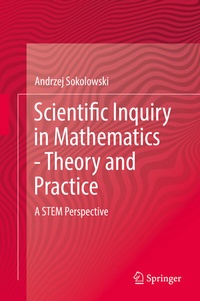
Scientific Inquiry in Mathematics - Theory and Practice
Description

This valuable resource provides an overview of recent research and strategies in developing and applying modelling to promote practice-based research in STEM education. In doing so, it bridges barriers across academic disciplines by suggesting activities that promote integration of qualitative science concepts with the tools of mathematics and engineering. The volume's three parts offer a comprehensive review, by
1) Presenting a conceptual background of how scientific inquiry can be induced in mathematics classes considering recommendations of prior research,
2) Collecting case studies that were designed using scientific inquiry process designed for math classes, and
3) Exploring future possibilities and directions for the research included within.
Among the topics discussed:
· STEM education: A platform for multidisciplinary learning.
· Teaching and learning representations in STEM.· Formulating conceptual framework for multidisciplinary STEM modeling.
· Exploring function continuity in context.
· Exploring function transformations using a dynamic system.
Scientific Inquiry in Mathematics - Theory and Practice delivers hands-on and concrete strategies for effective STEM teaching in practice to educators within the fields of mathematics, science, and technology. It will be of interest to practicing and future mathematics teachers at all levels, as well as teacher educators, mathematics education researchers, and undergraduate and graduate mathematics students interested in research based methods for integrating inquiry-based learning into STEM classrooms.
Reviews / Votes
"This book stands out offering both a theory and a practice of STEM education. It provides examples of STEM curriculum grounded in the realities of school mathematics and sciences. . I commend this book for starting the line of work that taps into both theory and practice and pushing us in the mathematics classroom to look beyond the numbered theorems in the texts for our aspiring scientists, engineers, mathematicians, and future citizens with STEM literacy." (Woong Lim, MAA Reviews, July, 2018)More details
Other editions
Additional editions
Person
Content
Part I.Scientific and Mathematics Reasoning in STEM - Conceptual Framework.- Chapter 1.STEM Education: A Platform for Multidisciplinary Learning.- Chapter 2. Integrating Mathematics and Science within the STEM Paradigm.- Chapter 3.Teaching and Learning Representations in STEM.- Chapter 4.Modeling in STEM.- Chapter 5.Survey of the Field of Empirical Research on Scientific Methods in STEM.- Chapter 6.Formulating Conceptual Framework for Multidisciplinary STEM Modeling.- Part II.Scientific and Mathematics Reasoning in STEM Practice.- Chapter 7.Modeling with Exponential Decay Function.- Chapter 8.Exploring Function Continuity in Context.- Chapter 9.Exploring Function Transformations using a Dynamic System.- Chapter 10.Investigating Function Extreme Value - Case of Optimization.
