

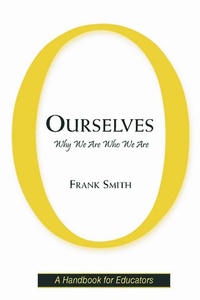
Ourselves
Why We Are Who We Are
1st Edition
Published on 13. May 2013
136 pages
978-1-135-59606-4 (ISBN)
Description

This book delves into how we come to terms with ourselves, with other people, and with the world in general. It is about how we come to be what we are, and to think the way we do. It is a book about influences on this process. A particular influence to which Smith gives central consideration is language, not just in terms of the communicative networks in which it engages us--the "information" that presents itself to us--but in the largely unsuspected framework for thought that lies within language itself. He also considers deeply the role of technology.
This is a book of description, not of explanations--these are two quite different intellectual territories. Smith writes about what can be observed, not philosophized about. Thus he does not discuss the inner workings of the human brain. His claim is that what he is interested in--thinking, learning, understanding, remembering--have never been found in the brain. The aim is to describe the scope and limits for how we can be seen to think, learn, understand, and remember--but not to "explain" such behavior by recourse to hypothetical inner entities.
Ourselves speaks especially to educators. It outlines the possibilities and limitations inherent in all of us. It delineates who we are, but also stresses that no two people are the same, that what we become depends on our journeys in life and the people we encounter on the way. The formal part of learning that is called education is particularly sensitive to the role of people who organize critical experiences for us, our teachers. The brief summaries at the end of each chapter reinforce and highlight points that are of particular relevance to teachers.
Researchers, professionals, and graduate students across the fields of literacy education, psychology of reading, learning theory, human learning, educational psychology, and psycholinguistics will find this book compelling.
This is a book of description, not of explanations--these are two quite different intellectual territories. Smith writes about what can be observed, not philosophized about. Thus he does not discuss the inner workings of the human brain. His claim is that what he is interested in--thinking, learning, understanding, remembering--have never been found in the brain. The aim is to describe the scope and limits for how we can be seen to think, learn, understand, and remember--but not to "explain" such behavior by recourse to hypothetical inner entities.
Ourselves speaks especially to educators. It outlines the possibilities and limitations inherent in all of us. It delineates who we are, but also stresses that no two people are the same, that what we become depends on our journeys in life and the people we encounter on the way. The formal part of learning that is called education is particularly sensitive to the role of people who organize critical experiences for us, our teachers. The brief summaries at the end of each chapter reinforce and highlight points that are of particular relevance to teachers.
Researchers, professionals, and graduate students across the fields of literacy education, psychology of reading, learning theory, human learning, educational psychology, and psycholinguistics will find this book compelling.
Reviews / Votes
"I strongly recommend Ourselves as an impetus for discussion among educators...I am confident that readers will find this book to be an engaging mix of thoughts and theory pertaining to instruction and learning."--PsycCRITIQUES, November 29, 2006, Vol. 51, No. 48"This is a great book [that] could easily become a classic.... It may be the most coherent book about learning ever published. It has a clear and sensible explanation for the concept of consciousness. It is a series of profound insights, well supported by cognitive science, that once stated seem simple and obvious. It is a profound statement on technology, presenting technology and its development in a completely new and convincing way. These are amazing contributions for such a modest-sized volume."
-Stephen Krashen, University of Southern California
More details
Language
English
Place of publication
London
United Kingdom
Publishing group
Taylor & Francis Ltd
Target group
Professional and scholarly
Product notice
Reflowable
File size
1,41 MB
ISBN-13
978-1-135-59606-4 (9781135596064)
Copyright in bibliographic data and cover images is held by Nielsen Book Services Limited or by the publishers or by their respective licensors: all rights reserved.
Schweitzer Classification
Other editions
Person
Frank Smith
Content
Contents: Preface. Our Myths. Our Certainties. Our Ideas. Our Limitations. Our Differences. Our Stupidities. Our Language. Our Identity. Our Consciousness. Our Technology. Ourselves.
