

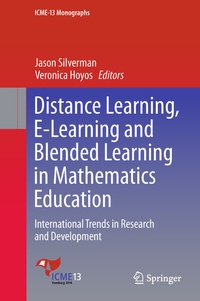
Distance Learning, E-Learning and Blended Learning in Mathematics Education
Description

This book builds on current and emerging research in distance learning, e-learning and blended learning. Specifically, it tests the boundaries of what is known by examining and discussing recent research and development in teaching and learning based on these modalities, with a focus on lifelong mathematics learning and teaching. The book is organized in four sections: The first section focuses on the incorporation of new technologies into mathematics classrooms through the construction or use of digital teaching and learning platforms. The second section presents a wide range of perspectives on the study and implementation of different tutoring systems and/or computer assisted math instruction. The third section presents four new innovations in mathematics learning and/or mathematics teacher education that involve the development of novel interfaces' for communicating mathematical ideas and analyzing student thinking and student work. Finally, the fourth section presents the latest work on the construction and implementation of new MOOCs and rich media platforms developed to carry out specialized mathematics teacher education.
More details
Other editions
Additional editions
Content
CHAPTER 1: Research on Technologically Mediated Mathematics Learning at a Distance: An Overview and Introduction.- Section I: E-learning and Blended Learning of Mathematics.- CHAPTER 2: The Blended Learning Concept E:T:P:M@Math: Practical Insights and Research Findings.- CHAPTER 3: Challenges and Opportunities in Distance and Hybrid Environments for Technology-Mediated Mathematics Teaching and Learning.- Section II: Online Environments and Tutoring Systems for Leveling College Students' Mathematics Learning.- CHAPTER 4: Computer Assisted Math Instruction: A Case Study for MyMathLab Learning System.- CHAPTER 5: Lessons Learned from a Calculus E-Learning System for First-Year University Students with Diverse Mathematics Backgrounds.- CHAPTER 6: A Customized Learning Environment and Individual Learning in Mathematical Preparation Courses.- Section III: Innovations on E-Math Learning and Teaching.- CHAPTER 7: Scripting Collaboration for Competence-Based Mathematics Learning: A Case Study of Argumentation.- CHAPTER 8: Effective Use of Math E-Learning with Questions Specification.- CHAPTER 9: Designing Interactive Technology to Scaffold Generative Pedagogical Practice.- CHAPTER 10: Supporting Teachers in Developing their RiTPACK through Using Video Cases in an Online Course.- Section IV: MOOC and Rich Media Platform for Mathematics Teacher Education.- CHAPTER 11: Design and Impact of MOOCS for Mathematics Teachers.- CHAPTER 12: Describing Curricular Materials for Mathematics Teacher Education in an Online, Rich Media Platform .
