

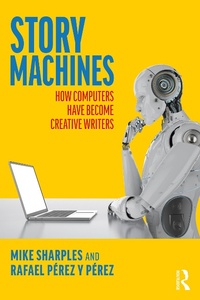
Story Machines: How Computers Have Become Creative Writers
1st Edition
Published on 5. July 2022
194 pages
978-1-000-59145-3 (ISBN)
Description

This fascinating book explores machines as authors of fiction, past, present, and future. For centuries, writers have dreamed of mechanical storytellers. We can now build these devices. What will be the impact on society of AI programs that generate original stories to entertain and persuade? What can we learn about human creativity from probing how they work?
In Story Machines, two pioneers of creative artificial intelligence explore the design and impact of AI story generators. The book covers three themes: language generators that compose coherent text, storyworlds with believable characters, and AI models of human storytellers. Providing examples of story machines through the ages, it covers the history, recent developments, and future implications of automated story generation.
Anyone with an interest in story writing will gain a new perspective on what it means to be a creative writer, what parts of creativity can be mechanized, and what is essentially human. Story Machines is for those who have ever wondered what makes a good story, why stories are important to us, and what the future holds for storytelling.
In Story Machines, two pioneers of creative artificial intelligence explore the design and impact of AI story generators. The book covers three themes: language generators that compose coherent text, storyworlds with believable characters, and AI models of human storytellers. Providing examples of story machines through the ages, it covers the history, recent developments, and future implications of automated story generation.
Anyone with an interest in story writing will gain a new perspective on what it means to be a creative writer, what parts of creativity can be mechanized, and what is essentially human. Story Machines is for those who have ever wondered what makes a good story, why stories are important to us, and what the future holds for storytelling.
Reviews / Votes
"A masterful and highly accessible overview of exciting developments in computer-generated literature by two experts in the field."Arthur I. Miller, author of The Artist in the Machine: The World of AI-Powered Creativity
"Story Machines is a lot of fun to read. It's a fascinating cultural and technological history of the centuries-long attempt to automate creative writing. It is also an exploration of what makes writing good: interesting characters; intriguing relationships; surprising events and plots; and aesthetically pleasing prose. Ultimately, Story Machines is about human creativity."
Keith Sawyer, author of Explaining Creativity: The Science of Human Innovation
"Software that writes stories? A fascinating insight into how computers are learning to replicate the power of human imagination. Sharples and Perez y Perez are experts in the field of computational creativity. Their insights into language, story structure and the replication of human creativity map a journey in which computers could create future stories that change behaviours and beliefs. The ethics of how these are enabled, engaged and deployed will be a debated for years to come."
Vikki Kirby, Chief Storyteller, Vibrato Consulting
"Stories have been computer-generated for decades by a curious assortment of programmers, artists, and authors. Mike Sharples and Rafael Perez y Perez tell their stories, providing a rich, broad history that will interest and inform anyone interested in the future of literary art."
Nick Montfort, author/programmer of Golem "A masterful and highly accessible overview of exciting developments in computer-generated literature by two experts in the field."
Arthur I. Miller, author of The Artist in the Machine: The World of AI-Powered Creativity
"Story Machines is a lot of fun to read. It's a fascinating cultural and technological history of the centuries-long attempt to automate creative writing. It is also an exploration of what makes writing good: interesting characters; intriguing relationships; surprising events and plots; and aesthetically pleasing prose. Ultimately, Story Machines is about human creativity."
Keith Sawyer, author of Explaining Creativity: The Science of Human Innovation
"Software that writes stories? A fascinating insight into how computers are learning to replicate the power of human imagination. Sharples and Perez y Perez are experts in the field of computational creativity. Their insights into language, story structure and the replication of human creativity map a journey in which computers could create future stories that change behaviours and beliefs. The ethics of how these are enabled, engaged and deployed will be a debated for years to come."
Vikki Kirby, Chief Storyteller, Vibrato Consulting
"Stories have been computer-generated for decades by a curious assortment of programmers, artists, and authors. Mike Sharples and Rafael Perez y Perez tell their stories, providing a rich, broad history that will interest and inform anyone interested in the future of literary art."
Nick Montfort, author/programmer of Golem
"One of the most valuable features of the book is its rich presentation of examples. Readers come away having read nearly 100 instances of mechanically and computationally generated stories, which provide a clear sense of the variety of approaches and the kind of story they produce. Readers are even invited at several moments to experiment with these methods themselves. The authors also integrate computer-generated prose into the book's text, which serves as a frequent reminder that the act of reading may shift and transform as automation and authorship converge in different ways."
Stephanie Dick, Science
"If you're a writer, should the growing sophistication of artificial intelligence worry you? Or is AI more likely to actually enhance your writing? This fascinating book charts the recent history of AI-driven 'story machines', probing their strengths and weaknesses, and what they can tell us about the creative writing process."
Terry Freedman, Teach Secondary
More details
Edition
1. Auflage
Language
English
Place of publication
London
United Kingdom
Publishing group
Taylor & Francis Ltd
Target group
Professional and scholarly
Product notice
Reflowable
Illustrations
4 Tables, black and white; 10 Line drawings, black and white; 3 Halftones, black and white; 13 Illustrations, black and white
ISBN-13
978-1-000-59145-3 (9781000591453)
Copyright in bibliographic data and cover images is held by Nielsen Book Services Limited or by the publishers or by their respective licensors: all rights reserved.
Schweitzer Classification
Other editions
Additional editions
Mike Sharples | Rafael Perez y Perez
Story Machines: How Computers Have Become Creative Writers
How Computers Have Become Creative Writers
Book
07/2022
1st Edition
Routledge
€30.50
Shipment within 15-20 days
Mike Sharples | Rafael Perez y Perez
Story Machines: How Computers Have Become Creative Writers
How Computers Have Become Creative Writers
Book
07/2022
1st Edition
Routledge
€206.10
Shipment within 15-20 days
Persons
Mike Sharples is Emeritus Professor of Educational Technology at The Open University, UK. He is the author of How We Write: Writing as Creative Design. His other works include Computers and Thought: A Practical Introduction to Artificial Intelligence and over 300 books and papers on artificial intelligence, computers and writing and educational technology.
Rafael Perez y Perez is a full Professor at Universidad Autonoma Metropolitana at Cuajimalpa, Mexico City. He specializes in computational creativity, particularly models for narrative generation, and has led the Association for Computational Creativity. His works include MEXICA: 20 Years - 20 Stories, Creatividad Computacional and diverse papers on artificial intelligence and computational creativity. His website is www.rafaelperezyperez.com.
Rafael Perez y Perez is a full Professor at Universidad Autonoma Metropolitana at Cuajimalpa, Mexico City. He specializes in computational creativity, particularly models for narrative generation, and has led the Association for Computational Creativity. His works include MEXICA: 20 Years - 20 Stories, Creatividad Computacional and diverse papers on artificial intelligence and computational creativity. His website is www.rafaelperezyperez.com.
Content
Preface, Chapter 1. Can a computer write a story?, Chapter 2. Human story machines, Chapter 3. Artificial versifying, Chapter 4. Automatic novel writers, Chapter 5. The shape of a story, Chapter 6. The program that swallowed the internet, Chapter 7. Storyworlds, Chapter 8. Being creative, Chapter 9. Modelling the mind of a writer, Chapter 10. Build your own story generator, Chapter 11. Capacity for empathy, Notes, Further reading
