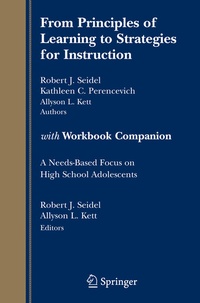
From Principles of Learning to Strategies for Instruction-with Workbook Companion
Description

From Principles of Learning to Strategies for Instruction
Part One
The purpose of this book is to help educators and training developers to improve the quality of their instruction. Unlike other available works, the text is not limited to a particular theoretical position. Nor is it like many of the instructional design texts, which ignore the learning literature. Rather, it draws upon any and all of those research-based principles regardless of learning theory, which suggest heuristics to guide instructional strategies. The approach of the authors is unique in that they develop a framework or model taxonomy for tasks, through which the principles of learning can be related to particular learning processes, suggesting distinctive strategies for specific instructional tasks. The authors present a four-stage model that includes acquisition, automaticity, near term transfer, and far term transfer.
Workbook Companion
Part Two
In this Workbook Companion, the strategies presented in the original book are expanded by supplying practical and specific strategies to implement of a variety of other subject matters. These strategies are based on the needs which the authors currently see and cite in existing educational systems. Each chapter concentrates on providing recommended instructional strategies and practical exercises for a specific target group: high school age adolescents. Contributors supply strategies in the different learning domains including Cognitive, Psychomotor, Affect, and Interpersonal, and each individual is responsible for training teachers, developing and/or evaluating curricula for such training, and educating high school students through the development and implementation of curricula.
Developed for both new and experienced teachers developing curricula for high-school adolescents, the goal of the Workbook Companion is to provide those in the field of education with strategies to incorporate each of the four domains into their lesson plans, regardless of subject area.
More details
Other editions
Additional editions