

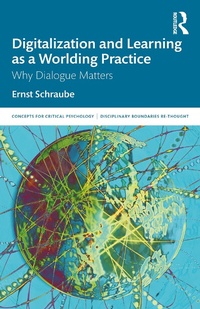
Digitalization and Learning as a Worlding Practice
Why Dialogue Matters
1st Edition
Published on 5. March 2024
186 pages
978-0-429-63369-0 (ISBN)
Description

In the face of a world in crisis, Digitalization and Learning as a Worlding Practice: Why Dialogue Matters examines the significance of digital technologies in human learning.
The book explores how learning is not just an internalization of knowledge but a problem- oriented activity of engaging with the world, a process of both meaning making and world making. It raises a pivotal question: how can digital technologies help to expand and enrich learning as a collaborative worlding practice? It discusses the importance of digital artifacts in shaping students' learning experiences, discerning how they nourish meaningful engagement and where they pose a hindrance. The book also investigates the role of digitalization in transforming everyday life and learning activity of students, and how learners, teachers, and educators can approach these transformations critically and constructively. Based on an embodied, subject- and world- centered concept of learning, the book offers its readers a sophisticated understanding of the inner connection between digitalization and learning.
This book will appeal to students and scholars in Psychology, Education, and Science and Technology Studies, as well as to anyone concerned with the implications of digital technology for the processes of human learning.
The book explores how learning is not just an internalization of knowledge but a problem- oriented activity of engaging with the world, a process of both meaning making and world making. It raises a pivotal question: how can digital technologies help to expand and enrich learning as a collaborative worlding practice? It discusses the importance of digital artifacts in shaping students' learning experiences, discerning how they nourish meaningful engagement and where they pose a hindrance. The book also investigates the role of digitalization in transforming everyday life and learning activity of students, and how learners, teachers, and educators can approach these transformations critically and constructively. Based on an embodied, subject- and world- centered concept of learning, the book offers its readers a sophisticated understanding of the inner connection between digitalization and learning.
This book will appeal to students and scholars in Psychology, Education, and Science and Technology Studies, as well as to anyone concerned with the implications of digital technology for the processes of human learning.
Reviews / Votes
"This book articulates an original analysis of the relationship between technology, learning, and society. Ernst Schraube presents a masterpiece on the psychology of technology that centers on the subjectivity and experiences of learners, who are understood as conducting their lives in the real world, and discusses the agentic possibilities that persons create when dealing with digital things." -Thomas Teo, Professor of Psychology, York University, Toronto, Canada"This ambitious book significantly advances the conversation around digital technologies and learning. In contrast to the usual instrumental accounts of technology and education, Ernst Schraube tackles the important questions of how the digital is now entwined with learner subjectivity, agency and what it means to be human." -Neil Selwyn, Professor of Education, Monash University, Melbourne, Australia
"At a time, when we are witnessing the internet in the daily life of most people in different contexts, especially in schools, this book contributes to a necessary deep reflection on the relationship between digitalization, learning, and education. This is a huge help for us to understand the potential and limitations of digital technologies and their implications for children's development and learning." -Raquel Guzzo, Professor of Psychology, Pontifical Catholic University of Campinas, Brazil
"What is learning like in the web of digital sirens? Ernst Schraube discovers not only distraction, but intermingling activities that belong to a worlding practice. A fresh look at the subjective and intersubjective entanglements of learning in a world of digital technology is needed. This book is an inspiration for researchers and practitioners." -Ines Langemeyer, Professor of Education, Karlsruhe Institute of Technology, Germany
"As powerful digital technologies are introduced to the realm of education, unfortunately our fascination with the wonders of computerized devices can easily overshadow the basic questions about how people learn and why. Tackling this situation head-on, Ernst Schraube leads us through a colorful landscape of philosophies that explore learning and education as their fundamental focus. Along the way, he invites his readers to think deeply about the significance of digital technology in human learning and how to find limits in a world of unlimited digital connectedness." -Langdon Winner, Professor of Politics and Humanities, Emeritus, RPI, Troy, NY, USA
More details
Series
Edition
1. Auflage
Language
English
Place of publication
London
United Kingdom
Publishing group
Taylor & Francis Ltd
Target group
College/higher education
ISBN-13
978-0-429-63369-0 (9780429633690)
Copyright in bibliographic data and cover images is held by Nielsen Book Services Limited or by the publishers or by their respective licensors: all rights reserved.
Schweitzer Classification
Other editions
Additional editions
Book
03/2024
1st Edition
Routledge
€57.50
Shipment within 15-20 days
Book
03/2024
1st Edition
Routledge
€196.80
Shipment within 15-20 days
Person
Ernst Schraube is Professor of Social Psychology of Technology in the Department of People and Technology at Roskilde University, Denmark. His research centers on digital technology, learning, and education, and he is President of the International Society for Theoretical Psychology.
Content
1. Learning as a Worlding Practice Grounded in Learners' Conduct of Everyday Life 2. The Politics of Digitalization: Learning and the Materialized Action of Things 3. The Dilemma of Digital Distraction: Student Experience with Digitalization and Learning 4. The Magic of Dialogue: Tentacular Learning, its Preconditions, and the Ir/Relevance of Digital Things 5. The Art of Disconnecting: Shaping Worlding Practices of Learning in an Age of Digital Connectedness
