

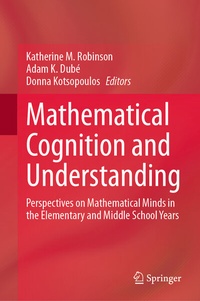
Mathematical Cognition and Understanding
Description

This book focuses on elementary and middle school children's understanding of mathematics as well as the cognitive aspects involved in the development of mathematical knowledge, skills, and understanding. Children's success in and understanding of mathematics stem from factors beyond the mathematics curriculum. Researchers are increasingly becoming aware of the necessity to consider a complex set of variables when accounting for large individual differences in mathematics achievement. These chapters contribute to how both researchers and educators can consider the multidimensionality of skills involved in developing mathematical knowledge in the middle school years as well as to how this knowledge can be used to enhance practices in the mathematics classroom. Topics include the cognitive and spatial skills involved in mathematics knowledge, the role of motivation in mathematics learning, the neurological processes and development of children's mathematics skills, the development ofunderstanding of arithmetic and fraction concepts, the factors relating to children's word problem success, and techniques to promote mathematics understanding.
This book and its companion,
Mathematical Teaching and Learning
, take an interdisciplinary perspective to mathematical learning and development in the elementary and middle school years. The authors and perspectives in this book draw from education, neuroscience, developmental psychology, and cognitive psychology. The book will be relevant to scholars/educators in the field of mathematics education and also those in childhood development and cognition. Each chapter also includes practical tips and implications for parents as well as for educators and researchers.
More details
Other editions
Additional editions
Persons
Adam Dubé is the Associate Dean-Academic Programs and a professor in the Faculty of Education, at McGill University, Quebec, Canada. His research focuses on the use of educational technology and games with emphases on how these technologies affect mathematical cognition. He is an AERA-SRCD Early Career Fellow in middle childhood education and development and his work has informed the UNESCO-MGIEP 'Industry Guidelines on Digital Learning'.
Donna Kotsopoulos is the Dean and a professor in the Faculty of Education, at Western University, Ontario, Canada. Her research focuses on mathematical cognition and learning across the lifespan. Her research has resulted in social innovation with the LittleCounters® program - a community and early child care centre play-based early numeracy program.
