

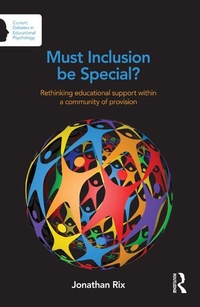
Must Inclusion be Special?
Rethinking educational support within a community of provision
Published on 5. June 2015
228 pages
978-1-317-49892-6 (ISBN)
Description

Must Inclusion be Special? examines the discord between special and inclusive education and why this discord can only be resolved when wider inequalities within mainstream education are confronted. It calls for a shift in our approach to provision, from seeing it as a conglomeration of individualised needs to identifying it as a conglomeration of collective needs.
The author examines the political, medical and cultural tendency of current times to focus upon the individual and contrasts this with the necessity to focus on context. This book distinguishes the theoretical perspectives that are often associated with special or inclusive education and the broad range of interests which depend upon their ongoing development. This examination leads to a problematisation of mainstream education provision, our understanding of why social inequities emerge and how additional support can overcome these inequities.
Further chapters explore the underlying challenges which emerge from our use and understanding of the notions of special and inclusive, outlining an alternative approach based upon a community of provision. This approach recognises the interconnectedness of services and the significance of context, and it encapsulates the aspiration of much international legislation for participation and inclusion for all. But it also assumes that we tend towards diffuse practices, services, policies, settings and roles, spread across provision which is variously inclusive and exclusionary. In seeking to create equitable participation for all, support needs to shift its focus from the individual to this diffuse network of contexts.
Must Inclusion be Special? emerges from the research base which problematises inclusion and special education, drawing upon examples from many countries. It also refers to the author's research into pedagogy, language and policy, and his experiences as a teacher and the parent of a child identified with special educational needs.
The author examines the political, medical and cultural tendency of current times to focus upon the individual and contrasts this with the necessity to focus on context. This book distinguishes the theoretical perspectives that are often associated with special or inclusive education and the broad range of interests which depend upon their ongoing development. This examination leads to a problematisation of mainstream education provision, our understanding of why social inequities emerge and how additional support can overcome these inequities.
Further chapters explore the underlying challenges which emerge from our use and understanding of the notions of special and inclusive, outlining an alternative approach based upon a community of provision. This approach recognises the interconnectedness of services and the significance of context, and it encapsulates the aspiration of much international legislation for participation and inclusion for all. But it also assumes that we tend towards diffuse practices, services, policies, settings and roles, spread across provision which is variously inclusive and exclusionary. In seeking to create equitable participation for all, support needs to shift its focus from the individual to this diffuse network of contexts.
Must Inclusion be Special? emerges from the research base which problematises inclusion and special education, drawing upon examples from many countries. It also refers to the author's research into pedagogy, language and policy, and his experiences as a teacher and the parent of a child identified with special educational needs.
More details
Series
Language
English
Place of publication
London
United Kingdom
Publishing group
Taylor & Francis Ltd
Target group
College/higher education
Illustrations
14 s/w Tabellen, 1 s/w Photographie bzw. Rasterbild, 19 s/w Zeichnungen
14 Tables, black and white; 19 Line drawings, black and white; 1 Halftones, black and white
File size
1,69 MB
ISBN-13
978-1-317-49892-6 (9781317498926)
Copyright in bibliographic data and cover images is held by Nielsen Book Services Limited or by the publishers or by their respective licensors: all rights reserved.
Schweitzer Classification
Other editions
Additional editions
Jonathan Rix
Must Inclusion be Special?
Rethinking educational support within a community of provision
Book
06/2015
1st Edition
Routledge
€251.90
Shipment within 15-20 days
Jonathan Rix
Must Inclusion be Special?
Rethinking educational support within a community of provision
Book
06/2015
1st Edition
Routledge
€60.20
Shipment within 15-20 days
Person
Jonathan Rix is Professor of Participation and Learning Support at the Open University, UK
Content
Part 1: 1. Inclusive and special 2. Why do we need special and inclusive education? 3. The structures and processes of inclusion 4. Thinking and talking about special and inclusive Part 2: 5. Our focus upon the individual and the context 6. Confronting the mainstream challenge 7. Challenging the contadictions within a community of provision
