

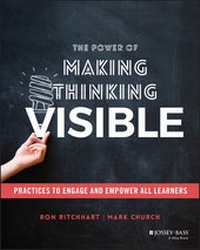
The Power of Making Thinking Visible
Description

Visible Thinking--a research-based approach developed at Harvard's Project Zero - prompts and promotes students' thinking. This approach has been shown to positively impact student engagement, learning, and development as thinkers. Visible Thinking involves using thinking routines, documentation, and effective questioning and listening techniques to enhance learning and collaboration in any learning environment. The Power of Making Thinking Visible explains how educators can effectively use thinking routines and other tools to engage and empower students as learners and transform classrooms into places of deep learning.
Building on the success of the bestselling Making Thinking Visible, this highly-anticipated new book expands the work of the original by providing 18 new thinking routines based on new research and work with teachers and students around the world. Original content explains how to use thinking routines to maximum effect in the classroom, engage students exploration of big ideas, link thinking routines to formative assessment, and more. Providing new research, new global case studies, and new practices, this book:
* Focuses on the power that thinking routines can bring to learning
* Provides practical insights on using thinking routines to facilitate student engagement
* Highlights the most effective techniques for using thinking routines in the classroom
* Identifies the skillsets and mindsets needed to truly make thinking visible
* Features actionable classroom strategies that can be applied across grade levels and content areas
Written by researchers from Harvard's Project Zero, The Power of Making Thinking Visible: Using Routines to Engage and Empower Learners is an indispensable resource for K-12 educators and curriculum designers, higher education instructional designers and educators, and professional learning course developers.
More details
Other editions
Additional editions
Persons
MARK CHURCH has been an educator for over twenty years and has particular interest in helping teachers and school leaders think deeply about their efforts to cultivate thinking and learning opportunities for students.
Ron Ritchhart and Mark Church (with Karin Morrison) are the coauthors of Making Thinking Visible.
Content
Acknowledgments xi
About the Authors xv
Introduction xvii
Part One Laying the Foundation for Power 1
One Six Powers of Making Thinking Visible 3
Fostering Deep Learning 6
Cultivating Engaged Students 7
Changing the Role of the Student and Teacher 9
Enhancing Our Formative Assessment Practice 11
Improving Learning (Even When Measured by Standardized Tests) 13
Developing Thinking Dispositions 17
Conclusion 19
Two Making Thinking Visible: A Goal and Set of Practices 21
Making Thinking Visible as a Goal of Teaching 23
Making Thinking Visible as a Set of Practices 24
Organizing Thinking Routines 33
Part Two Eighteen Powerful Routines 37
Three Routines for Engaging with Others 39
Give One Get One 42
Ladder of Feedback 50
The Leaderless Discussion 59
SAIL: Share-Ask-Ideas-Learned 67
Making Meaning 76
+1 Routine 86
Four Routines for Engaging with Ideas 95
Question Sorts 98
Peeling the Fruit 107
The Story Routine: Main-Side-Hidden 117
Beauty & Truth 124
NDA 132
Take Note 140
Five Routines for Engaging in Action 147
PG&E: Predict-Gather-Explain 150
ESP+I 158
Be-Sure-To 166
What? So What? Now What? 174
The 3 Y's 182
The 4 If 's 190
Part Three Realizing the Power 199
Six Using Thinking Routines for Maximum Effect 201
Planning for Thinking 204
Being Primed for Thinking 211
Pressing for Thinking 215
Positioning for Thinking 219
Seven Learning to Support One Another as We Make Thinking Visible 223
Beyond the Toolset: Developing Our Skills at Using the Tools 226
Beyond the Skill Set: The Mindsets That Motivate Action 231
Supports for Developing Skill Sets and Mindsets 233
In Conclusion 239
References 241
Index 245
INTRODUCTION
During the 1998-1999 school year, I spent a year studying a group of teachers who were very adept at getting their students to think (Ritchhart 2000). These were teachers who had been nominated by colleagues, coaches, principals, or university professors as educators who cared about thinking and making it central to their teaching and were also effective at doing so. These teachers not only got their students to think in the moment but also developed their disposition to think, cultivating their habits of mind in the long haul and forging their intellectual character. My collaboration with this extraordinary group of teachers has resonated with me for years, informing over two decades of research and writing.
Traveling back and forth to these classrooms, which served a diverse range of students in different schools and different states, I began to notice a very powerful pattern emerging: these teachers who were so skilled at getting students to think never once taught a thinking-skills lesson. Rather than instructing students on thinking, each of these teachers with vastly different backgrounds and experiences made use of structures, generally of their own making and design, to carefully prompt, scaffold, and support students' thinking. What is more, these structures were used over and over throughout the school year so that they quickly became the routine way of learning and thinking. These routines became part of the fabric of the classroom and helped to create a culture of thinking.
Having seen the power of thinking routines to make students' thinking visible in the moment while also developing their thinking dispositions in the long term, my colleagues David Perkins, Shari Tishman, and I chose to make thinking routines a core practice of the Visible Thinking project conducted by our research group, Project Zero (PZ) at the Harvard Graduate School of Education (www.pz.harvard.edu). Whereas the teachers I had observed had created their own routines to fit their needs, our team set out to develop a collection of thinking routines that might be useful broadly. We sought to craft routines that not only could work across different subject areas but also with different age levels. As researchers we were not tasked with designing a program or an intervention but an approach to developing students as thinkers and learners. Our goal was to design an approach that would cultivate dispositional development and enhance students' intellectual character. For this approach to work, we recognized that teachers must first embrace the goal of making thinking visible (MTV) as a significant aim of teaching; only then would the practices come alive in their classrooms.
From the outset of the Visible Thinking project, we noticed that teachers gravitated to these tools because of their ease of use. Furthermore, students liked them and began to engage more actively in their learning. More important, the teachers with whom we were working began to appreciate what it meant to get students to think and to make their thinking visible. When we first asked teachers to bring evidence of students' thinking to share with colleagues, many brought student essays, worksheets, or flawless tests. They had simply assumed that thinking must be evident in students' correct answers or in their exemplary work. However, teachers quickly realized that thinking is more a process than a product. Although certainly products may contain evidence of thinking, sometimes products obscure students' thinking. Was that correct response a guess? A hunch? An error? Or was it simply a memorized answer? How had the student arrived at that destination? It is only by illuminating the often mysterious and invisible process of thinking that we can begin to answer those questions.
Of course we were pleased that teachers found thinking routines useful, appealing, and applicable. The original Visible Thinking website (www.visiblethinkingpz.org, 2005) and the follow-up book, Making Thinking Visible (Ritchhart et al. 2011) made thinking routines accessible to teachers all over the world. Now, almost a decade later, we feel we have much more to share. We have developed a number of new routines that we want to introduce. These in themselves warrant a companion volume to the original. However, we want to do more than merely share these new routines-as useful as we think they are. We also want to share what we have learned about the power of thinking routines to truly transform teaching and learning. We want to communicate what we have learned about how teachers can realize the power of MTV practices themselves. This theme of "power" frames this book. Because both this book and the previous one offer useful insights and valuable tools, they should be considered a companion set. However, this new volume will be particularly useful in understanding why and how MTV is an important set of educational practices and how teachers, working together or individually, can help to realize the power of these practices.
We begin by exploring six powers of MTV in Chapter 1. These "powers" emerge through our extensive research in diverse schools around the world. They represent the promise of MTV practices to reshape schooling and constitute our raison d'etre as researchers. Although teachers often share thinking routines as useful practices and helpful strategies with their colleagues, for effective schoolwide use we must have a good understanding of just where these practices can take students, teachers, and schools. For many teachers, understanding this potential is necessary before they can begin to institute the routines themselves. Seasoned educators are often skeptical of the latest fad or technique and need a good reason around why they should try a set of new practices.
In Chapter 2 we draw on our long history of research to share our understanding of MTV as both a goal of teaching as well as a set of practices. This background information helps us to use thinking routines well and to fully realize their power to transform learning. There are some basics presented about how thinking routines are designed and structured that may be familiar to those who have read Making Thinking Visible. However, our knowledge of how routines operate continues to grow and evolve through our current work. There are new ideas presented here that are likely to enhance the practice of even experienced users.
Today almost every new research project at Harvard Project Zero makes use of thinking routines. Sometimes project teams will draw on routines already created. Other times teams invent new routines that help to scaffold and support specific thinking moves that the project is trying to encourage. Often thinking routines are backward designed by examining a learning situation and identifying the kinds of thinking to engage effectively in that context. These efforts have resulted in an abundance of new thinking routines. Although our first instinct in writing this book was to share all the routines we had developed or adapted, we quickly found there were too many. Consequently, we have chosen to share the 18 thinking routines most widely applicable and powerful for "Engaging with Others" (Chapter 3), "Engaging with Ideas" (Chapter 4), and "Engaging in Action" (Chapter 5).
Our past two decades have taught us much about how to use thinking routines most effectively. We have learned from the skill teachers have exhibited in adapting and applying thinking routines to engage students in learning and thinking. We have learned as much from the moments where things have not gone smoothly, or even failed, as we have from the moments when things went seamlessly. In addition, we have learned from seeing teachers sometimes using thinking routines superficially as mere activities. Such superficiality is never any teacher's intent. Nonetheless, it caused us to think more about why and how this happens and how we might help teachers avoid such superficiality. As a result, we have come to understand the importance of planning for thinking, priming that thinking both in our own minds as well as in our students, pressing students' thinking in the moment so as to advance their thinking, and positioning thinking routines well within an instructional sequence. We share these learnings about how to use thinking routines effectively in Chapter 6.
Finally, we conclude by communicating what we have learned over the years about how teachers can learn from and with one another as they embrace the goal of making thinking visible. In Chapter 7, we share the tools and practices we have developed to help teachers learn from and with one another through professional inquiry, observation, analysis, and reflection. For those looking to connect with educators outside their school who are using these ideas to share and discuss further, there are conferences, institutes, and online courses offered by Project Zero at the Harvard Graduate School of Education (http://www.pz.harvard.edu/professional-development) that provide valuable professional opportunities.
As you read this book, we invite you now to join with us in the quest to realize the power of MTV. Take inspiration from the stories shared here, drawing on the learning of others even as you extend it into your own context to produce your own insights. Add your voice to the chorus by sharing your own learning with us through Facebook (https://www.facebook.com/MakingThinkingVisible), or on Twitter and Instagram using...
