

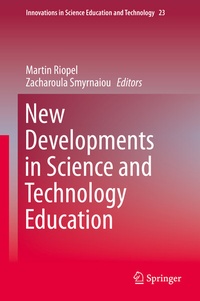
New Developments in Science and Technology Education
Description

This book explores the beneficial impact of pedagogically updated practices and approaches in the teaching of science concepts as well as elaborates on future challenges and emerging issues that address Science and Technology Education. By pointing out new research directions it informs educational practices and bridges the gap between research and practice providing information, ideas and new perspectives. The book also promotes discussions and networking among scientists and stakeholders such as researchers, professors, students and companies developing educational software and ICT tools. The volume presents papers from the First International Conference on " New Developments in Science and Technology Education " (1 st NDSTE) that was structured around four main thematic axes Modern Pedagogies in Science and Technology Education, New Technologies in Science and Technology Education, Teaching and Learning in the light of Inquiry learning Methods and Interest, Attitude and Motivation in Science.
More details
Other editions
Additional editions
Persons
Content
Introduction.- Constructing yourself in school science, Professor Kathrin Otrel-Cass.- Learning science in a collaborative and technological environment, Éric Durocher.- Applying Computer Assisted Assessment as a learning enhancement approach: Teachers' perception in the Greek context, Zacharoula Smyrnaiou, Evangelia Petropoulou, Eleni Spinou, Kathrin Otrel Cass.- Brain activity during observation of affective pictures with scientific content, G. K. Zacharis, A. Tsiara, P., Chalki, J. Vrellis, T. A. Mikropoulos.- Using contexts referring to human body to improve women's interest in introductory physics, Geneviève Allaire-Duquette, Patrick Charland, Martin Riopel.- Interest and disinterest from college students for higher education in Sciences, Michel Pronovost, Caroline Cormier, Patrice Potvin, Martin Riopel.- New Technologies in Science and Technology Education.- Introduction.- Improvement of Inquiry in a Complex Technology-Enhanced Learning Environment, Margus Pedaste, Külli Kori, Mario Mäeots, Ton de Jong.- Five Powerful Ideas about Technology and Education, Prof. Andrea A. DiSessa.- Analysis of an Inquiry-based design process for the construction of computer-based educational tools: The paradigm of a secondary development tool negotiating scientific concepts, Zacharoula Smyrnaiou, Evangelia Petropoulou, Maria Margoudi, Ioannis Kostikas.- Scaffolding for Inquiry Learning in Computer-Based Learning Environments, Emily B. Moore, Mario Mäeots, Zacharoula Smyrnaiou.- Multimedia Applications by Using Video Recorded Experiments for Teaching Biology in Secondary Education, Dokopoulou M., Bozas E., Pavlatou E.A.- Inquiry and meaning generation in Science while learning to learn together: how can digital media provide support? Zacharoula Smyrnaiou , Foteini Moustaki, Chronis Kynigos.- Using Physical and Virtual Manipulatives to Improve Primary School Students' Understanding of Concepts of Electric Circuits, Zacharias C. Zacharia & Marios Michael.- Impact of an Educational Video Game on Students' Conceptual Change Regarding Newtonian Mechanics, Martin Riopel.- Teaching and Learning in the light of Inquiry Learning Methods.- Introduction.- New Competences to Develop in Students to Help Them Get Involved in Sustainable Development while they Learn through Inquiry Methods, Diane Pruneau, Jackie Kerry, Joanne Langis.- CREAT-IT: Implementing Creative strategies into Science Teaching, Anna Craft, Oded Ben Horin, Menelaos Sotiriou, Petros Stergiopoulos, Sofoklis Sotiriou, Kerry Chappell, Sarah Hennessy, Dobrivoje Lale Eric, Cinzia Belmonte.- The PATHWAY to inquiry-based teaching - European perspective to shift science classroom realities, Sotiriou, Sofoklis, Gras-Velázquez, A. & Bogner Franz X..- Pedagogy as an Inquiry Approach to Teaching: Inspiring Science Educators through CPD Webinars, Yvonne Crotty, Margaret Farren, Martin Owen, Marian Lowry .
