
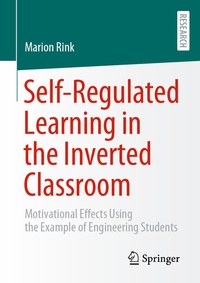
Self-Regulated Learning in the Inverted Classroom
Description
Alles über E-Books | Antworten auf Fragen rund um E-Books, Kopierschutz und Dateiformate finden Sie in unserem Info- & Hilfebereich.
The Inverted Classroom is a blended learning scenario that consists of two phases: In the Online Phase the learners acquire learning content using interactive learning materials, primarily videos, provided by the teacher online. In a second stage, there is an Attendance Phase at the higher education institution with the purpose of learners processing, practising and deepening their understanding of what they have already learnt in a class with other stakeholders.
Based on the Self-Determination Theory of Richard M. Ryan and Edward L. Deci, this qualitative study examines how learning in the Inverted Classroom affects the basic psychological needs of autonomy, competence and relatedness of higher education engineering students. A central aspect is the promotion of the students' intrinsic learning motivation through support measures and appropriate didactical design.
More details
Other editions
Additional editions
Persons
Dr. Marion Rink
works as a project manager for a digital agency. She also leads workshops about her research into e-learning and is a freelance writer.
Content
Introduction.- Fundamentals of the Inverted Classroom Model.- Fundamentals of Self-Regulated Learning.- Collaborative Learning.- State of Research.- Empirical Study.- Outlook.- Appendix.

System requirements
File format: PDF
Copy protection: Watermark-DRM (Digital Rights Management)
System requirements:
- Computer (Windows; MacOS X; Linux): Use the free software Adobe Reader, Adobe Digital Editions, or any other PDF viewer of your choice (see eBook Help).
- Tablet/Smartphone (Android; iOS): Install the free app Adobe Digital Editions or another reading app for eBooks, e.g., PocketBook (see eBook Help).
- E-reader: Bookeen, Kobo, Pocketbook, Sony, Tolino and many more (only limited: Kindle).
The file format PDF always displays a book page identically on any hardware. This makes PDF suitable for complex layouts such as those used in textbooks and reference books (images, tables, columns, footnotes). Unfortunately, on the small screens of e-readers or smartphones, PDFs are rather annoying, requiring too much scrolling.
This eBook uses Watermark-DRM, a „soft” copy protection. This means that there are no technical restrictions to prevent illegal distribution. However, there is a personalised watermark embedded in the eBook that can be used to identify the purchaser of the eBook in the event of misuse and to provide evidence for legal purposes.
For more information, see our eBook Help page.