

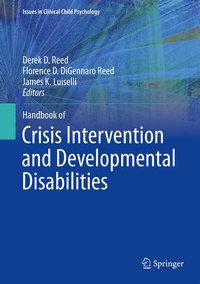
Handbook of Crisis Intervention and Developmental Disabilities
Description

The Handbook of Crisis Intervention and Developmental Disabilities synthesizes a substantive range of evidence-based research on clinical treatments as well as organizational processes and policy. This comprehensive resource examines the concept of behavioral crisis in children and adults with special needs and provides a data-rich trove of research-into-practice findings. Emphasizing continuum-of-care options and evidence-based best practices, the volume examines crisis interventions across diverse treatment settings, including public and private schools, nonacademic residential settings as well as outpatient and home-based programs.
Key coverage includes:
- Assessment of problem behaviors.
- Co-occurring psychiatric disorders in individuals with intellectual disabilities.
- Family members' involvement in prevention and intervention.
- Intensive treatment in pediatric feeding disorders.
- Therapeutic restraint and protective holding.
- Effective evaluation of psychotropic drug effects.
The Handbook of Crisis Intervention and Developmental Disabilities is a must-have resource for researchers, scientist-practitioners, and graduate students in clinical child, school, developmental, and counseling psychology, clinical social work, behavior therapy/analysis, and special education as well as other related professionals working across a continuum of service deliverysettings.
More details
Other editions
Additional editions
Persons
Content
1. Introduction.- Part I: Organizational Preparedness .- 2. Importance of Organizational Infrastructure.- 3. Peer Review.- 4. Evidence-Based Practice and Crisis Intervention.- 5. Empirically-Supported Staff Selection, Training, and Management Strategies.- 6. The Use of Protective Equipment in the Management of Severe Behavior Disorders.- 7. Therapeutic Restraint and Protective Holding.- Part II: Crisis Identification and Acknowledgement .- 8. Assessment of Problem Behavior.- 9. Functional Analysis of Problem Behavior.- 10. Assessment of Pediatric Feeding Disorders.- 11. Unique Considerations of Prader-Willi Syndrome.- 12. The Motivation for Self-Injury: Looking Backward to Move Forward.- 13. Co-occurring Psychiatric Disorders in Individuals with Intellectual Disability.- 14. Involving Family in the Prevention and Intervention of Behavior Problems in Individuals with Intellectual and Developmental Disabilities.- Part III: Navigating the Continuum of Care .- 15. Legal and Ethical Issues.- 16. Less to More Restrictive Settings: Policy and Planning Considerations.- 17. How to Make Effective Evaluation of Psychotropic Drug Effects in People with Developmental Disabilities and Self-injurious Behavior.- 18. Consultation in Public School Settings.- 19. Home-Based Services.- 20. Components of a Private School Program Serving Children and Adolescents with Severe Problem Behavior.- 21. Treating Severe Problem Behavior within Intensive Day-Treatment Programs.- 22. Intensive Treatment of Pediatric Feeding Disorders.- 23. Outpatient Units.- 24. Intensive Outpatient Services.- 25. Do Good, Take Data, Get a Life, and Make a Meaningful Difference in Providing Residential Services.
