

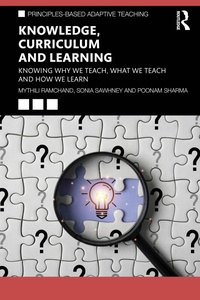
Knowledge, Curriculum and Learning
Knowing Why We Teach, What We Teach and How We Learn
Published on 15. December 2025
196 pages
978-1-040-80313-4 (ISBN)
Description

This book presents key epistemological ideas to enable teachers to understand different perspectives on knowledge, knowing and learning. It engages them to critically analyse various dimensions of knowledge and learning alongside their social and political implications.
Drawing on theoretical perspectives in psychology, philosophy, sociology and anthropology, this book offers an opportunity for teachers to understand the multiple dimensions of learning. This encompasses values, beliefs and the cultivation of habits in various domains of learning such as the arts, languages, sciences, mathematics and sports. While engaging with questions of the know-that and know-how of knowledge, the book focuses on its different forms and their characterisation as school subjects. It critically examines the role of culture and politics in the formulation of the curriculum. With illustrative examples, it discusses the ideas shaping curriculum development and reforms such as child-centred education, inclusive education and integrated curriculum.
This book will be of interest to students and teachers of education, BA, BEd and MEd courses, and epistemology. It will also be of interest to teachers of secondary and higher secondary schools, teacher educators, curriculum designers, developers of textbooks and other curriculum resources, non-governmental organisations (NGOs) and public and private sector bodies working in the area of education.
Drawing on theoretical perspectives in psychology, philosophy, sociology and anthropology, this book offers an opportunity for teachers to understand the multiple dimensions of learning. This encompasses values, beliefs and the cultivation of habits in various domains of learning such as the arts, languages, sciences, mathematics and sports. While engaging with questions of the know-that and know-how of knowledge, the book focuses on its different forms and their characterisation as school subjects. It critically examines the role of culture and politics in the formulation of the curriculum. With illustrative examples, it discusses the ideas shaping curriculum development and reforms such as child-centred education, inclusive education and integrated curriculum.
This book will be of interest to students and teachers of education, BA, BEd and MEd courses, and epistemology. It will also be of interest to teachers of secondary and higher secondary schools, teacher educators, curriculum designers, developers of textbooks and other curriculum resources, non-governmental organisations (NGOs) and public and private sector bodies working in the area of education.
More details
Series
Language
English
Place of publication
London
United Kingdom
Publishing group
Taylor & Francis Ltd
Target group
Professional and scholarly
Illustrations
8 Tables, black and white; 1 Line drawings, black and white; 4 Halftones, black and white; 5 Illustrations, black and white
File size
3,09 MB
ISBN-13
978-1-040-80313-4 (9781040803134)
Copyright in bibliographic data and cover images is held by Nielsen Book Services Limited or by the publishers or by their respective licensors: all rights reserved.
Schweitzer Classification
Other editions
Additional editions
Mythili Ramchand | Sonia Sawhney | Poonam Sharma
Knowledge, Curriculum and Learning
Knowing Why We Teach, What We Teach and How We Learn
Book
approx. 12/2025
1st Edition
Routledge
€206.10
Not yet published
Mythili Ramchand | Sonia Sawhney | Poonam Sharma
Knowledge, Curriculum and Learning
Knowing Why We Teach, What We Teach and How We Learn
Book
12/2025
1st Edition
Routledge
€63.00
Shipment within 15-20 days
Persons
Mythili Ramchand is currently at the National Institute of Advanced Studies, Bengaluru. Until 2024, she was the Co-Chairperson at the Centre of Excellence in Teacher Education, Tata Institute of Social Sciences, Mumbai. Mythili has helmed many collaborative projects and research studies in teacher education and inclusion. In the last five years, she has led a comparative study of initial teacher education in the BRICS countries, supported an inclusive STEM teacher education programme in Nigeria, Tanzania and Bhutan and anchored a research project on professional development for inclusive education in India.
Sonia Sawhney is Assistant Professor at the School of Educational Studies, Tata Institute of Social Sciences (TISS), Hyderabad. She has a rich background in education, having worked as a primary-grade teacher and a junior headmistress before joining TISS. Her core interests lie in engaging with the complexities of inclusive education, special educational needs, equity and social justice, child rights, and students' socio-emotional well-being. More specifically, she explores the nature of inclusive strategies and the influence of these on students' well-being and academic achievements. Her scholarship is interdisciplinary and draws on multiple perspectives and methods.
Poonam Sharma is Teacher Educator and Ethnographer. She is Faculty Member at the Centre of Excellence in Teacher Education, Tata Institute of Social Sciences, Mumbai. Previously, she has worked as a teacher educator at the university as well as in the NGO sector. She began her career as a primary school teacher. Her PhD was an ethnographic work on the educational experiences of children in the context of the family-school relationship. Her research interests include education policy, curriculum development, teacher education, non-state actors and privatisation of education.
Sonia Sawhney is Assistant Professor at the School of Educational Studies, Tata Institute of Social Sciences (TISS), Hyderabad. She has a rich background in education, having worked as a primary-grade teacher and a junior headmistress before joining TISS. Her core interests lie in engaging with the complexities of inclusive education, special educational needs, equity and social justice, child rights, and students' socio-emotional well-being. More specifically, she explores the nature of inclusive strategies and the influence of these on students' well-being and academic achievements. Her scholarship is interdisciplinary and draws on multiple perspectives and methods.
Poonam Sharma is Teacher Educator and Ethnographer. She is Faculty Member at the Centre of Excellence in Teacher Education, Tata Institute of Social Sciences, Mumbai. Previously, she has worked as a teacher educator at the university as well as in the NGO sector. She began her career as a primary school teacher. Her PhD was an ethnographic work on the educational experiences of children in the context of the family-school relationship. Her research interests include education policy, curriculum development, teacher education, non-state actors and privatisation of education.
Content
Foreword
Acknowledgements
List of Abbreviations
Introduction
1 The Interplay between Education, Society and School
2 Schooling and Learning
3 Learning and Knowing
4 Knowledge and Knowing
5 Indian Knowledge Systems
6 Forms of Knowledge
7 Knowledge and Curriculum
8 Key Ideas and Practices in Curriculum Reform
Acknowledgements
List of Abbreviations
Introduction
1 The Interplay between Education, Society and School
2 Schooling and Learning
3 Learning and Knowing
4 Knowledge and Knowing
5 Indian Knowledge Systems
6 Forms of Knowledge
7 Knowledge and Curriculum
8 Key Ideas and Practices in Curriculum Reform
