

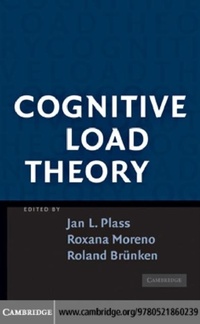
Cognitive Load Theory
1st Edition
Published on 23. May 2010
978-0-511-73109-9 (ISBN)
Description

Cognitive load theory (CLT) is one of the most important theories in educational psychology, a highly effective guide for the design of multimedia and other learning materials. This edited volume brings together the most prolific researchers from around the world who study various aspects of cognitive load to discuss its current theoretical as well as practical issues. The book is divided into three parts. The first part describes the theoretical foundations and assumptions of CLT, the second discusses the empirical findings about the application of CLT to the design of learning environments, and the third part concludes the book with discussions and suggestions for new directions for future research. It aims to become the standard handbook in CLT for researchers and graduate students in psychology, education, and educational technology.
Reviews / Votes
"This handbook provides an extensive account of the history, current state, and future prospects of the influential Cognitive Load Theory framework for the design of multimedia educational experiences. I plan to use this excellent book in my own classes and research. I didn't get overloaded reading this in-depth coverage, so the authors seem to practice what they preach."- John B. Black, Teachers College, Columbia University "Within the last two decades, CLT has become one of the most cited instructional design theories along with Richard E. Mayer's Cognitive Theory of Multimedia Learning. The book provides a valuable and accessible resource for familiarizing students at the undergraduate and graduate level with CLT's basic theoretical assumptions as well as with the extensive empirical research that has been conducted against the theory's background. The chapters have been written by notable CLT researchers and nicely cover the state of the art achieved in cognitive load research. Whereas a book like this cannot possibly solve the theoretical and measurement challenges that have been uttered by researchers from different fields in the last years, it does a good job in openly discussing these issues."
- Friedrich W. Hesse, Knowledge Media Research Center, Tuebingen "Cognitive Load Theory bridges cognition and instruction and is one of the few prescriptive instructional theories. The editors and authors of this volume are the key individuals for both the theoretical and the empirical development of Cognitive Load Theory. A must-have book if one is interested in instructional design and the improvement of student learning."
- Harry O'Neil, University of Southern California "Cognitive Load Theory and the empirical research it has spawned over two decades provide a powerful tool for understanding why learners surmount or succumb to challenges in learning, solving problems and transferring skills. This volume synthesizes and articulates this work with clarity and an encyclopedic scope, drawing a clear and helpful map of the field's terrain for instructional designers and theorists alike."
- - Philip H. Winne, Simon Fraser University
More details
Language
English
Place of publication
Cambridge
United Kingdom
Publishing group
Cambridge University Press
Target group
Professional and scholarly
Illustrations
20 Tables, unspecified; 13 Line drawings, unspecified
File size
2,63 MB
ISBN-13
978-0-511-73109-9 (9780511731099)
Copyright in bibliographic data and cover images is held by Nielsen Book Services Limited or by the publishers or by their respective licensors: all rights reserved.
Schweitzer Classification
Other editions
Additional editions
Jan L. Plass | Roxana Moreno | Roland Bruenken
Cognitive Load Theory
Book
04/2010
Cambridge University Press
€135.80
Shipment within 15-20 days
Jan L. Plass | Roxana Moreno | Roland Bruenken
Cognitive Load Theory
Book
04/2010
Cambridge University Press
€49.10
Shipment within 15-20 days
Persons
Jan L. Plass is an Associate Professor of Educational Communication and Technology in the Steinhardt School of Culture, Education, and Human Development at New York University, where he co-directs the NYU Games for Learning Institute. He is also the founding director of the Consortium for Research and Evaluation of Advanced Technology in Education (CREATE). His research is at the intersection of cognitive science, learning sciences, and design and seeks to enhance the educational effectiveness of visual environments. Dr Plass's current focus is on the cognitive and emotional aspects of information design and the interaction design of simulations and educational games for science education and second language acquisition. He has received funding for his research from the US Department of Education's Institute of Education Sciences, the National Science Foundation, the National Institutes of Health, and, most recently, from Microsoft Research and the Motorola Foundation. Roxana Moreno is an Educational Psychology Professor at the University of New Mexico. Her research interests are in applying cognitive-affective theories of learning to derive principles of instructional design for a diversity of learners. Her investigations involve undergraduate students as well as K-12 students who are culturally and linguistically diverse. Dr Moreno's most recent projects include an engineering education grant aimed at applying empirically based technology tools to foster problem solving and cognitive flexibility in pre-college students and the 'Bridging the Gap Between Theory and Practice in Teacher Education: Guided Interactive Virtual Environments for Case-Based Learning' grant, for which she received the prestigious Presidential Early Career Award in Science and Engineering. Other awards and honors include the American Psychological Association Richard E. Snow Award, being a Fulbright Senior Specialist in the areas of education and instructional media design, and an appointment as a veteran social scientist for the Department of Education. Roland Bruenken is Full Professor in Education and Dean for Student Affairs of the Faculty of Empirical Human Sciences at Saarland University, Germany. He is also Speaker of the special interest group Educational Psychology of the German Psychological Association (DGPs). His main research interests are concerned with using new technology for education, direct measurement of cognitive load by behavioral measures, and applying cognitive psychology to the instructional design of multimedia learning environments.
Content
Introduction Jan L. Plass, Roxana Moreno and Roland Bruenken; Part I. Theory: 1. Cognitive load theory: historical development and relation to other theories Roxana Moreno and Babette Park; 2. Cognitive load theory: recent theoretical advances John Sweller; 3. Schema acquisition and sources of cognitive load Slava Kalyuga; 4. Individual differences and cognitive load theory Jan L. Plass and Slava Kalyuga; Part II. Empirical Evidence: 5. Learning from worked-out examples and problem solving Alexander Renkl and Robert K. Atkinson; 6. Instructional control of cognitive load in the design of complex learning environments Liesbeth Kester, Fred Paas and Jeroen J. G. van Merrienboer; 7. Techniques that reduce extraneous cognitive load and manage intrinsic cognitive load during multimedia learning Richard E. Mayer and Roxana Moreno; 8. Techniques that increase generative processing in multimedia learning: open questions for cognitive-load research Roxana Moreno and Richard E. Mayer; Part III. Discussion: 9. Measuring cognitive load Roland Bruenken, Tina Seufert and Fred Paas; 10. From neo-behaviorism to neuroscience: perspectives on the origins and future contributions of cognitive load research Richard E. Clark and Vincent P. Clark; 11. Cognitive load in learning with multiple representations Holger Horz and Wolfgang Schnotz; 12. Current issues and open questions in cognitive load research Roland Bruenken, Jan L. Plass and Roxana Moreno.
