

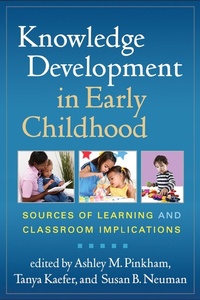
Knowledge Development in Early Childhood
Description

Researchers, professors, and graduate students in early literacy, child development, educational and developmental psychology, and speech?language pathology; classroom teachers and school administrators in PreK?2; early education policymakers. May serve as a supplemental text in courses such as Early Childhood Education, Preschool Education, Child Development (in Education and Psychology); Early Childhood Intervention.
More details
Other editions
Additional editions
Persons
Content
I. Sources of Children's Knowledge
1. What You See Is What You Get: Learning from the Ambient Environment, Tanya Kaefer
2. Learning through Play: Procedural versus Declarative Knowledge, Jennifer Van Reet
3. How Children Understand and Use Other People as Sources of Knowledge: Children's Selective Use of Testimony, Sherryse L. Corrow, Jason Cowell, Sabine Doebel, and Melissa A. Koenig
4. Beyond Pedagogy: How Children's Knowledge Develops in the Context of Everyday Parent-Child Conversations, Maureen Callanan, Jennifer Rigney, Charlotte Nolan-Reyes, and Graciela Solis
5. Drawing on the Arts: Less-Traveled Paths toward a Science of Learning, Jessa Reed, Kathy Hirsh-Pasek, and Roberta Michnick Golinkoff
6. Learning by the Book: The Importance of Picture Books for Young Children's Knowledge Acquisition, Ashley M. Pinkham
7. Television and Children's Knowledge, Heather J. Lavigne and Daniel R. Anderson
II. Promoting Knowledge Development in the Classroom
8. Four Play Pedagogies and a Promise for Children's Learning, Kathleen Roskos and James Christie
9. The Research-Reality Divide in Early Vocabulary Instruction, Tanya S. Wright
10. The Contributions of Curriculum to Shifting Teachers' Practices, David K. Dickinson, Erica M. Barnes, and Jin-Sil Mock
11. Scaffolding Preschoolers' Vocabulary Development through Purposeful Conversations: Unpacking the ExCELL Model of Language and Literacy Professional Development, Barbara A. Wasik and Annemarie H. Hindman
12. Building Knowledge through Informational Text, Nell K. Duke, Anne-Lise Halvorsen, and Jennifer A. Knight
13. Knowledge Acquisition in the Classroom: Literacy and Content-Area Knowledge, Carol McDonald Connor and Frederick J. Morrison14. Building Literacy Skills through Multimedia, Rebecca Silverman and Sarah Hines