

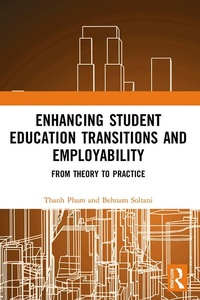
Enhancing Student Education Transitions and Employability
From Theory to Practice
1st Edition
Published on 8. April 2021
242 pages
978-1-000-38506-9 (ISBN)
Description

This book explores student education transition and employability negotiation experiences in various contexts. It explores determinants of student transitions at three levels including macro, meso and micro but focuses on exploring affordances, constraints and strategies at the micro level. The framework underpinning the explorations at the micro level covers a range of different forms of capital including human, culture, social, identity, psychological and agentic.
The book is unique in three ways. First, it consists of chapters about critical discussion, empirical research and practical guidance about student transition experiences. The critical discussion and empirical research chapters explore and obtain insights about the complexity of student transitions and develop conceptual frameworks that guide the development of applicable practices. The book is, therefore, a useful resource for policy makers, institutions, academics, professionals and students. Second, it provides insights about how student transitions are determined by a range of factors at different levels. These insights extend discussions about student transitions in the current literature which have mainly explored impacts of policies, institutional programmes and human capital. Finally, it is international in focus because it draws on research with different cohorts of students and graduates in different contexts. Insights provided in the book are, therefore, rich, diverse and comparative.
The book is unique in three ways. First, it consists of chapters about critical discussion, empirical research and practical guidance about student transition experiences. The critical discussion and empirical research chapters explore and obtain insights about the complexity of student transitions and develop conceptual frameworks that guide the development of applicable practices. The book is, therefore, a useful resource for policy makers, institutions, academics, professionals and students. Second, it provides insights about how student transitions are determined by a range of factors at different levels. These insights extend discussions about student transitions in the current literature which have mainly explored impacts of policies, institutional programmes and human capital. Finally, it is international in focus because it draws on research with different cohorts of students and graduates in different contexts. Insights provided in the book are, therefore, rich, diverse and comparative.
More details
Edition
1. Auflage
Language
English
Place of publication
London
United Kingdom
Publishing group
Taylor & Francis Ltd
Target group
College/higher education
Product notice
Reflowable
Illustrations
14 Tables, black and white; 6 Line drawings, black and white; 6 Illustrations, black and white
ISBN-13
978-1-000-38506-9 (9781000385069)
Copyright in bibliographic data and cover images is held by Nielsen Book Services Limited or by the publishers or by their respective licensors: all rights reserved.
Schweitzer Classification
Other editions
Additional editions
Thanh Pham | Behnam Soltani
Enhancing Student Education Transitions and Employability
From Theory to Practice
Book
04/2021
1st Edition
Routledge
€179.51
Shipment within 15-20 days
Thanh Pham | Behnam Soltani
Enhancing Student Education Transitions and Employability
From Theory to Practice
Book
04/2021
1st Edition
Routledge
€60.60
Shipment within 15-20 days
Book
04/2021
Routledge
Unfortunately, price unknown
Available (delivery time upon request)
Persons
Thanh Pham is currently a senior lecturer at the Faculty of Education, Monash University, Australia. Thanh completed her degrees and postdoctoral fellowship at the University of Queensland, Australia. She has done substantial research on internationalisation of higher education curricula and enhancing interactions of students from various backgrounds. Thanh has published extensively in cross-cultural pedagogies and is currently researching graduate employability with a focus on unpacking how graduates develop strategies to navigate barriers in the labour markets. She has worked with leading researchers in the field of graduate employability to develop comparative models showing resources/capitals that graduates need to articulate to thrive in the labour markets. Her research has been published in various sources including journals, books and magazines. Thanh initiated the Alumni Experience Conference series as a platform for alumni to share their career development experiences as well as a channel for mentorship between graduates and current students.
Behnam Soltani earned his PhD in Applied Linguistics from Victoria University of Wellington, New Zealand. He has lectured in Sociolinguistics at Massey University, and has worked as a Research Officer on Massey University MBIE funded CaDDANZ project. He has been a Research Lead and Senior Research Fellow on the AKO Aotearoa funded Learner Capability Framework project at Otago Polytechnic, New Zealand. He has more than two decades of teaching experience and is currently an Academic Partner at Manukau Institute of Technology. His research interests include graduate employability, academic socialisation, learner and teacher identities, classroom participation, silence in the classroom, production of space, internationalisation of higher education, mentorship and supervisory practices, assessment for learning, and professional practice.
Behnam Soltani earned his PhD in Applied Linguistics from Victoria University of Wellington, New Zealand. He has lectured in Sociolinguistics at Massey University, and has worked as a Research Officer on Massey University MBIE funded CaDDANZ project. He has been a Research Lead and Senior Research Fellow on the AKO Aotearoa funded Learner Capability Framework project at Otago Polytechnic, New Zealand. He has more than two decades of teaching experience and is currently an Academic Partner at Manukau Institute of Technology. His research interests include graduate employability, academic socialisation, learner and teacher identities, classroom participation, silence in the classroom, production of space, internationalisation of higher education, mentorship and supervisory practices, assessment for learning, and professional practice.
Content
1. An overview of student transition experiences and the significance of 'capitals' (Thanh Pham) PART I: SCHOOL TO TERTIARY EDUCATION TRANSITIONS 2. Student transition experiences: Key concepts and exemplar investigation models (Thanh Pham) 3. Navigating post-school trajectories: A conceptual framework of key determinants and essential resources (Thanh Pham) 4. International students' socialisation and transition experiences in high school: An empirical study (Behnam Soltani) PART II: EDUCATION TO WORK TRANSITIONS 5. Transitioning from education to the labour market: What matters and essential resources for positive employability outcomes (Thanh Pham) 6. Transitioning to vocational education: An investigation in experiences of international students (Behnam Soltani) 7. Transitioning to the home labour market: What counts, what matters and what are strategies? (Thanh Pham) 8. Transitioning from university to the teaching profession: Challenges of beginning teachers (Thanh Pham) 9. Reconceptualise graduate employability: The role of 'capitals' in navigating the teaching profession (Thanh Pham) 10. Strategies utilised by international graduates to overcome communication limitations and negotiate employability trajectories (Thanh Pham) PART III: RECOMMENDATIONS TO DEVELOP PRACTICAL RESOURCES FOR DIFFERENT STAKEHOLDERS 11. Enhancing student transition experiences: The role of students in proactively building essential resources (Thanh Pham and Behnam Soltani) 12. Enhancing student transition experiences: The role of institutions in creating opportunities for students to build essential resources (Thanh Pham and Behnam Soltani) 13. Enhancing student transition experiences: Initiatives guiding the development of essential resources (Thanh Pham and Behnam Soltani)
