

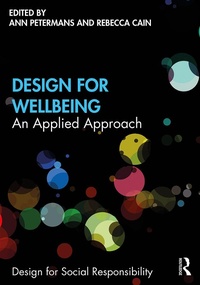
Design for Wellbeing
An Applied Approach
1st Edition
Published on 4. November 2019
248 pages
978-1-351-35558-2 (ISBN)
Description

Design for Wellbeing charts the development and application of design research to improve the personal and societal wellbeing and happiness of people. It draws together contributions from internationally leading academics and designers to demonstrate the latest thinking and research on the design of products, technologies, environments, services and experiences for wellbeing.
Part I starts by conceptualising wellbeing and takes an in-depth look at the rise of the design for wellbeing movement. Part II then goes on to demonstrate design for wellbeing in practice through a broad range of domains from products and environments to services. Among others, we see emerging trends in the design of interiors and urban spaces to support wellbeing, designing to enable and support connectedness and social interaction, and designing for behaviour change to tackle unhealthy eating behaviour in children. Significantly, the body of work on subjective wellbeing, design for happiness, is increasing, and several case studies are provided on this, demonstrating how design can contribute to support the wellbeing of people. Part III provides practical guidance for designing for wellbeing through a range of examples of tools, methods and approaches, which are highly user-centric, participatory, critical and speculative. Finally, the book concludes in Part IV with a look at future challenges for design for wellbeing.
This book provides students, researchers and practitioners with a detailed assessment of design for wellbeing, taking a distinctive global approach to design practice and theory in context. Design for Wellbeing concerns designers and organisations but also defines its broader contribution to society, culture and economy.
Part I starts by conceptualising wellbeing and takes an in-depth look at the rise of the design for wellbeing movement. Part II then goes on to demonstrate design for wellbeing in practice through a broad range of domains from products and environments to services. Among others, we see emerging trends in the design of interiors and urban spaces to support wellbeing, designing to enable and support connectedness and social interaction, and designing for behaviour change to tackle unhealthy eating behaviour in children. Significantly, the body of work on subjective wellbeing, design for happiness, is increasing, and several case studies are provided on this, demonstrating how design can contribute to support the wellbeing of people. Part III provides practical guidance for designing for wellbeing through a range of examples of tools, methods and approaches, which are highly user-centric, participatory, critical and speculative. Finally, the book concludes in Part IV with a look at future challenges for design for wellbeing.
This book provides students, researchers and practitioners with a detailed assessment of design for wellbeing, taking a distinctive global approach to design practice and theory in context. Design for Wellbeing concerns designers and organisations but also defines its broader contribution to society, culture and economy.
More details
Series
Edition
1. Auflage
Language
English
Place of publication
London
United Kingdom
Publishing group
Taylor & Francis Ltd
Target group
Professional and scholarly
Product notice
Reflowable
Illustrations
3 Tables, black and white; 32 Line drawings, black and white; 21 Halftones, black and white; 56 Illustrations, black and white
ISBN-13
978-1-351-35558-2 (9781351355582)
Copyright in bibliographic data and cover images is held by Nielsen Book Services Limited or by the publishers or by their respective licensors: all rights reserved.
Schweitzer Classification
Other editions
Additional editions
Book
09/2021
1st Edition
Routledge
€54.20
Shipment within 10-20 days
Book
11/2019
1st Edition
Routledge
€215.40
Shipment within 10-20 days
Persons
Ann Petermans is Assistant Professor at the Faculty of Architecture and Arts, Hasselt University, Belgium. She chairs the Design Research Society's Special Interest Group on Design for Wellbeing, Happiness and Health. Her research interests pertain in particular to designing for experience in designed environments and for diverse user groups, and research related to design for subjective wellbeing and how architecture and interior architecture can contribute in this respect. Ann is editorial board member of The Design Journal and publishes in various high-quality journals. She is also coeditor of the book Retail Design: Theoretical Perspectives, published by Routledge in 2017.
Rebecca Cain is Professor of Transdisciplinary Design, in the School of Design and Creative Arts, Loughborough University, UK. She also holds the position of Associate Dean for Enterprise. An industrial designer by training, her expertise is in bringing together different disciplines and working with industry and society to design and research future products, environments, services and systems that create positive outcomes for people. She works across sectors including mobility, energy and healthcare. She founded the Design Research Society's Special Interest Group for Wellbeing, Happiness and Health, which she now co-convenes.
Rebecca Cain is Professor of Transdisciplinary Design, in the School of Design and Creative Arts, Loughborough University, UK. She also holds the position of Associate Dean for Enterprise. An industrial designer by training, her expertise is in bringing together different disciplines and working with industry and society to design and research future products, environments, services and systems that create positive outcomes for people. She works across sectors including mobility, energy and healthcare. She founded the Design Research Society's Special Interest Group for Wellbeing, Happiness and Health, which she now co-convenes.
Content
About the Contributors, Preface, Rachel Cooper, PART I. The rise of design for wellbeing, Chapter 1 Setting the Scene for Design for Subjective Wellbeing, Ann Petermans and Rebecca Cain, Chapter 2 Wellbeing, Happiness and Flourishing: Different views on a common goal, Ruth Stevens, Ann Petermans, Anna Pohlmeyer, Rebecca Cain and Jan Vanrie, PART II. Domains in design for wellbeing, Chapter 3 Designing for People Living with Dementia, Cathy Treadaway, Chapter 4 Design for Wellbeing in Architecture and Interior Architecture: Educating future designers on ageing well in place, Ann Petermans, Jan Vanrie, Gitte Harze and Jo Broekx, Chapter 5 Social Connectedness, Social Interaction and the Design of Interior Environments, Tiiu Poldma, Chapter 6 'Joyful Journeys': Putting wellbeing at the centre of future travel, Luke Harmer, Rebecca Cain and Artur Mausbach, Chapter 7 Healthy Eating and Behaviour Change, Geke Ludden and Sander Hermsen, PART III. Tools, methods and approaches for design for wellbeing, Chapter 8 Co-Design and Participatory Methods for Wellbeing, Emmanuel Tsekleves, Chapter 9 Creative Methods for Sustainable Design for Happiness and Wellbeing, Emily Corrigan-Doyle and Carolina Escobar-Tello, Chapter 10 Building Storey/ies: A scenario card game to architecturally design for human flourishing, Ruth Stevens and Pieter M.A. Desmet, Chapter 11 Mind the Gap: A social practice approach to wellbeing-driven design, Holger Klapperich, Matthias Laschke, Marc Hassenzahl, Melanie Becker, Diana Cuerlis, Thorsten Frackenpohl, Henning Koehler, Kai Ludwigs, Marius Tippkaemper, Chapter 12 Dilemma-thinking as a Means to Enhance Criticality in Design for Wellbeing, Deger Ozkaramanli, PART IV. Future challenges for design for wellbeing, Chapter 13 Mapping Research at the Intersection of Design and Mental Health, Sarah Kettley and Rachel Lucas, Chapter 14 Design for Wellbeing: An applied approach to housing in later life, An-Sofie Smetcoren, Liesbeth De Donder, Dominique Verte, Chapter 15 An International Perspective on Design for Wellbeing, Leandro Tonetto, Conclusion It's love, my friend! Some reflections on cultivating the Positive Design Plot, Pieter M.A. Desmet, Index
