

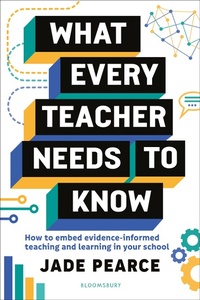
What Every Teacher Needs to Know
How to Embed Evidence-Informed Teaching and Learning in Your School
1st Edition
Published on 15. September 2022
208 pages
978-1-80199-032-5 (ISBN)
Description

What Every Teacher Needs to Know is a must-have guide for both primary and secondary teachers that summarises key research papers, offers evidence-informed teaching and learning strategies, and explains how to disseminate this information across departments and schools.
There is a growing thirst for evidence-informed teaching in the UK and beyond, in order to help ensure that schools have the biggest impact on student learning. In a concise, accessible manner, this book distils key educational research into clear, precise guidance that can be used immediately. It is ideal for any busy teacher or school leader looking to transform student outcomes through a research-informed approach.
What Every Teacher Needs to Know is essential reading for research leads, heads of department, and teaching and learning leads. It offers:
- summaries of 20 prominent research papers on effective teaching and learning
- key takeaways for classroom practice
- evidence-informed teaching and learning strategies
- examples across a variety of phases and subjects
- insightful case studies from practising teachers.
There is a growing thirst for evidence-informed teaching in the UK and beyond, in order to help ensure that schools have the biggest impact on student learning. In a concise, accessible manner, this book distils key educational research into clear, precise guidance that can be used immediately. It is ideal for any busy teacher or school leader looking to transform student outcomes through a research-informed approach.
What Every Teacher Needs to Know is essential reading for research leads, heads of department, and teaching and learning leads. It offers:
- summaries of 20 prominent research papers on effective teaching and learning
- key takeaways for classroom practice
- evidence-informed teaching and learning strategies
- examples across a variety of phases and subjects
- insightful case studies from practising teachers.
Reviews / Votes
This is a must-have book in every school's staff library collection and is a dream for anyone in charge of teaching and learning or whole-school CPD... Exceptional value for money. * The School Librarian *More details
Edition
1. Auflage
Language
English
Place of publication
London
United Kingdom
Publishing group
Bloomsbury Publishing PLC (Digital)
Target group
Professional and scholarly
ISBN-13
978-1-80199-032-5 (9781801990325)
Copyright in bibliographic data and cover images is held by Nielsen Book Services Limited or by the publishers or by their respective licensors: all rights reserved.
Schweitzer Classification
Other editions
Additional editions
Jade Pearce
What Every Teacher Needs to Know
How to embed evidence-informed teaching and learning in your school
Book
09/2022
Bloomsbury Education
€21.50
Shipment within 3-4 weeks
Person
Jade Pearce, formerly an assistant headteacher for teaching and learning in a secondary school in Staffordshire, Jade now leads professional development across a large trust of schools. She is an evidence lead in education for the Research Schools Network and a regular speaker and presenter at education conferences. She is the author of the bestselling book What Every Teacher Needs to Know: How to embed evidence-informed teaching and learning in your school and she regularly writes articles for a range of education media. You can follow Jade on X @PearceMrs.
Content
- Cover
- Half-title
- Title
- Copyright
- Dedication
- Contents
- Acknowledgements
- Introduction
- Part 1: What does the evidence say? A summary of seminal research in education
- A. Papers giving an overview of eff ective teaching and learning
- 1. The Great Teaching Toolkit
- 2. MARGE: A Whole-Brain Learning Approach for Students and Teachers
- 3. Top 20 principles from psychology for pre-K to 12 teaching and learning
- 4. What makes great teaching? Review of the underpinning research
- B. Papers addressing cognitive science
- 5. The Science of Learning
- 6. Improving students' learning with eff ective learning techniques: Promising directions from cognitive educational psychology
- 7. Organizing instruction and study to improve student learning
- 8. Cognitive science approaches in the classroom: A review of the evidence
- 9. Teaching the science of learning
- 10. Why don't students like school? Because the mind is not designed for thinking
- 11. Making things harder on yourself, but in a good way: Creating desirable diffi culties to enhance learning
- C. Papers addressing cognitive load theory and explicit instruction
- 12. Putting students on the path to learning: The case for fully guided instruction
- 13. Principles of instruction: Research-based strategies that all teachers should know
- 14. Cognitive load theory: Research that teachers really need to understand
- 15. Cognitive architecture and instructional design
- D. Papers addressing specifi c teaching practices
- 16. Teacher feedback to improve pupil learning
- 17. Metacognition and self-regulated learning
- 18. Eight ways to promote generative learning
- 19. The crucial role of motivation and emotion in classroom learning
- 20. Classroom assessment: Minute by minute, day by day
- Part 2: What does evidence-informed teaching look like in the classroom? Key evidence-informed practices
- 21. Explicit instruction
- 22. Managing cognitive load
- 23. Questioning and checking for understanding
- 24. Retrieval practice
- 25. Spacing
- 26. Interleaving
- 27. Feedback
- Part 3: How can schools develop an evidenceinformed culture? Becoming an evidenceinformed school
- 28. A framework for whole-school evidence-informed teaching
- 29. CPD and research engagement
- 30. Recruitment, quality assurance and performance management
- 31. The foundations of an evidence-informed culture
- 32. My school's journey to an evidence-informed culture
- 33. Developing an evidence-informed culture: Two case studies
- References
- Glossary
- Index
