

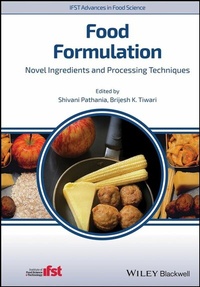
Food Formulation
Description

Food Formulation: Novel Ingredients and Processing Techniques is a comprehensive and up-to-date account of novel food ingredients and new processing techniques used in advanced commercial food formulations. This unique volume will help students and industry professionals alike in understanding the current trends, emerging technologies, and their impact on the food formulation techniques. Contributions from leading academic and industrial experts provide readers with informed and relevant insights on using the latest technologies and production processes for new product development and reformulations.
The text first describes the basis of a food formulation, including smart protein and starch ingredients, healthy ingredients such as salt and sugar replacers, and interactions within the food components. Emphasizing operational principles, the book reviews state-of-the-art 3D printing technology, encapsulation and a range of emerging technologies including high pressure, pulsed electric field, ultrasound and supercritical fluid extraction. The final chapters discuss recent developments and trends in food formulation, from foods that target allergies and intolerance, to prebiotic and probiotic food formulation designed to improve gut health. A much-needed reference on novel sourcing of food ingredients, processing technologies, and application, this book:
* Explores new food ingredients as well as impact of processing on ingredient interactions Describes new techniques that improve the flavor and acceptability of functional food ingredients
* Reviews mathematical tools used for recipe formulation, process control and consumer studies
* Includes regulations and legislations around tailor-made food products
Food Formulation: Novel Ingredients and Processing Techniques is an invaluable resource for students, educators, researchers, food technologists, and professionals, engineers and scientists across the food industry.
More details
Other editions
Additional editions

Persons
Shivani Pathania is a Research Officer based in Teagasc Food Research Centre, Ashtown, Ireland. Her research interests include food packaging, food formulation, novel food processing technologies and ingredient interactions. She supports food companies on development of pilot scale processes for new formulations.
Brijesh Tiwari is a Principal Research Officer at Teagasc Food Research Centre, Ashtown. His research interests include advanced food processing and extraction technologies. He is the series editor of the IFST Advances in Food Science book series. He currently serves as the Editor-in-Chief of the Journal of Food Processing and Preservation.
Content
List of Contributors xi
Preface xv
1 Food Formulation and Product Development 1
Shivani Pathania, Cheenam Bhatia, and Brijesh K. Tiwari
1.1 Introduction 1
1.2 New Product Development 2
1.3 Challenges in Food Formulations 2
1.4 Relevance of the Book and Objectives 3
1.5 Conclusions 4
2 Smart Functional Ingredients 5
Milica Pojic
2.1 Introduction 5
2.2 Smart Protein Ingredients 6
2.3 Smart Carbohydrate Ingredients 15
2.4 Conclusion and Future Considerations 19
3 Healthy Ingredients 27
Ciara McDonagh
3.1 Introduction 27
3.2 Need for Healthy Ingredients 28
3.3 Salt Replacers 29
3.4 Sugar Replacers 32
3.5 Phosphate Replacers 39
3.6 Bioactives 41
3.7 Peptides 43
3.8 Conclusions and Future Trends 44
4 Macromolecules Interactions in Food Formulations 49
Puneet Parmar, Rajpreet Kaur Goraya, and Shivani Pathania
4.1 Introduction 49
4.2 Role of Macromolecular Interactions 50
4.3 Types of Macromolecular Interactions 51
4.4 Role of Macromolecular Interactions in Various Food Products 61
4.5 Conclusions 65
5 Effect of Ingredient Interactions on Techno-Functional Properties 71
Hanuman Bobade, Savita Sharma, and Baljit Singh
5.1 Introduction 71
5.2 Effect of Food Formulation on Structural Properties 72
5.3 Effect of Food Formulation on Functional Properties 78
5.4 Effect of Food Formulation on Flavour 90
5.5 Conclusions 91
6 3D Printing 101
Arianna Dick, Sangeeta Prakash, and Bhesh Bhandari
6.1 Introduction 101
6.2 A Brief History of 3D Food Printing 101
6.3 Principle and Application 102
6.4 3D Printed Food Products 102
6.5 Scalability and Future Outlook 115
6.6 Conclusion 116
7 E ncapsulation Technologies Applied to Food Processing 121
Carlos Alvarez and Daniel Pando
7.1 Introduction 121
7.2 Encapsulation Techniques 123
7.3 Applications in the Food Industry 133
7.4 Factors Affecting Releasing Kinetics 138
7.5 Conclusions 139
8 Advances in Extrusion Technologies 147
Manzoor Ahmad Shah, Shabir Ahmad Mir, and B.N. Dar
8.1 Introduction 147
8.2 History and State of the Art 151
8.3 Application of Extrusion Technology 152
8.4 Recent Advances in Extrusion Process 153
8.5 Effect of Processing Conditions on Food Formulation 157
8.6 Conclusions 160
9 T hermal Processing Technologies 165
Tomas Lafarga, Anna Vallverdu Queralt, Gloria Bobo, Maribel Abadias, and Ingrid Aguilo-Aguayo
9.1 Introduction 165
9.2 Conventional Thermal Processing Technologies 166
9.3 Novel Thermal Technologies 170
9.4 Conclusions 173
10 N on-thermal Processing Technologies: High Pressure Processing and Others 183
Maneesha S. Mohan, Ingrid Aguilo-Aguayo, and Tomas Lafarga
10.1 Introduction 183
10.2 Non-thermal Technologies 183
10.3 Conclusions and Future Studies 198
11 Formulation for Food Intolerance 211
Iuliana Vintila
11.1 Introduction 212
11.2 Celiac Disease 213
11.3 Celiac Disease Food Formulations, Technology, and Quality 214
11.4 Lactose Intolerance 225
11.5 Lactose-Free Food Formulations, Technology, and Quality 227
11.6 Formulations for Other Food Intolerances 229
11.7 Conclusions 231
12 Prebiotic and Probiotic Food Formulations 237
Pradip Behare, Shaik Abdul Hussain, Desiree Roman Naranjo, Prateek Sharma, and Olivia McAuliffe
12.1 Introduction 237
12.2 Need for Probiotics and Prebiotics 238
12.3 Probiotic Food Formulations 239
12.4 Prebiotic Food Formulations 246
12.5 Functional Properties 247
12.6 Health Effects 249
12.7 Conclusion 257
13 Mathematical Tools for Food Formulation 265
Camila A. Perussello and Jesus M. Frias
13.1 Introduction 265
13.2 Food Formulation Experimental Design 267
13.3 Consumer-Based Food Formulation 273
13.4 Nutrikinetics and Nutridynamic Characteristics of Food Formulations 277
13.5 Conclusion 279
14 Regulatory and Legislative Framework for Novel Foods 285
Jessica Vapnek, Kai Purnhagen, and Ben Hillel
Summary 285
14.1 Introduction 285
14.2 What Is a Novel Food? 286
14.3 Overview of Regulatory Frameworks for Novel Foods 287
14.4 Specific Regulatory Issues 295
14.5 Other Legal Issues 299
14.6 Conclusion 302
Notes 302
Index 309
1
Food Formulation and Product Development
Shivani Pathania1, Cheenam Bhatia2, and Brijesh K. Tiwari1
1 Teagasc Food Research Centre, Ashtown, Dublin, Ireland
2 Department of Clinical Nutrition, Sri Guru Ram Das University of Health Science & Research, Amritsar, Punjab, India
Summary
Food formulation strategies are key for the product development process. Food formulation is critical in developing new food products along with rising consumer demand for products with key health and nutritional properties. As it is imperative to have a clear understanding of various ingredients, their roles, and judicious use of technologies available, this chapter provides an overview of the book and its relevance for various food formulations.
1.1 Introduction
Formulation is a common term used in various applications, with a fundamental meaning of placing a range of desired components in an appropriate manner according to a predefined formula. Food formulation can be defined as the activity of creating, designing or developing food products with an objective of providing some functionality. The functionality can range from providing additional nutritional benefits, to dietary supplementations over and above the basic function of the food. Food formulation can be perceived as a simple concept if it includes mixing ingredients, and it could be as complex and stringent as the pharmaceutical processes to regulate the concentration of highly functional ingredients such as bioactive peptides and fatty acids. Therefore, food formulation is perhaps one of the most important and critical steps involved in the new product development (NPD) process. Food formulation irrespective of the discipline, whether in food production, culinary research and development, or formulation of nutraceuticals/pharmaceuticals, requires careful consideration of ingredient selection and the application of technologies, considering consumer demand and legislative requirements. Food products are made by combining food ingredients in specific proportions in a formulation. Research on the effects of various formulations and processes on product qualities is common. However, research is focused on the effect of either a formulation or a novel processing technique on the product characteristics. Comprehensive, documented understanding of the trends in food formulation, its effect on the commercialisation of new technologies, and the impact of new technologies on formulations is limited.
1.2 New Product Development
NPD and product reformulations have been implemented globally by food processors to develop novel foods. Novel foods are newly developed, innovative foods produced using new technologies and production processes, as well as foods which are eaten outside of their traditional geographical boundary/region. Novel foods could be new sources of a major food component (e.g. protein, carbohydrate, fibre) or minor food component (e.g. vitamins, minerals, enzymes), or extracts from existing food or food derived from new production processes such as UV-treated foods (milk, bread, mushrooms, and yeast). New food formulations and processing techniques have been adopted commercially for better nutrient retention, quality improvement, and shelf life enhancement, and to support sustainability. Moreover, in recent times, consumers' attention, interest, and awareness of the health impact of various ingredients, as well as the manufacturing processes (e.g. thermal treatment) used in formulations, have grown tremendously. Health-conscious consumers have driven the increasing consumption of minimally and alternatively processed clean label products, which have been shown to fulfil tailored consumer needs for high-protein, low-fat, low-calorie products. From flavour enhancement and blocking to formulating for an ageing populace to carbohydrate systems for weight management, the future focus is on ingredients that promote better overall health. Thus, there is a requirement for detailed industrially relevant information concerning novel food ingredients and their application in the formulation of novel and health-promoting food products. In addition, industrial adoption of novel processing techniques is in its infancy; however, some technologies have seen commercial application.
1.3 Challenges in Food Formulations
Food formulation is a systematic, critical, complex, and commercially-oriented research process, and a great number of challenges are faced by the formulators in finalizing a formulation. Key components associated with the food formulation include: (i) the identification and selection of raw materials, which is generally based on the target end product and its use; (ii) the interaction of raw materials at the ingredient level and molecular level, i.e. protein-protein, protein-lipid, etc.; and (iii) the application of technology depending on food components, target consumer, quality, shelf life, and cost (Figure 1.1). Cost is one of the most important factors in food formulation. From the price of the raw materials to the cost of manufacturing, everything needs special consideration. It is important to formulate a product that follows certain requirements, especially in terms of its pricing. Therefore, a clear process is required to facilitate the sharing of information, from the raw materials needed to the manufacturing technique to the packaging material.
Figure 1.1 Factors impacting new food formulation process.
1.4 Relevance of the Book and Objectives
Applications of new and innovative technologies, either individually or in combination, and their resulting effects on ingredients and product characteristics are always of great interest to academic, industrial, nutrition, and health professionals. With the advancements in novel ingredients, including novel sources of raw material (proteins, starch), an understanding of the effects of food sources and their processing, as well as the interactions between ingredients, is critical. This book provides a comprehensive overview of novel food ingredients, the role of emerging processing techniques on product and health benefits, and customized food formulations for targeted populations. It provides a comprehensive assessment of food ingredients, their interaction, and the application of emerging technologies to formulate new food products. The book addresses three main areas of significant relevance to food and nutraceutical sectors, namely:
- Ingredients and their interactions (Chapters 2-5): The first section of the book consists of a number of chapters covering the basis of a food formulation, i.e. ingredients. Smart and functional ingredients from plant and animal sources; healthy ingredients such as replacements for salt, sugar, and phosphate, bioactives, and peptides; macronutrient and micronutrient ingredient interactions.
- Processing techniques (Chapters 6-9): This section outlines the application of emerging technologies in the processing of new food formulations. New techniques such as 3D printing for tailor-made, demand-driven production and products with geometric intricacy is covered (Chapter 6). The role of encapsulation techniques (Chapter 7), extrusion (Chapter 8), and combination techniques to improve the flavour and acceptability of functional food ingredients and recent developments in greener technologies including high pressure, microwave heating, ultrasound, supercritical fluid extraction, pulsed electric fields, ohmic heating, dielectric heating and other emerging technologies are discussed, with emphasis on the operational principles and inherent strengths and weaknesses of the technologies (Chapters 8 and 9) from a food formulation viewpoint.
- New trends in food formulation (Chapters 11-12): This section describes recent trends in the development of food for specific challenges for targeted populations, food targeting allergies and intolerances (gluten-free and lactose-free products), and prebiotic and probiotic food formulation for gut health.
The final chapters of the book focus on mathematical tools identified to support NPD and the food formulation process. Chapter 13 covers a wide range of mathematical tools, ranging from experimental design to consumer studies for the assessment of nutrient bioavailability, and outlines various examples of studies having different objectives (e.g. the effect of ingredients on a formulation vs consumer studies and panel studies vs nutrient delivery) and the mathematical tools utilized in each of them. One of the key hurdles associated with NPD and any food formulation is the route to market. Key issues associated with the route to market are regulatory and legislative issues around the use of ingredients and novel technologies. Therefore, novel and healthy ingredients, along with the increasing requirement for novel processing techniques for clean label food products, as well as regulations and legislation are covered in Chapter 14. Hitherto, this book provides a comprehensive text covering recent advances in food formulation, and offers the reader a broad review of novel food ingredients and the application of new processing techniques for advanced food formulations.
1.5 Conclusions
The novel food industry has made significant steps in the last several years, and is predicted to grow exponentially with product...
