

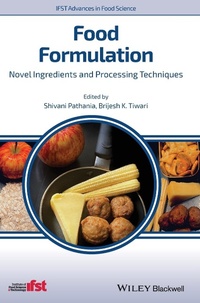
Food Formulation
Novel Ingredients and Processing Techniques
1st Edition
Published on 7. January 2021
Book
Hardback
332 pages
978-1-119-61474-6 (ISBN)
Description
Split in to 3 sections, this book will address areas of significant relevance to the food and nutraceutical sectors.
The first section will cover the basis of food formulation i.e. ingredients. Smart and functional ingredients from plant and animal sources, healthy ingredients such as salt, sugar and phosphate replacers, bioactives and peptides, macronutrient and micronutrient ingredient interactions.
The second section will review the application of emerging technologies in processing of new food formulations. New techniques such as 3D printing for tailor made, demand driven production and products with geometric intricacy have great potential. Encapsulation and combination techniques to improve the flavour and acceptability of functional food ingredients, and recent developments in greener technologies, including microwave heating, ultrasonication, supercritical fluid extraction, pulsed electric field, ohmic heating, dielectric heating and other emerging technologies will be discussed, with emphasis on operational principles and inherent strengths and weaknesses of the technologies from food formulation viewpoint.
The final section will look at recent developments in food formulations. Detailing new customised food formulations for targeted populations (baby food, high protein formulations for athletes, lactating mothers and ageing populace), food targeting allergies and intolerance (gluten free, lactose free products), and prebiotic and probiotic food formulation for gut health.
Recently, mathematical tools have been developed and identified to support new product development and food formulation process. Therefore, a part of this section will also review the mathematical tools used for formulating a recipe for a food product and process control. This section will conclude with a look at the recent amendments and additions in regulations and legislations for novel food formulations.
This book will serve as a comprehensive reference book for students, researchers, food ingredients specialists and products developers providing an up-to-date insight into food formulation.
More details
Other editions
Additional editions
E-Book
02/2021
1st Edition
Wiley
€168.99
Available for download
E-Book
02/2021
1st Edition
Wiley
€168.99
Available for download
Persons
Content
SECTION I: RELEVANCE
Chapter 1: Introduction to food formulation
Editors
1.1. Introduction
1.2. History
1.3. Economic releavance
1.4. Commercial applications
1.5. Book objective
1.6. Book structure
1.7. Conclusion
Chapter 2: Smart functional ingredients
Dr Milica Pojiæ
2.2. Introduction
2.3. Plants and animal sourced smart protein ingredients
2.4. Plant and animal sourced smart starch ingredients
2.5. Potential novel sources of food ingredients
2.6. Conclusion
Chapter 3: Healthy ingredients
Edward O'Neill
3.1. Introduction
3.2. Need for healthy ingredients
3.3. Salt replacers
3.4. Sugar replacers
3.5. Phosphate replacers
3.6. Bio actives
3.7. Peptides
3.8. Interactions with food components
3.9. Conclusions and future trends
Chapter 4: Ingredient interactions I
Dr. Savita Sharma
4.1. Introduction
4.2. Physical and chemical properties of macromolecules
4.3. Protein-carbohydrate interaction
4.4. Protein-
4.5. Conclusion
Chapter 5: Ingredient interaction II
Dr. Fabio Favati
5.1. Introduction
5.2. Effect of particle size distribution on food formulation
5.3. Effect of microstructure on food formulation
5.4. Effect of formulation on functional properties:
5.4.1. Emulsification behaviour
5.4.2. Texture attributes
5.4.3. Water absorption behaviour
5.4.4. Flavor
5.5. Conclusion
Chapter 6: 3D printing
Dr. Basharat Nabi Dar
6.1. Introduction
6.2. Principle
6.3. Application of 3D printing
6.4. 3D printed food products
6.5. Scalability
6.6. Conclusions and future outlook
Chapter 7: Encapsulation technologies
Dr Laura Trujillo
7.1. Introduction
7.2. Conventional techniques
7.3. Novel techniques
7.4. Combination techniques
7.5. Challenges associated with Encapsulation
7.6. Conclusion and future perspectives
Chapter 8: Advances in extrusion technologies
Prof. Charles Brennan
8.1. Introduction
8.2. Conventional process
8.3. Recent advances in extrusion process
8.4. Effect of processing conditions on food formulation
8.5. Conclusions
Chapter 9: Advances in thermal processing technologies/Green processing techniques
Dr. Ingrid Aguilo-Aguayo
9.1. Introduction
9.2. Conventional techniques
9.3. Emerging technologies in food formulation
9.3.1. Pulsed electric field
9.3.2. Ohmic heating
9.3.3. Microwave heating
9.3.4. Dielectric heating
9.4. Conclusions and future outlook
Chapter 10: Advances in non-thermal processing technologies
Dr. Maneesha Mohan
10.1. Introduction
10.2. Conventional techniques
10.3. Application of novel technologies
10.3.1. Ultrasonics
10.3.2. Novel freezing methods
10.3.3. Membrane technologies
10.4. Conclusions and Future outlook
10.5. Challenges and future recommendations
SECTION III: APPLICATIONS
Chapter 11: Tailor made functional food formulations
Dr. Carla.Brites
11.1. Introduction
11.2. Food formulation for high performing athletes
11.3. Food formulation for babies
11.4. Food formulations for pregnant/lactating mothers
11.5. Food formulations for ageing populace
11.6. Conclusion and future trends
Chapter 12: Formulations for food intolerances
Dr. Eimear Gallagher
12.1. Introduction
12.2. Celiac disease
12.3. Nutritional quality of celiac foods
12.4. Gluten free food products
12.5. Functional ingredients in gluten free products
12.6. Lactose intolerance
12.7. Lactose free formulations
12.8. Conclusion
Chapter 13: Prebiotic and probiotic food formulations
Tiina M. Mattila-Sandholm
13.1. Introduction
13.2. Need for probiotics and prebiotics
13.3. Probiotic food formulations
13.4. Prebiotic food formulations
13.5. Functional properties
13.6. Health effects
13.7. Conclusion
Chapter 14: Mathematical tools for food formulations
Dr Izabela Michalak
Prof. Colm o'Donnell
14.1. Introduction
14.2. Need for mathematical tools
14.3. Recent development in mathematical tools
14.4. Mathematical Models
14.5. Potential commercial applications
14.6. Conclusion and future trends
Chapter 15: Regulations and legislations
Jessica Vapnek
15.1. Introduction
15.2. Legislations on tailor made food formulations
15.3. Regulations on novel food ingredients
15.4. Regulations on use of novel technologies
15.5. Conclusion