

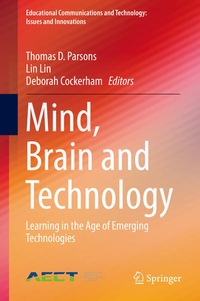
Mind, Brain and Technology
Description

As technology becomes increasingly integrated into our society, cultural expectations and needs are changing. Social understanding, family roles, organizational skills, and daily activities are all adapting to the demands of ever-present technology, causing changes in human brain, emotions, and behaviors. An understanding of the impact of technology upon our lives is essential if we are to adequately educate children for the future and plan for meaningful learning environments for them.
Mind, Brain and Technology provides an overview of these changes from a wide variety of perspectives. Designed as a textbook for students in the fields and interdisciplinary areas of psychology, neuroscience, technology, computer science, and education, the book offers insights for researchers, professionals, educators, and anyone interested in learning more about the integration of mind, brain and technology in their lives. The book skilfully guides readers to explore alternatives, generate new ideas, and develop constructive plans both for their own lives and for future educational needs.
More details
Other editions
Additional editions
Persons
Lin Lin, Ed.D., is an Associate Professor of Learning Technologies at the University of North Texas. Lin's research looks into interactions between the mind, brain, and technology in complex learning environments. She has conducted research on 1) media multitasking; 2) learning in online, blended, and virtual/augmented reality environments. Lin has published over 30 refereed articles in journals including the Proceedings of the National Academy of Sciences (PNAS) of USA, Educational Technology Research and Development (ETR&D), and Computers and Education in addition to a dozen book chapters and over 60 conference papers. Lin recently completed co-editing a book with Dr. Mike Spector to be published in the summer of 2017 by Routledge. The book focuses on the constructive articulation between learning sciences and instructional technology communities. She is currently co-editing another book focusing on innovative instructional design approaches. Lin serves as the Associate Director of Texas Center for Educational Technology (TCET), and Co-Director of a Joint-Lab on Big Data, Little Devices, and Life-long Learning. She is Associate Editor for the International Journal of Smart Technology andLearning (IJSmartTL) as well an editorial board member of several other peer-reviewed journals. Lin received her doctoral degree in Instructional Technology and Media at Teachers College, Columbia University.
Deborah Cockerham , managing director of the Research and Learning Center at the Fort Worth Museum of Science and History, also serves as Visiting Research Scholar at Texas Christian University's Center for Science Communication. In these roles, she works to strengthen interdisciplinary communication and build connections between research scientists and the public, and has supported multiple research university collaborations in public education and communication. In earlier work as a learning disabilities specialist, she taught children and adolescents with a variety of learning and attentional differences. Her work with students who have attention deficit hyperactivity (ADHD) and/or autism spectrum disorder (ASD) has focused on social learning, based on connections between communication skills and the fine arts. Cockerham's research takes place at the intersection of learning technologies, psychology, education and communication. Recent investigations include EEG studies on ASD interpretation of nonverbal emotional cues, and behavioral studies focused on media multitasking and technology addiction. Cockerham has presented practitioner workshops at venues that include the International Learning Disabilities Association, the National Council of Teachers of Mathematics, Colorado Dyslexia Center, Association of Texas Educators, Texas Learning Disabilities Association, Association of Science and Technology Centers, the Association of Texas Professional Educators. In addition, she has presented papers at the International Conference on Advanced Learning Technologies and the American Educational Research Association, and has publications in Technology, Knowledge, and Learning, and Zeitschrift f?r Psychologie. She is a graduate of the University of Texas at Arlington's Masters of Mind, Brain, and Education. Through her work and studies, Cockerham focuses on developing community-based collaborations that build skills for lifelong learning.
Content
Part I: Preface.- Part II: Introduction.- Mind, brain, and technology: what is learning and how people learn.- Multidisciplinary emerging technologies to assess and measure how people learn.- Part III: Neurosciences, learning sciences, and technologies in complex learning contexts.- Developing brain in a multitasking world.- Perspectives from social and affective neuroscience on design and implementation of learning technologies.- Complex learning environments with emerging technologies.- Part IV: Domain specific aspects of emerging technologies for learning.- Learning to read in the era of educational technologies.- Learning technologies for mathematical processing.- Neuroscience, metacognition, and instructional research.- Part V: Future directions.- Edu-game sensors for cognitive appraisal and affect detection.- The potential impact on educational practices and policies.- Implications for instructional design and technology research.- Future possible computational neuropsychologyfor educational technologies.
