

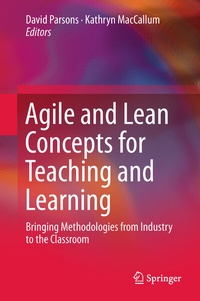
Agile and Lean Concepts for Teaching and Learning
Description

This book explores the application of agile and lean techniques, originally from the field of software development and manufacturing, to various aspects of education. It covers a broad range of topics, including applying agile teaching and learning techniques in the classroom, incorporating lean thinking in educational workflows, and using team-based approaches to student-centred activities based on agile principles and processes.
Demonstrating how agile and lean ideas can concretely be applied to education, the book offers practical guidance on how to apply these ideas in the classroom or lecture hall, as well as new concepts that could spark further research and development.
More details
Other editions
Additional editions
Persons
Dr David Parsons is National Postgraduate Director of The Mind Lab by Unitec, where he runs a digital and collaborative learning programme for in-service teachers. He holds a PhD in Information Technology (IT) and has extensive experience in academia and the IT industry in the UK and Australasia. He is the founding editor-in-chief of the International Journal of Mobile and Blended Learning and the author of numerous books, chapters and articles on various aspects of technology-enhanced learning and the teaching of software engineering. He also has substantial experience in agile and lean software development, and provides industry training on applying these techniques.
Associate Professor Kathryn MacCallum (PhD) has over 10 years' experience in teaching and research, and a passion for technology and education. Her research focuses on digital and educational technology, and as a former practitioner in the Information Technology (IT) industry she has a strongdesire to align these professional IT skills with teaching. With a PhD in Information Systems and a history of research within the education technologies sector, she has authored a broad range of journal papers, book chapters and conference articles in this area. She also serves as an editor for three academic education journals.
