

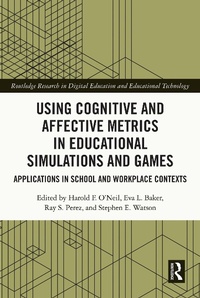
Using Cognitive and Affective Metrics in Educational Simulations and Games
Applications in School and Workplace Contexts
1st Edition
Published on 17. May 2021
244 pages
978-1-000-39005-6 (ISBN)
Description

Presenting original studies and rich conceptual analyses, this volume explores how cognitive and affective metrics can be used to effectively assess, modify, and enhance learning and assessment outcomes of simulations and games used in education and training.
The volume responds to the increasing use of computer-based simulations and games across academic and professional sectors by bringing together contributions from different research communities, including K-12 and postsecondary education, medical, and military contexts. Drawing on empirical results, the chapter authors focus on the design and assessment of educational simulations and games. They describe how quantitative and qualitative metrics can be used effectively to evaluate and tailor instructional resources to the cognitive and affective needs of the individual learner. In doing so, the volume enhances understanding of how games and simulations can intersect with the science of learning to improve educational outcomes.
Given its rigorous and multidisciplinary approach, this book will prove an indispensable resource for researchers and scholars in the fields of educational assessment and evaluation, educational technology, military psychology, and educational psychology.
The volume responds to the increasing use of computer-based simulations and games across academic and professional sectors by bringing together contributions from different research communities, including K-12 and postsecondary education, medical, and military contexts. Drawing on empirical results, the chapter authors focus on the design and assessment of educational simulations and games. They describe how quantitative and qualitative metrics can be used effectively to evaluate and tailor instructional resources to the cognitive and affective needs of the individual learner. In doing so, the volume enhances understanding of how games and simulations can intersect with the science of learning to improve educational outcomes.
Given its rigorous and multidisciplinary approach, this book will prove an indispensable resource for researchers and scholars in the fields of educational assessment and evaluation, educational technology, military psychology, and educational psychology.
More details
Series
Edition
1. Auflage
Language
English
Place of publication
London
United Kingdom
Publishing group
Taylor & Francis Ltd
Target group
College/higher education
Illustrations
26 Tables, black and white; 2 Line drawings, black and white; 2 Halftones, black and white; 4 Illustrations, black and white
ISBN-13
978-1-000-39005-6 (9781000390056)
Copyright in bibliographic data and cover images is held by Nielsen Book Services Limited or by the publishers or by their respective licensors: all rights reserved.
Schweitzer Classification
Other editions
Additional editions
Harold F. O'Neil | Eva L. Baker | Ray S. Perez
Using Cognitive and Affective Metrics in Educational Simulations and Games
Applications in School and Workplace Contexts
Book
01/2023
1st Edition
Routledge
€60.60
Shipment within 10-20 days
Harold F. O'Neil | Eva L. Baker | Ray S. Perez
Using Cognitive and Affective Metrics in Educational Simulations and Games
Applications in School and Workplace Contexts
Book
05/2021
1st Edition
Routledge
€207.70
Shipment within 15-20 days
Using Cognitive and Affective Metrics in Educational Simulations and Games
Applications in School and Workplace Contexts
Book
05/2021
Routledge
Unfortunately, price unknown
Available (delivery time upon request)
Persons
Harold F. O'Neil is Professor of Educational Psychology and Technology in the Rossier School of Education, University of Southern California, US.
Eva L. Baker is a Distinguished Professor at UCLA and founding Director of CRESST, US.
Ray S. Perez is Program Officer of the Cognitive Science of Learning Program, Office of Naval Research, US.
Stephen E. Watson is Chief Inventor, Affinity Associates LLC, US.
Eva L. Baker is a Distinguished Professor at UCLA and founding Director of CRESST, US.
Ray S. Perez is Program Officer of the Cognitive Science of Learning Program, Office of Naval Research, US.
Stephen E. Watson is Chief Inventor, Affinity Associates LLC, US.
Content
Editors' Preface; Part I: Cognitive Metrics; 1. Video Games and Higher Cognition; 2. Teaching and Assessing Young Gamers' Engineering Problem Solving Using Interactive Simulation Games; 3. Adaptation Evidence From a Digital Physics Game; Part II: Affective Metrics; 4. Metrics of Motivation in Simulations or Game Environments; 5. Metrics for Engagement in Games and Simulations for Learning; 6. Measuring and Increasing Self-Efficacy in a Game; 7. Measuring and Increasing Interest in a Game; 8. Metrics for Assessment in the Navy Life Game
