

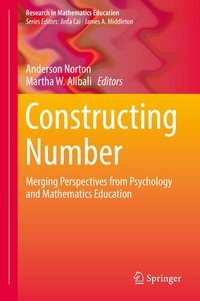
Constructing Number
Description

The book synergizes research on number across two disciplines-mathematics education and psychology. The underlying problem the book addresses is how the brain constructs number. The opening chapter frames the problem in terms of children's activity, including mental and physical actions. Subsequent chapters are organized into sections that address specific domains of number: natural numbers, fractions, and integers. Chapters within each section address ways that children build upon biological primitives (e.g., subitizing) and prior constructs (e.g., counting sequences) to construct number. The book relies on co-authored chapters and commentaries at the end of each section to create dialogue between junior faculty and senior researchers, as well as between psychologists and mathematics educators. The final chapter brings this work together around the framework of children's activity and additional themes that arise in the collective work. The book is aimed to appeal to mathematics educators, mathematics teacher educators, mathematics education researchers, educational psychologists, cognitive psychologists, and developmental psychologists.
Reviews / Votes
"The research reported in this book covers a range of grade levels and I found it interesting as an undergraduate math education researcher. I would recommend this book to researchers at any level that are doing cognitive work around conceptions of number, value, and their representations." (MAA Reviews, May 24, 2020)"This is a volume for mathematics education researchers and for anyone who studies the cognitive development of children. Summing Up: Recommended. Graduate students, researchers, faculty." (R. M. Fischer, Choice, Vol. 57 (4), December, 2019)
More details
Other editions
Additional editions
Persons
Anderson Norton is Professor in the Department of Mathematics at Virginia Tech. His research focuses on the epistemology of mathematics. This work has generated interdisciplinary collaborations with psychologists and neuroscientists. Prior to this volume, Norton served as chair of the steering committee for the North American Chapter of the International Group for the Psychology of Mathematics Education, chair of the editorial panel for the Journal for Research in Mathematics Education , and guest editor (along with Julie Nurnberger-Haag) for a special issue of the Journal of Numerical Cognition -bridging frameworks from psychology and mathematics education.
Martha W. Alibali is Vilas Distinguished Achievement Professor in the Departments of Psychology and Educational Psychology atthe University of Wisconsin-Madison. Her research investigates processes of knowledge change in cognitive development and mathematics learning. She also conducts basic research on gestures and on communication processes in instructional settings. She collaborates with scholars from a range of fields, including mathematics education, educational psychology, communicative disorders and computer science. She is a recipient of the Friedrich Wilhelm Bessel Research Prize from the Alexander von Humboldt Foundation, and she is co-author (with Robert Siegler) of the cognitive development textbook, Children's Thinking .