

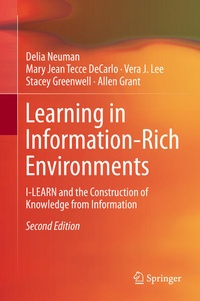
Learning in Information-Rich Environments
Description

The amount and range of information available to today's students-and indeed to all learners-is unprecedented. If the characteristics of "the information age" demand new conceptions of commerce, national security, and publishing-among other things-it is logical to assume that they carry implications for education as well. Little has been written, however, about how the specific affordances of these technologies-and the kinds of information they allow students to access and create-relate to the central purpose of education: learning. What does "learning" mean in an information-rich environment? What are its characteristics? What kinds of tasks should it involve? What concepts, strategies, attitudes, and skills do educators and students need to master if they are to learn effectively and efficiently in such an environment? How can researchers, theorists, and practitioners foster the well-founded and widespread development of such key elements of the learning process?
This second edition continues these discussions and suggests some tentative answers. Drawing primarily from research and theory in three distinct but related fields-learning theory, instructional systems design, and information studies-it presents a way to think about learning that responds directly to the actualities of a world brimming with information. The second edition also includes insights from digital and critical literacies and provides a combination of an updated research-and-theory base and a collection of instructional scenarios for helping teachers and librarians implement each step of the I-LEARN model. The book could be used in courses in teacher preparation, academic-librarian preparation, and school-librarian preparation.
More details
Other editions
Additional editions
Persons
Mary Jean Tecce DeCarlo is Associate Clinical Professor of Literacy Studies in the School of Education at Drexel University. She spent 20 years in public and Catholic schools as a classroom teacher and curriculum developer. At Drexel, Dr. DeCarlo teaches undergraduate and graduate courses in the Teacher Education, Special Education, and Reading Specialist programs. Her research interests include a number of areas in literacy studies-including information literacy, digital literacy, early literacy development, and reading comprehension.
Vera J. Lee is Associate Clinical Professor of Literacy Studies in the School of Education at Drexel University. She teaches literacy courses for the prek-4 program, the Reading Specialist Certification program, and the ESL add-on Certificate program. She has published on topics related to information literacy, critical literacy, teacher education, online learning, and family literacy. Her current research focuses on fostering the home/school literacy and language practices of immigrant families, school and community engagement with multilingual families, and civic literacy with adult learners.
Stacey Greenwell is Instructional Design Librarian at the University of Kentucky. She has held a variety of roles there, including Associate Dean and Director of the Information Commons. In her current role, Dr. Greenwell creates online instructional materials to help undergraduates develop information-literacy skills. She teaches graduate classes in the School of Information Science and has co-authored textbooks on academic librarianship and management. Her current research interests are focused on designing effective online instructional materials.
Allen C. Grant is Professor and Dean of the School of Education and Professional Studies at SUNY Potsdam. He has also taught kindergarten, worked as a language instructor in Spain, consulted as an International Baccalaureate----Primary Years Program expert, and spent many years in state service. His research interests center around emerging technologies, urban school reform, leadership development, and anything dealing with K-12 virtual schooling. He is a frequent contributor as an expert witnessand pundit for online learning.
