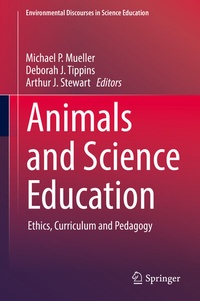
Animals and Science Education
Description

This book discusses how we can inspire today's youth to engage in challenging and productive discussions around the past, present and future role of animals in science education. Animals play a large role in the sciences and science education and yet they remain one of the least visible topics in the educational literature. This book is intended to cultivate research topics, conversations, and dispositions for the ethical use of animals in science and education. This book explores the vital role of animals with/in science education, specimens, protected species, and other associated issues with regards to the role of animals in science. Topics explored include ethical, curriculum and pedagogical dimensions, involving invertebrates, engineering solutions that contribute to ecosystems, the experiences of animals under our care, aesthetic and contemplative practices alongside science, school-based ethical dialogue, nature study for promoting inquiry and sustainability, the challenge ofwhether animals need to be used for science whatsoever, reconceptualizing museum specimens, cultivating socioscientific issues and epistemic practice, cultural integrity and citizen science, the care and nurturance of gender-balanced curriculum choices for science education, and theoretical conversations around cultivating critical thinking skills and ethical dispositions. The diverse authors in this book take on the logic of domination and symbolic violence embodied within the scientific enterprise that has systematically subjugated animals and nature, and emboldened the anthropocentric and exploitative expressions for the future role of animals.
At a time when animals are getting excluded from classrooms (too dangerous! too many allergies! too dirty!), this book is an important counterpoint. Interacting with animals helps students develop empathy, learn to care for living things, engage with content. We need more animals in the science curriculum, not less.
David Sobel, Senior Faculty, Education Department, Antioch University New England
Reviews / Votes
"This text is an approachable, informative, and playful resource to augment curricular and other pedagogical practices in science education with a dimension of animal ethics. . Readers involved in education at the grade school level will find this text inspiring, as will readers in educational studies. Scholars interested in practical applications of ideas from animal ethics, ecological ethics, and/or interspecies justice will find this text useful for its case studies. . Summing Up: Highly recommended. All readers." (S. M. Weiss, Choice, Vol. 55 (10), June, 2018)More details
Other editions
Additional editions