

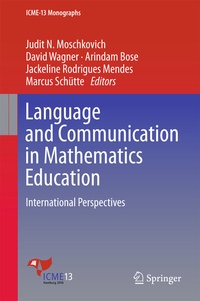
Language and Communication in Mathematics Education
Description

This book considers some of the outstanding questions regarding language and communication in the teaching and learning of mathematics - an established theme in mathematics education research, which is growing in prominence. Recent research has demonstrated the wide range of theoretical and methodological resources that can contribute to this area of study, including those drawing on cross-disciplinary perspectives influenced by, among others, sociology, psychology, linguistics, and semiotics.
Examining language in its broadest sense to include all modes of communication, including visual and gestural as well as spoken and written modes, it features work presented and discussed in the Language and Communication topic study group (TSG 31) at the 13th International Congress on Mathematical Education (ICME-13). A joint session with participants of the Mathematics Education in a Multilingual and Multicultural Environment topic study group (TSG 32) enhanced discussions, which are incorporated in elaborations included in this book.
Discussing cross-cutting topics it appeals to readers from a wide range of disciplines, such as mathematics education and research methods in education, multilingualism, applied linguistics and beyond.More details
Other editions
Additional editions
Content
1. Introduction. - 2. Fifty years of language data in mathematics education: A brief history.- 3. Explaining as mathematical discursive practices of navigating through different epistemic fields.- 4. Subject-specific academic language versus mathematical discourse.- 5. Authority and politeness: Complementary analyses of mathematics teaching episodes.- 6. The interplay of language and objects in the process of abstracting.- 7. Interactional processes in inclusive mathematics teaching.- 8. How learners communicate their mathematics reasoning in a mathematics discourse.- 9. "I am sorry. I did not understand you": The learning of dialogue by prospective teachers.- 10. Dealing with function word problems: Identifying and interpreting verbal representations.- 11. 4-year-old language repertoire in a counting situation.- 12. Making student explanations relevant in whole class discussion.- 13. A teacher's use of revoicing in mathematical discussions.- 14. Podcasts insecond language math teaching as an instrument for measuring teachers' language awareness.- 15. The meaning of 'number' in Kaiabi language: Indigenous teachers' identity discourses in a multilingual setting.- 16. The use of language in the construction of the natural number meaning.- 17. Exploring how a grade 7 teacher promotes mathematical reasoning in multilingual mathematics class of English second language.- 18. Identity fostered language communication in a mathematics classroom: An analysis.- 19. Recommendations for research on language and learning mathematics.
