

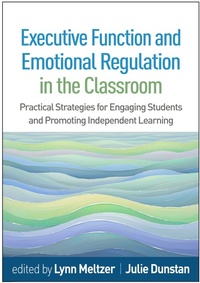
Executive Function and Emotional Regulation in the Classroom
Practical Strategies for Engaging Students and Promoting Independent Learning
Published on 5. February 2026
240 pages
978-1-4625-5986-2 (ISBN)
Description

This book presents research-based strategies for helping students thrive academically, socially, and emotionally by harnessing the dynamic interplay of executive function (EF) and emotional regulation. The expert editors and contributors--including EF pioneer Lynn Meltzer--explain how teachers can support EF and emotional regulation in their daily classroom practice with all learners, including neurodiverse students. Chapters describe innovative ways to build students' ability to set goals, think flexibly, stay on task, and manage their behavior, alongside crucial capacities for reducing anxiety and stress. Case vignettes illustrate how the interventions discussed help to enhance student engagement while fostering resilience and independent learning.
More details
Other editions
Additional editions
Lynn Meltzer | Julie Dunstan
Executive Function and Emotional Regulation in the Classroom
Practical Strategies for Engaging Students and Promoting Independent Learning
Book
03/2026
1st Edition
Guilford Press
€47.50
Shipment within 15-20 days
Persons
Lynn Meltzer, PhD, is President and Co-Founder of the Research Institute for Learning and Development (ResearchILD) in Lexington, Massachusetts. Since the 1980s, her clinical work, research, publications, and presentations have focused on understanding the complexity of learning and attention differences. Dr. Meltzer is founder and Program Chair of the annual Executive Function and Learning Differences Conference, which she established in 1984. A Fellow and past president of the International Academy for Research in Learning Disabilities, she served for 30 years as an Associate in Education at the Harvard Graduate School of Education and Adjunct Associate Professor in the Department of Child Development at Tufts University. Dr. Meltzer has been an invited speaker at numerous national and international conferences, and has received many awards, including the Outstanding Researcher Award from the Council for Learning Disabilities and the Innovative Program of the Year Award from Children and Adults with Attention-Deficit/Hyperactivity Disorder (CHADD). Together with her ResearchILD colleagues, she has developed SMARTS, an evidence-based executive function curriculum for elementary, middle, and high school students that is used bv schools in 48 states across the United States and in 38 countries worldwide (www.smarts-ef.org).
Julie Dunstan, PhD, is a psychologist, author, and consultant. She has conducted policy research in areas including child development, family needs, learning differences, and general education, and has lectured at the undergraduate and graduate levels in psychology, education, and organizational development. Dr. Dunstan has presented internationally at professional conferences and research-based symposia. She has driven the development of several cutting-edge educational initiatives and programs, including the ICAN Program for children with math-related learning difficulties, the I-PLAY Preschool Program that boosts phonological skills, the Pirates of Pondering Program that builds the early foundation for executive function processes, and the 3C's for Changemakers program. She is committed to equipping learners with the tools they need to respond adaptively and resiliently to the adversity of today's complex and ever-changing world. Dr. Dunstan sees herself as a changemaker who strives to transform mindsets and create environments that nurture investigators, innovators, and inspirers. She is based in Hamilton, Bermuda.
Julie Dunstan, PhD, is a psychologist, author, and consultant. She has conducted policy research in areas including child development, family needs, learning differences, and general education, and has lectured at the undergraduate and graduate levels in psychology, education, and organizational development. Dr. Dunstan has presented internationally at professional conferences and research-based symposia. She has driven the development of several cutting-edge educational initiatives and programs, including the ICAN Program for children with math-related learning difficulties, the I-PLAY Preschool Program that boosts phonological skills, the Pirates of Pondering Program that builds the early foundation for executive function processes, and the 3C's for Changemakers program. She is committed to equipping learners with the tools they need to respond adaptively and resiliently to the adversity of today's complex and ever-changing world. Dr. Dunstan sees herself as a changemaker who strives to transform mindsets and create environments that nurture investigators, innovators, and inspirers. She is based in Hamilton, Bermuda.
Content
I. Rethinking Education: Integrating Executive Function and Emotional Regulation into Teaching
1. Transforming Classrooms: Preparing Students to Succeed in a Complex World, Lynn Meltzer & Julie Dunstan
2. Metacognition: The Spark for Igniting Students' Ability to Learn How to Learn, Lynn Meltzer, Laurel Black, & Taylor McKenna
3. Promoting Emotional Intelligence to Build Effective Schools, Laura Bond, Maurice J. Elias, Richard Cohen, Lauren Fullmer, & Andrea Sadow
4. Nurturing Resilience, Executive Function, and Tenacity in the Classroom, Sam Goldstein & Robert B. Brooks
II. Executive Function and Emotional Regulation in Neurodiverse Learners
5. Strategies for Addressing Anxiety and Stress in the Classroom, Alexandra Allen-Barrett, Donna B. Pincus, Kristine Lee, Alyssa Farley, Rachel Merson, Anamika Dutta, & Jennifer Greif Green
6. Learning Difficulties: Fostering Motivation, Passion, and Drive, Hillary Bush & Ellen Braaten
7. Attention-Deficit/Hyperactivity Disorder and Autism Spectrum Disorders: Executive Function Strategies for Building Self-Awareness, Self-Efficacy, and Social Awareness, Sucheta Kamath
8. Math Anxiety: Transforming Mindsets and Boosting Engagement in Mathematics, Julie Dunstan & Juliet Pearman
III. Fostering a Schoolwide Culture of Strategic Learning and Engagement
9. Reading Instruction: Executive Function and Self-Regulation Processes That Promote Differentiated Literacy Outcomes, Kelly B. Cartwright, Ana Taboada Barber, & Erica Neal
10. The SMARTS Approach: Going Beyond the Three R's to Foster Reasoning, Regulation, and Resilience, Lynn Meltzer, Michael Greschler, & Shelly Levy
11. Emotional Regulation for All Students: Using Collaborative Problem Solving to Build Social−Emotional Skills, J. Stuart Ablon & Hallie Carpenter
12. Flexible Mindsets Schools: Opening the Window to Equitable Learning Opportunities, Julie Dunstan, Susannah Cole, Stephanie Guthman, & Mark Amaral
Index
1. Transforming Classrooms: Preparing Students to Succeed in a Complex World, Lynn Meltzer & Julie Dunstan
2. Metacognition: The Spark for Igniting Students' Ability to Learn How to Learn, Lynn Meltzer, Laurel Black, & Taylor McKenna
3. Promoting Emotional Intelligence to Build Effective Schools, Laura Bond, Maurice J. Elias, Richard Cohen, Lauren Fullmer, & Andrea Sadow
4. Nurturing Resilience, Executive Function, and Tenacity in the Classroom, Sam Goldstein & Robert B. Brooks
II. Executive Function and Emotional Regulation in Neurodiverse Learners
5. Strategies for Addressing Anxiety and Stress in the Classroom, Alexandra Allen-Barrett, Donna B. Pincus, Kristine Lee, Alyssa Farley, Rachel Merson, Anamika Dutta, & Jennifer Greif Green
6. Learning Difficulties: Fostering Motivation, Passion, and Drive, Hillary Bush & Ellen Braaten
7. Attention-Deficit/Hyperactivity Disorder and Autism Spectrum Disorders: Executive Function Strategies for Building Self-Awareness, Self-Efficacy, and Social Awareness, Sucheta Kamath
8. Math Anxiety: Transforming Mindsets and Boosting Engagement in Mathematics, Julie Dunstan & Juliet Pearman
III. Fostering a Schoolwide Culture of Strategic Learning and Engagement
9. Reading Instruction: Executive Function and Self-Regulation Processes That Promote Differentiated Literacy Outcomes, Kelly B. Cartwright, Ana Taboada Barber, & Erica Neal
10. The SMARTS Approach: Going Beyond the Three R's to Foster Reasoning, Regulation, and Resilience, Lynn Meltzer, Michael Greschler, & Shelly Levy
11. Emotional Regulation for All Students: Using Collaborative Problem Solving to Build Social−Emotional Skills, J. Stuart Ablon & Hallie Carpenter
12. Flexible Mindsets Schools: Opening the Window to Equitable Learning Opportunities, Julie Dunstan, Susannah Cole, Stephanie Guthman, & Mark Amaral
Index
