

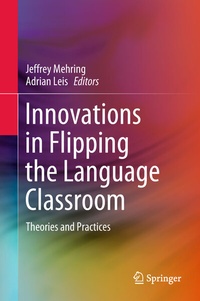
Innovations in Flipping the Language Classroom
Theories and Practices
Published on 4. December 2017
VIII, 230 pages
978-981-10-6968-0 (ISBN)
Description

This book provides advice on flipping from a vast range of topics related to second and foreign language teaching, such as assessment, pronunciation, speaking, listening, reading, writing, and content-based language teaching. Based on insights from other professionals in the field, it helps teachers of English as a foreign language better understand the idea of a flipped classroom. The book provides examples for teachers who wish to start flipping their own classes and additional ideas for those who are already flipping.
More details
Other editions
Additional editions
Book
12/2017
Springer
€171.19
Shipment within 15-20 days
Persons
Dr. Jeff Mehring is a freelance teacher trainer. He completed his doctorate in Learning Technologies in the Graduate School of Education and Psychology at Pepperdine University with the dissertation topic "An Exploratory Study of the Lived Experiences of Japanese Undergraduate EFL Students in the Flipped Classroom." Dr. Mehring is a seasoned educator with exceptional leadership, analytical, communication, technological and organizational skills. He has over twenty years' experience in both corporate and educational technology arenas, as well as extensive experience developing and maintaining small businesses, managing employees, and designing new curricula that incorporate 21st century learning skills.
Dr. Adrian Leis is an associate professor at Miyagi University of Education in Sendai, Japan. He completed his doctorate in Educational Informatics at Tohoku University, Japan. His doctorate focused on the effects of flipped learning on increasing output from students studying in EFL environments. He has spent 18 years teaching English at a variety of Japanese academic institutions from kindergarten to university. Adrian began flipping his classes in 2012 in order to help deaf and hard-of-hearing students integrate smoothly into regular classes. He has since published and presented on flipped learning and other areas of computer-assisted language learning, especially on the effects on student motivation in various countries, and has also conducted workshops on effective flipped learning. His research interests include computer and mobile-assisted language learning and second-language learning motivation.
Dr. Adrian Leis is an associate professor at Miyagi University of Education in Sendai, Japan. He completed his doctorate in Educational Informatics at Tohoku University, Japan. His doctorate focused on the effects of flipped learning on increasing output from students studying in EFL environments. He has spent 18 years teaching English at a variety of Japanese academic institutions from kindergarten to university. Adrian began flipping his classes in 2012 in order to help deaf and hard-of-hearing students integrate smoothly into regular classes. He has since published and presented on flipped learning and other areas of computer-assisted language learning, especially on the effects on student motivation in various countries, and has also conducted workshops on effective flipped learning. His research interests include computer and mobile-assisted language learning and second-language learning motivation.
Content
The Flipped Classroom.- Implementing the Flipped Classroom: Challenges & Strategies.- Flipping or Flopping: Lessons Learnt from Flipping a Course for ASEAN Teachers of English.- Flipping a Pronunciation Lesson for a Teacher Training Course.- Flipped Learning and Formative Assessment in an English Language Class.- Flipping Your Writing Lessons: Optimizing Time in Your EFL Writing Classroom.- In-Class Flip: Flipping a Literature Class for Student-Centered Learning.- Flipping EFL Classes for Future Teachers.- Flip Your Classroom to Improve EFL Students' Speaking Skills.- Dialogic Inquiry as a Process in the Flipped EFL Classroom.- Flipping the ESL/EFL Academic Reading Classroom: A 'Group Leader Discussion Activity'.- Flipping the ESL/EFL Classroom to Reduce Cognitive Load: A New Way of Organizing Your Classroom.- Flipping Movies for Dynamic Engagement.- Flipping Tech-Enhanced Content-based EAP Courses with Online Content.- Content-based Language Teaching and the Flipped Classroom: A CaseStudy in the Japanese EFL environment.
