

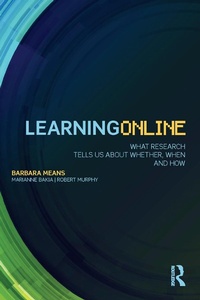
Learning Online
What Research Tells Us About Whether, When and How
Published on 3. April 2014
232 pages
978-1-136-21658-9 (ISBN)
Description

At a time when more and more of what people learn both in formal courses and in everyday life is mediated by technology, Learning Online provides a much-needed guide to different forms and applications of online learning. This book describes how online learning is being used in both K-12 and higher education settings as well as in learning outside of school. Particular online learning technologies, such as MOOCs (massive open online courses), multi-player games, learning analytics, and adaptive online practice environments, are described in terms of design principles, implementation, and contexts of use.
Learning Online synthesizes research findings on the effectiveness of different types of online learning, but a major message of the book is that student outcomes arise from the joint influence of implementation, context, and learner characteristics interacting with technology--not from technology alone. The book describes available research about how best to implement different forms of online learning for specific kinds of students, subject areas, and contexts.
Building on available evidence regarding practices that make online and blended learning more effective in different contexts, Learning Online draws implications for institutional and state policies that would promote judicious uses of online learning and effective implementation models. This in-depth research work concludes with a call for an online learning implementation research agenda, combining education institutions and research partners in a collaborative effort to generate and share evidence on effective practices.
Learning Online synthesizes research findings on the effectiveness of different types of online learning, but a major message of the book is that student outcomes arise from the joint influence of implementation, context, and learner characteristics interacting with technology--not from technology alone. The book describes available research about how best to implement different forms of online learning for specific kinds of students, subject areas, and contexts.
Building on available evidence regarding practices that make online and blended learning more effective in different contexts, Learning Online draws implications for institutional and state policies that would promote judicious uses of online learning and effective implementation models. This in-depth research work concludes with a call for an online learning implementation research agenda, combining education institutions and research partners in a collaborative effort to generate and share evidence on effective practices.
Reviews / Votes
"[The authors] discuss four major trends in online learning in higher education - "self-paced, adaptive instruction and competency-based learning; blended learning; learning analytics; and MOOCs". For K-12 schools, they define blended learning as "the use of online learning in conjunction with traditional teacher-led forms of instruction", which may increase "the amount of time during which students are actively engaged in learning". The authors suggest that "technology-enabled self-initiated learning will one day displace formal learning", blended learning serves as "part of a systemic approach to improving developmental education", and online universities and schools point "the way towards efficiencies and improvements that more traditional institutions are likely to adopt". Summing Up: Recommended" - D.L. Stoloff, Eastern Connecticut State University, in CHOICE, November 2014"This outstanding book synthesizes the latest research on online learning, providing an invaluable guide to the menu of technological options available, including 'massive' delivery systems. Its key insight is that outcomes are determined by a variety of factors beyond the media utilized, including objectives, context, implementation, and participants' characteristics." - Chris Dede, Harvard Graduate School of Education, USA
"Learning Online provides timely and sorely needed details on the state of the art in online learning and its future. The authors share current examples from kindergarten through higher education that are difficult if not impossible to find. They critically explain what research does and does not tell us. I enthusiastically recommend the book to anyone working with technology to improve education, especially startup teams who desperately need to understand the lay of the land." - Alan Louie, Founder of Imagine K12
"The authors in Learning Online: What Research Tells Us About Whether, When, and How accomplish a great deal and do it well. This book gives a well written and accessible, quick, holistic view of online learning grounded in meta-analysis of research articles about the effectiveness of online learning. The solid index and numerous citations offer significant value... Overall, Learning Online is a pleasurable dive into a well-organized, clearly written overview of online education." - Dr. Gregory Zobel, Western Oregon University, USA, in Technical Communication
More details
Language
English
Place of publication
London
United Kingdom
Publishing group
Taylor & Francis Ltd
Target group
College/higher education
Illustrations
7 Tables, black and white
File size
1,45 MB
ISBN-13
978-1-136-21658-9 (9781136216589)
Copyright in bibliographic data and cover images is held by Nielsen Book Services Limited or by the publishers or by their respective licensors: all rights reserved.
Schweitzer Classification
Other editions
Additional editions
Barbara Means | Marianne Bakia | Robert Murphy
Learning Online
What Research Tells Us About Whether, When and How
Book
04/2014
1st Edition
Routledge
€186.10
Shipment within 15-20 days
Barbara Means | Marianne Bakia | Robert Murphy
Learning Online
What Research Tells Us About Whether, When and How
Book
03/2014
1st Edition
Routledge
€54.10
Shipment within 15-20 days
Persons
Dr. Barbara Means directs the Center for Technology in Learning at SRI International. Dr. Means is an educational psychologist whose research focuses on ways to use technology to support students' learning of advanced skills and the revitalization of classrooms and schools. A fellow of the American Educational Research Association, she is regarded as a leader in defining issues and approaches for evaluating the implementation and efficacy of technology-supported educational innovations.
Dr. Marianne Bakia is a senior social science researcher with SRI International's Center for Technology in Learning, where she leads research and evaluation projects that explore online learning and other educational technology policies and programs. Prior to joining SRI, Dr. Bakia worked at the Federation of American Scientists and the Education Unit of the World Bank.
Dr. Robert Murphy is a principal scientist with SRI International's Center for Technology in Learning, where he designs and conducts large-scale experimental and quasi-experimental evaluations of widely adopted educational programs and technologies. Prior to joining SRI, he was a research graduate fellow at the Institute for Policy Research at Northwestern University, a Rotary Ambassadorial Scholar at the University of Dublin - Trinity College, and a research engineer at United Technologies Research Center in East Hartford, Connecticut.
Dr. Marianne Bakia is a senior social science researcher with SRI International's Center for Technology in Learning, where she leads research and evaluation projects that explore online learning and other educational technology policies and programs. Prior to joining SRI, Dr. Bakia worked at the Federation of American Scientists and the Education Unit of the World Bank.
Dr. Robert Murphy is a principal scientist with SRI International's Center for Technology in Learning, where he designs and conducts large-scale experimental and quasi-experimental evaluations of widely adopted educational programs and technologies. Prior to joining SRI, he was a research graduate fellow at the Institute for Policy Research at Northwestern University, a Rotary Ambassadorial Scholar at the University of Dublin - Trinity College, and a research engineer at United Technologies Research Center in East Hartford, Connecticut.
Content
Contents
List of Tables
List of Figures
Preface
Acknowledgments
1 Introduction
2 Research on the Effectiveness of Online Learning
3 Online and Blended Learning in Higher Education
4 Interest-Driven Learning Outline
5 Blending Teacher and Online Instruction in K-12 Schools
6 Online Schools and Universities
7 Online Learning for Less-Prepared Students
8 Online Learning and Educational Productivity
9 Conclusion
List of Tables
List of Figures
Preface
Acknowledgments
1 Introduction
2 Research on the Effectiveness of Online Learning
3 Online and Blended Learning in Higher Education
4 Interest-Driven Learning Outline
5 Blending Teacher and Online Instruction in K-12 Schools
6 Online Schools and Universities
7 Online Learning for Less-Prepared Students
8 Online Learning and Educational Productivity
9 Conclusion
