

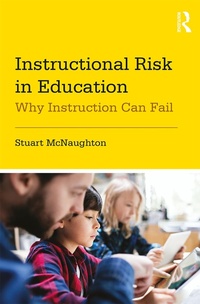
Instructional Risk in Education
Why Instruction Can Fail
1st Edition
Published on 11. May 2018
164 pages
978-1-351-12919-0 (ISBN)
Description

This book is based on the idea that instruction carries in-built risks, and instructional practices can be counterproductive unless used with care. Referencing a wide range of approaches to increasing effectiveness, Instructional Risk provides an explanation of why some forms of instruction are less powerful than they should be. Elaborating on rather than advising against these forms of instruction, it illustrates how teachers can use instructional practices effectively through managing risk and being adaptive in their use of them in the many and dynamic microsystems of the classroom.
The book is unique in bringing together disparate evidence from a range of research areas and across core curriculum areas of English Language Arts, mathematics and science, for a theory of 'Instructional Risk'; the basic proposition for which is that instructional approaches carry known and predictable risks. The book focuses on the expertise required to overcome risks, which are exaggerated for children from communities not well served by our schools. The book is also a critique of research that is 'programmatic' and limited to experimental evidence and summaries of that evidence which are uncritically developed into statements about 'What Works'.
Made to be both an explication of the theory through repeated examples as well as a technical resource, this book will be vital reading for lecturers and postgraduate students of Education and Educational Psychology.
The book is unique in bringing together disparate evidence from a range of research areas and across core curriculum areas of English Language Arts, mathematics and science, for a theory of 'Instructional Risk'; the basic proposition for which is that instructional approaches carry known and predictable risks. The book focuses on the expertise required to overcome risks, which are exaggerated for children from communities not well served by our schools. The book is also a critique of research that is 'programmatic' and limited to experimental evidence and summaries of that evidence which are uncritically developed into statements about 'What Works'.
Made to be both an explication of the theory through repeated examples as well as a technical resource, this book will be vital reading for lecturers and postgraduate students of Education and Educational Psychology.
Reviews / Votes
Instructional Risk in Education: Why Instruction Can Fail is a thoughtful and provocative book that deserves to be widely read and discussed. At the heart of it are analyses of the types of knowledge involved in successful teaching and considerations of how education may be lost. McNaughton draws on an extensive range of ideas in psychology and education. He illustrates his points with telling examples from work on primary and secondary schooling, but it has much to offer those interested in any phase of education.Richard Cowan, UCL Institute of Education, UK
More details
Edition
1. Auflage
Language
English
Place of publication
London
United Kingdom
Publishing group
Taylor & Francis Ltd
Target group
College/higher education
Illustrations
1 Tables, black and white; 1 Line drawings, black and white
ISBN-13
978-1-351-12919-0 (9781351129190)
Copyright in bibliographic data and cover images is held by Nielsen Book Services Limited or by the publishers or by their respective licensors: all rights reserved.
Schweitzer Classification
Other editions
Additional editions
Book
05/2018
1st Edition
Routledge
€59.70
Shipment within 15-20 days
Book
05/2018
1st Edition
Routledge
€205.80
Shipment within 15-20 days
Person
Stuart McNaughton is Professor of Education at the University of Auckland and New Zealand's Chief Education Scientific Advisor.
Content
Part I: Introduction
Chapter One: The idea of risk
Part II: Too much support
Chapter Two: Teaching routines that cause procedural displays
Chapter Three: Scaffolds that limit learning
Chapter Four: Isolating components and compartmentalising learning
Chapter Five: Feedback which undermines agency
Part III: Too much support
Chapter Six: Discovery and little learning
Chapter Seven: Inquiry and ineffective learning
Chapter Eight: Learner agency, digital learning and a new romanticism.
Part IV: Misdirected support
Chapter Nine: Assessment and the risk of restricting learning
Chapter Ten : Focusing on the familiar and reducing transfer
Conclusion: grand designs for teaching, learning and research
Chapter One: The idea of risk
Part II: Too much support
Chapter Two: Teaching routines that cause procedural displays
Chapter Three: Scaffolds that limit learning
Chapter Four: Isolating components and compartmentalising learning
Chapter Five: Feedback which undermines agency
Part III: Too much support
Chapter Six: Discovery and little learning
Chapter Seven: Inquiry and ineffective learning
Chapter Eight: Learner agency, digital learning and a new romanticism.
Part IV: Misdirected support
Chapter Nine: Assessment and the risk of restricting learning
Chapter Ten : Focusing on the familiar and reducing transfer
Conclusion: grand designs for teaching, learning and research
