

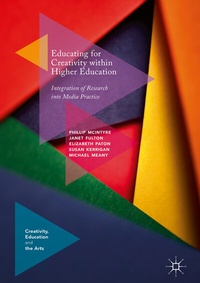
Educating for Creativity within Higher Education
Description

This book provides innovative insights into how creativity can be taught within higher education. Preparing students for employment in a dynamic set of global creative industries requires those students to not only be resilient and entrepreneurial, but also to be locally focused while being globally aware. Therefore it is imperative that they acquire a thorough understanding of creative processes and practice as they try to keep pace with worldwide digital trends. As the creation of media messages is a fundamental aspect of global creative industries, and that numerous concerns practitioners face are based upon a certain understanding of creativity, the authors propose an exploration of what creativity is in terms of research, and then apply it pedagogically. Drawing on extensive empirical research, the authors pose the thought-provoking question of whether creativity can be taught. This volume will be of interest to both students and scholars of creativity and higher education as well as to creatively-based practitioners more widely.
More details
Other editions
Additional editions
Persons
Janet Fulton is Senior Lecturer in Communication and Media at the University of Newcastle, Australia.
Elizabeth Paton is Senior Research Associate at Monash University, Australia and Sessional Academic in Communication and Media at the University of Newcastle, Australia.
Susan Kerrigan is Associate Professor in Communication and Media at the University of Newcastle, Australia.
Michael Meany is Senior Lecturer in Communication and Media at the University of Newcastle, Australia.
