

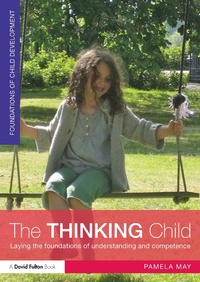
The Thinking Child
Laying the foundations of understanding and competence
Published on 2. September 2013
112 pages
978-1-136-32906-7 (ISBN)
Description

What characteristics do children need to become motivated to learn? How do children's experiences and relationships affect their cognitive development? How do you provide learning experiences that meet the developmental needs of every child in your care?
The Thinking Child thoughtfully discusses the key principles of children's cognitive and intellectual development alongside descriptions of everyday practice. It clearly explains the cognitive strategies that children use to learn new knowledge, the development of cognitive milestones such as symbolism, memories and the imagination, metacognition and creativity along with research into how the brain processes information.
Throughout the book, the author considers the key characteristics of effective learning and shows how play is one of the primary mechanisms that children use to access new knowledge and to consolidate their emerging ideas and concepts. These characteristics are then applied to integral aspects of early years practice to show how pracitioners can:
motivate children to learn new knowledge about themselves and the world around them;
help children to develop their own ideas creatively and use this knowledge as a base to learn new things;
reflect on their own teaching methods to encourage children's engagement, motivation and creativity through effective observation and planning;
engage with parents and carers to help support children's learning at home whilst maintaining the values of the family;
celebrate the uniqueness of each child and provide learning experiences that are appropriate for individuals with particular learning needs, be they physical, emotional or cognitive to ensure that every child has an equal opportunity to succeed.
Emphasising the importance of understanding the theory that underpins children's cognitive development, this accessible text shows practitioners how they can use this knowledge to provide learning opportunities that nourish children's thinking and creative skills.
The Thinking Child thoughtfully discusses the key principles of children's cognitive and intellectual development alongside descriptions of everyday practice. It clearly explains the cognitive strategies that children use to learn new knowledge, the development of cognitive milestones such as symbolism, memories and the imagination, metacognition and creativity along with research into how the brain processes information.
Throughout the book, the author considers the key characteristics of effective learning and shows how play is one of the primary mechanisms that children use to access new knowledge and to consolidate their emerging ideas and concepts. These characteristics are then applied to integral aspects of early years practice to show how pracitioners can:
motivate children to learn new knowledge about themselves and the world around them;
help children to develop their own ideas creatively and use this knowledge as a base to learn new things;
reflect on their own teaching methods to encourage children's engagement, motivation and creativity through effective observation and planning;
engage with parents and carers to help support children's learning at home whilst maintaining the values of the family;
celebrate the uniqueness of each child and provide learning experiences that are appropriate for individuals with particular learning needs, be they physical, emotional or cognitive to ensure that every child has an equal opportunity to succeed.
Emphasising the importance of understanding the theory that underpins children's cognitive development, this accessible text shows practitioners how they can use this knowledge to provide learning opportunities that nourish children's thinking and creative skills.
More details
Series
Language
English
Place of publication
London
United Kingdom
Publishing group
Taylor & Francis Ltd
Target group
College/higher education
Professional and scholarly
Illustrations
9 s/w Photographien bzw. Rasterbilder
9 Halftones, black and white
File size
1,81 MB
ISBN-13
978-1-136-32906-7 (9781136329067)
Copyright in bibliographic data and cover images is held by Nielsen Book Services Limited or by the publishers or by their respective licensors: all rights reserved.
Schweitzer Classification
Other editions
Additional editions
Book
04/2013
1st Edition
Routledge
€54.65
Shipment within 15-20 days
Book
04/2013
1st Edition
Routledge
€207.98
Shipment within 15-20 days
Person
Pamela May is an Early Years Consultant and a former Senior Lecturer in Childhood Studies at Canterbury Christ Church University, UK.
Content
1. Setting the Scene; 2. Play, Exploring and Learning; 3. Active Learning; 4. Creating and Thinking Critically; 5. Observing and Assessing Children's Progress; 6. Partnerships with Parents and Community; 7. Thinking Differently; 8. Thoughtful Organisation; 9. Equipped for Life, Ready for School?
