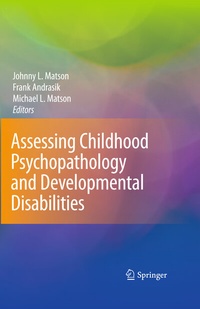
Assessing Childhood Psychopathology and Developmental Disabilities
Description

Not long ago, conducting child assessment was as simple as stating that "the child gets along with others" or "the child lags behind his peers". Today's pediatric psychologists and allied professionals, by contrast, know the critical importance of using accurate measures with high predictive quality to identify pathologies early, form precise case conceptualizations, and provide relevant treatment options.
Assessing Childhood Psychopathology and Developmental Disabilities provides a wide range of evidence-based methods in an immediately useful presentation from infancy through adolescence. Noted experts offer the most up-to-date findings in the most pressing areas, including: (1) Emerging trends, new technologies, and implementation issues. (2) Interviewing techniques and report writing guidelines. (3) Intelligence testing, neuropsychological assessment, and scaling methods for measuring psychopathology. (4) Assessment of major pathologies, including ADHD, conduct disorder, bipolar disorder, and depression. (5) Developmental disabilities, such as academic problems, the autism spectrum and comorbid pathology, and self-injury. (6) Behavioral medicine, including eating and feeding disorders as well as pain management.
This comprehensive volume is an essential resource for the researcher's library and the clinician's desk as well as a dependable text for graduate and postgraduate courses in clinical child, developmental, and school psychology.
(A companion volume, Treating Childhood Psychopathology and Developmental Disabilities , is also available to ensure greater continuity on the road from assessment to intervention to outcome.)
Reviews / Votes
From the reviews:
"Chapters begin with a clear statement about the importance of the topic, flowing smoothly to key issues, subtopics, and a wealth of research findings. . Psychologists who want to support their decisions scientifically, ethically and legally will find the information enormously valuable. The writing is smooth and easy to absorb with surprising consistency throughout considering the depth and breath of the contributors. The get to the point presentation makes the narrative interesting and comfortable to use as a reference." (The Psychology Times, Vol. 2 (3), November, 2010)More details
Other editions
Additional editions