

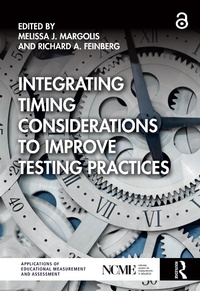
Integrating Timing Considerations to Improve Testing Practices
1st Edition
Published on 3. June 2020
200 pages
978-1-351-06477-4 (ISBN)
Description

Integrating Timing Considerations to Improve Testing Practices synthesizes a wealth of theory and research on time issues in assessment into actionable advice for test development, administration, and scoring. One of the major advantages of computer-based testing is the capability to passively record test-taking metadata-including how examinees use time and how time affects testing outcomes. This has opened many questions for testing administrators. Is there a trade-off between speed and accuracy in test taking? What considerations should influence equitable decisions about extended-time accommodations? How can test administrators use timing data to balance the costs and resulting validity of tests administered at commercial testing centers?
In this comprehensive volume, experts in the field discuss the impact of timing considerations, constraints, and policies on valid score interpretations; administrative accommodations, test construction, and examinees' experiences and behaviors; and how to implement the findings into practice. These 12 chapters provide invaluable resources for testing professionals to better understand the inextricable links between effective time allocation and the purposes of high-stakes testing.
The Open Access version of this book, available at http://www.taylorfrancis.com, has been made available under a Creative Commons Attribution-Non Commercial-No Derivatives 4.0 license.
In this comprehensive volume, experts in the field discuss the impact of timing considerations, constraints, and policies on valid score interpretations; administrative accommodations, test construction, and examinees' experiences and behaviors; and how to implement the findings into practice. These 12 chapters provide invaluable resources for testing professionals to better understand the inextricable links between effective time allocation and the purposes of high-stakes testing.
The Open Access version of this book, available at http://www.taylorfrancis.com, has been made available under a Creative Commons Attribution-Non Commercial-No Derivatives 4.0 license.
More details
Series
Edition
1. Auflage
Language
English
Place of publication
London
United Kingdom
Publishing group
Taylor & Francis Ltd
Target group
College/higher education
Professional and scholarly
Illustrations
9 Tables, black and white; 20 Line drawings, black and white; 20 Illustrations, black and white
File size
6,67 MB
ISBN-13
978-1-351-06477-4 (9781351064774)
Copyright in bibliographic data and cover images is held by Nielsen Book Services Limited or by the publishers or by their respective licensors: all rights reserved.
Schweitzer Classification
Other editions
Additional editions
Melissa J. Margolis | Richard A. Feinberg
Integrating Timing Considerations to Improve Testing Practices
Book
06/2020
1st Edition
Routledge
€63.40
Shipment within 10-20 days
Melissa J. Margolis | Richard A. Feinberg
Integrating Timing Considerations to Improve Testing Practices
Book
06/2020
1st Edition
Routledge
€204.90
Shipment within 10-20 days
Persons
Melissa J. Margolis is Senior Measurement Scientist at the National Board of Medical Examiners, USA.
Richard A. Feinberg is Senior Psychometrician at the National Board of Medical Examiners, USA.
Richard A. Feinberg is Senior Psychometrician at the National Board of Medical Examiners, USA.
Content
Foreword
Mark Raymond
Acknowledgments
1. A History of Test Speededness: Tracing the Evolution of Theory and Practice
Daniel P. Jurich
2. The Impact of Time Limits and Timing Information on Validity
Michael Kane
3. Timing Considerations in Test Development and Administration
Stephen G. Sireci and Sandra M. Botha
4. Extended Time Testing Accommodations for Students with Disabilities: Impact on Score Meaning and Construct Representation
Benjamin J. Lovett
5. Relationship between testing time and testing outcomes
Brent Bridgeman
6. How Examinees Use Time: Examples from a Medical Licensing Examination
Polina Harik, Richard Feinberg, and Brian Clauser
7. Timing Considerations for Performance Assessments
Melissa J. Margolis, Matthias von Davier, and Brian E. Clauser
8. Impact of Technology, Digital Devices, and Test Timing on Score Comparability
Wayne J. Camara and Deborah J. Harris
9. Using Response Time for Measuring Cognitive Ability Illustrated with Medical Diagnostic Reasoning Tasks
Patrick Kyllonen and Rick Thomas
10. Response Times in Cognitive Tests: Interpretation and Importance
Paul De Boeck and Frank Rijmen
11. A Cessation of Measurement: Identifying Test Taker Disengagement Using Response Time
Steven L. Wise and Megan R. Kuhfeld
12. Concurrent Use of Response Time and Response Accuracy for Detecting Examinees with Item Preknowledge
Seo Young Lee and James A. Wollack
Contributors
Mark Raymond
Acknowledgments
1. A History of Test Speededness: Tracing the Evolution of Theory and Practice
Daniel P. Jurich
2. The Impact of Time Limits and Timing Information on Validity
Michael Kane
3. Timing Considerations in Test Development and Administration
Stephen G. Sireci and Sandra M. Botha
4. Extended Time Testing Accommodations for Students with Disabilities: Impact on Score Meaning and Construct Representation
Benjamin J. Lovett
5. Relationship between testing time and testing outcomes
Brent Bridgeman
6. How Examinees Use Time: Examples from a Medical Licensing Examination
Polina Harik, Richard Feinberg, and Brian Clauser
7. Timing Considerations for Performance Assessments
Melissa J. Margolis, Matthias von Davier, and Brian E. Clauser
8. Impact of Technology, Digital Devices, and Test Timing on Score Comparability
Wayne J. Camara and Deborah J. Harris
9. Using Response Time for Measuring Cognitive Ability Illustrated with Medical Diagnostic Reasoning Tasks
Patrick Kyllonen and Rick Thomas
10. Response Times in Cognitive Tests: Interpretation and Importance
Paul De Boeck and Frank Rijmen
11. A Cessation of Measurement: Identifying Test Taker Disengagement Using Response Time
Steven L. Wise and Megan R. Kuhfeld
12. Concurrent Use of Response Time and Response Accuracy for Detecting Examinees with Item Preknowledge
Seo Young Lee and James A. Wollack
Contributors
