

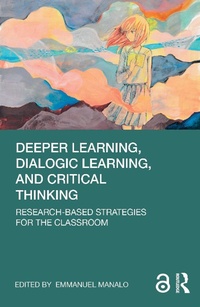
Deeper Learning, Dialogic Learning, and Critical Thinking
Research-based Strategies for the Classroom
Published on 12. September 2019
386 pages
978-1-000-61744-3 (ISBN)
Description

Deeper learning, dialogic learning, and critical thinking are essential capabilities in the 21st-century environments we now operate. Apart from being important in themselves, they are also crucial in enabling the acquisition of many other 21st-century skills/capabilities such as problem solving, collaborative learning, innovation, information and media literacy, and so on. However, the majority of teachers in schools and instructors in higher education are inadequately prepared for the task of promoting deeper learning, dialogic learning, and critical thinking in their students. This is despite the fact that there are educational researchers who are developing and evaluating strategies for such promotion. The problem is bridging the gap between the educational researchers' work and what gets conveyed to teachers and instructors as evidence-based, usable strategies.
This book addresses that gap: in it, leading scholars from around the world describe strategies they have developed for successfully cultivating students' capabilities for deeper learning and transfer of what they learn, dialogic learning and effective communication, and critical thought. They explore connections in the promotion of these capabilities, and they provide, in accessible form, research evidence demonstrating the efficacy of the strategies. They also discuss answers to the questions of how and why the strategies work.
A seminal resource, this book creates tangible links between innovative educational research and classroom teaching practices to address the all-important question of how we can realize our ideals for education in the 21st century. It is a must read for pre-service and in-service teachers, teacher educators and professional developers, and educational researchers who truly care that we deliver education that will prepare and serve students for life.
This book addresses that gap: in it, leading scholars from around the world describe strategies they have developed for successfully cultivating students' capabilities for deeper learning and transfer of what they learn, dialogic learning and effective communication, and critical thought. They explore connections in the promotion of these capabilities, and they provide, in accessible form, research evidence demonstrating the efficacy of the strategies. They also discuss answers to the questions of how and why the strategies work.
A seminal resource, this book creates tangible links between innovative educational research and classroom teaching practices to address the all-important question of how we can realize our ideals for education in the 21st century. It is a must read for pre-service and in-service teachers, teacher educators and professional developers, and educational researchers who truly care that we deliver education that will prepare and serve students for life.
Reviews / Votes
'The book provides a roadmap for teachers who want to provide their students with the knowledge and skills they will need to thrive in the 21st century.' - Allan Collins, Professor Emeritus of Learning Sciences, Northwestern University, US.'There has been so much research about deeper learning, communicative competence, and critical thinking but so little evidence or guidance about optimal teaching of these outcomes. This book fills this gap with its rich ideas, evidence, and implementation strategies, written by the "who's who" in the field. It is wonderful to see that the book recognises these topics as closely related, able to feed off each other, and can be taught within any domain.' - John Hattie, Laureate Professor, Melbourne Graduate School of Education, University of Melbourne, Australia
'This book is a valuable resource for teacher educators. Packed with a wide range of approaches to teaching aspects of thinking, each chapter seeks to make visible the practical, and sometimes implicit, steps between intention and the desired result.' - Rosemary Hipkins, Chief Researcher, New Zealand Council for Educational Research 'The book provides a roadmap for teachers who want to provide their students with the knowledge and skills they will need to thrive in the 21st century.' - Allan Collins, Professor Emeritus of Learning Sciences, Northwestern University, US.
'There has been so much research about deeper learning, communicative competence, and critical thinking but so little evidence or guidance about optimal teaching of these outcomes. This book fills this gap with its rich ideas, evidence, and implementation strategies, written by the "who's who" in the field. It is wonderful to see that the book recognises these topics as closely related, able to feed off each other, and can be taught within any domain.' - John Hattie, Laureate Professor, Melbourne Graduate School of Education, University of Melbourne, Australia
'This book is a valuable resource for teacher educators. Packed with a wide range of approaches to teaching aspects of thinking, each chapter seeks to make visible the practical, and sometimes implicit, steps between intention and the desired result.' - Rosemary Hipkins, Chief Researcher, New Zealand Council for Educational Research
'This book can be considered a novel resource, presenting strategies that educators can easily implement to improve students' capabilities.' - Mohamad Saripudin, Educational Review
More details
Language
English
Place of publication
London
United Kingdom
Publishing group
Taylor & Francis Ltd
Target group
College/higher education
Professional and scholarly
Illustrations
34 Tables, black and white; 63 Line drawings, black and white; 1 Halftones, black and white; 64 Illustrations, black and white
File size
11,46 MB
ISBN-13
978-1-000-61744-3 (9781000617443)
Copyright in bibliographic data and cover images is held by Nielsen Book Services Limited or by the publishers or by their respective licensors: all rights reserved.
Schweitzer Classification
Other editions
Additional editions
Emmanuel Manalo
Deeper Learning, Dialogic Learning, and Critical Thinking
Research-based Strategies for the Classroom
Book
09/2019
1st Edition
Routledge
€208.70
Shipment within 15-20 days
Emmanuel Manalo
Deeper Learning, Dialogic Learning, and Critical Thinking
Research-based Strategies for the Classroom
Book
09/2019
1st Edition
Routledge
€61.30
Shipment within 15-20 days
Person
Emmanuel Manalo is a professor at the Graduate School of Education of Kyoto University in Japan. He teaches educational psychology and academic communication skills to undergraduate and graduate students. His research interests include the promotion of effective learning and instructional strategies; diagram use for communication, problem solving, and thinking; and critical and other thinking skills.
Content
Acknowledgement
List of contributors
Introduction: Establishing a Case for Sharing Research-Based Instructional Strategies (Emmanuel Manalo)
Part 1: Structuring Dialogue
1. The Playground of Ideas: Developing a Structured Approach to the Community of Inquiry for Young Children (Laura Kerslake)
2. The Thinking Together approach to Dialogic Teaching (Neil Phillipson & Rupert Wegerif)
3. Compare and Discuss to Promote Deeper Learning (Bethany Rittle-Johnson, Jon R. Star, Kelley Durkin, & Abbey Loehr)
Part 2: Facilitating Meaning Construction
4. Refining Student Thinking through Scientific Theory Building (Hillary Swanson)
5. Extending Students Communicative Repertoires: A Culture of Inquiry Perspective for Reflexive Learning (Beth V. Yeager, Maria Lucia Castanheira, & Judith Green)
6. Transforming Classroom Discourse as a Resource for Learning: Adapting Interactional Ethnography for Teaching and Learning (W. Douglas Baker)
Part 3: Cultivating questioning 7. Question Based Instruction (QBI) Promotes Learners' Abilities to Ask More Questions and Express Opinions During Group Discussions (Yoshinori Oyama and Tomoko Yagihashi)
8. AugmentedWorld: A Location-based Question Generating Platform as a Means of Promoting 21st Century Skills (Shadi Asakle & Miri Barak)
9. Effective Way to Prepare for Deeper Learning of History (Keita Shinogaya)
Part 4: Promoting engagement and reflection
10. "Laughter is the Best Medicine": Pedagogies of Humor and Joy that Support Critical Thinking and Communicative Competence (Jean J. Ryoo)
11. Improving College Students' Critical Thinking Through the Use of a Story Tool for Self-regulated Learning Training (Pedro Rosario, Jose Carlos Nunez, Paula Magalhaes, Sonia Fuentes, Cleidilene Magalhaes, & Kyle Busing)
12. Debugging as a Context for Fostering Reflection on Critical Thinking and Emotion (David DeLiema, Maggie Dahn, Virginia J. Flood, Ana Asuncion, Dor Abrahamson, Noel Enyedy, & Francis Steen)
Part 5: Training Specific Competencies
13. Showing What It Looks Like: Teaching Students to Use Diagrams in Problem Solving, Communication, and Thinking (Emmanuel Manalo, Yuri Uesaka, Ouhao Chen, & Hiroaki Ayabe)
14. Class Design for Developing Presentation Skills for Graduate Research Students (Etsuko Tanaka & Emmanuel Manalo)
15. Online Written Argumentation: Internal Dialogic Features and Classroom Instruction (Naomi Rosedale, Stuart McNaughton, Rebecca Jesson, Tong Zhu, & Jacinta Oldehaver)
16. Cultivating Pre-Service and In-Service Teachers' Abilities to Deepen Understanding and Promote Learning Strategy Use in Pupils (Tatsushi Fukaya & Yuri Uesaka)
Part 6: Program/Course Teaching
17. Cultivation of a Critical Thinking Disposition and Inquiry Skills Among High School Students (Takashi Kusumi)
18. Using Task-based Language Teaching in the Second Language Classroom: Developing Global Communication Competencies (Chris Sheppard)
19. Collective Reasoning in Elementary Engineering Education (Christine M. Cunningham & Gregory J. Kelly)
Index
List of contributors
Introduction: Establishing a Case for Sharing Research-Based Instructional Strategies (Emmanuel Manalo)
Part 1: Structuring Dialogue
1. The Playground of Ideas: Developing a Structured Approach to the Community of Inquiry for Young Children (Laura Kerslake)
2. The Thinking Together approach to Dialogic Teaching (Neil Phillipson & Rupert Wegerif)
3. Compare and Discuss to Promote Deeper Learning (Bethany Rittle-Johnson, Jon R. Star, Kelley Durkin, & Abbey Loehr)
Part 2: Facilitating Meaning Construction
4. Refining Student Thinking through Scientific Theory Building (Hillary Swanson)
5. Extending Students Communicative Repertoires: A Culture of Inquiry Perspective for Reflexive Learning (Beth V. Yeager, Maria Lucia Castanheira, & Judith Green)
6. Transforming Classroom Discourse as a Resource for Learning: Adapting Interactional Ethnography for Teaching and Learning (W. Douglas Baker)
Part 3: Cultivating questioning 7. Question Based Instruction (QBI) Promotes Learners' Abilities to Ask More Questions and Express Opinions During Group Discussions (Yoshinori Oyama and Tomoko Yagihashi)
8. AugmentedWorld: A Location-based Question Generating Platform as a Means of Promoting 21st Century Skills (Shadi Asakle & Miri Barak)
9. Effective Way to Prepare for Deeper Learning of History (Keita Shinogaya)
Part 4: Promoting engagement and reflection
10. "Laughter is the Best Medicine": Pedagogies of Humor and Joy that Support Critical Thinking and Communicative Competence (Jean J. Ryoo)
11. Improving College Students' Critical Thinking Through the Use of a Story Tool for Self-regulated Learning Training (Pedro Rosario, Jose Carlos Nunez, Paula Magalhaes, Sonia Fuentes, Cleidilene Magalhaes, & Kyle Busing)
12. Debugging as a Context for Fostering Reflection on Critical Thinking and Emotion (David DeLiema, Maggie Dahn, Virginia J. Flood, Ana Asuncion, Dor Abrahamson, Noel Enyedy, & Francis Steen)
Part 5: Training Specific Competencies
13. Showing What It Looks Like: Teaching Students to Use Diagrams in Problem Solving, Communication, and Thinking (Emmanuel Manalo, Yuri Uesaka, Ouhao Chen, & Hiroaki Ayabe)
14. Class Design for Developing Presentation Skills for Graduate Research Students (Etsuko Tanaka & Emmanuel Manalo)
15. Online Written Argumentation: Internal Dialogic Features and Classroom Instruction (Naomi Rosedale, Stuart McNaughton, Rebecca Jesson, Tong Zhu, & Jacinta Oldehaver)
16. Cultivating Pre-Service and In-Service Teachers' Abilities to Deepen Understanding and Promote Learning Strategy Use in Pupils (Tatsushi Fukaya & Yuri Uesaka)
Part 6: Program/Course Teaching
17. Cultivation of a Critical Thinking Disposition and Inquiry Skills Among High School Students (Takashi Kusumi)
18. Using Task-based Language Teaching in the Second Language Classroom: Developing Global Communication Competencies (Chris Sheppard)
19. Collective Reasoning in Elementary Engineering Education (Christine M. Cunningham & Gregory J. Kelly)
Index
