

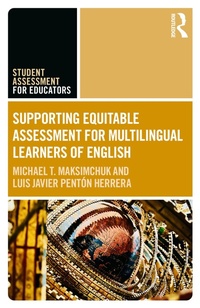
Supporting Equitable Assessment for Multilingual Learners of English
1st Edition
Published on 16. April 2026
164 pages
978-1-040-60692-6 (ISBN)
Description

Supporting Equitable Assessment for Multilingual Learners of English introduces the E5 model of equitable assessment, an original ramework developed by the authors to guide fair and culturally responsive evaluation of multilingual learners of English. The model integrates five guiding principles: equity, equality, educational justice, equanimity, and empowerment, across three interrelated dimensions: affective, social-moral, and technical. Drawing on research, professional expertise, and lived classroom experience, the book examines the historical context of language assessment as well as its policies, the central role of emotional well-being, and the balance between content rigor and language accessibility. Each chapter combines conceptual foundations with practical tools, adaptable rubrics, and reflection prompts that enable educators to design assessments fostering student agency, cultural relevance, and academic mastery. The authors also address emerging opportunities and challenges, including the integration of technology, the impacts of global migration, and shifts in educational policy. By centering student voice and identity, this book provides educators, leaders, and policymakers with actionable strategies for building assessment systems that are academically rigorous, culturally grounded, and responsive to the evolving needs of today's students.
Reviews / Votes
In this exceptional book, Maksimchuk and Penton Herrera unapologetically focus on the importance of equitable assessments for multilingual learners of English (MLEs). What makes this book unique is that it develops our assessment literacy while providing us with theoretical understandings, as well as a multidimensional framework that considers the complex interdependent dimensions of multilingual student learning and evaluation. The single focus of the book on equity, equality, justice, equanimity, and empowerment for MLE assessment is then amplified as it generates many different possibilities of assessment design and balanced actions by educators.~ Ofelia Garcia
The Graduate Center, City University of New York
The authors capture what it truly means to understand and provide equitable assessments for multilingual learners of English (MLEs). The solid research base provided, along with the clear explanations, makes this a book that should be required for all assessment courses. Educators interested in learning more about assessment, including the rationale behind assessments, will appreciate the opportunity to not only identify and review appropriate, equitable assessments but also to design equitable assessments tailored for MLEs. This book is a gem!
~Gilda Martinez-Alba
Towson University
This book brings a fresh perspective to the assessment of multilingual learners of English in content classrooms, with keen attention to affective, social-moral, and technical dimensions of assessment design. The authors' philosophy is that assessment practices should be equitable, inclusive, and empowering. As a result, this text guides teachers to frame "assessments as stepping stones rather than obstacles." By offering choice in assessment formats, creating supportive and respectful classroom environments, and crafting targeted feedback, teachers can maximize students' abilities, linguistic backgrounds, and cultural knowledge, and enable them to demonstrate their content knowledge and skills more fully.
~ Deborah J. Short
Academic Language Research & Training, LLC
More details
Series
Edition
1. Auflage
Language
English
Place of publication
London
United Kingdom
Publishing group
Taylor & Francis Ltd
Target group
College/higher education
Professional and scholarly
Product notice
Reflowable
Illustrations
5 Line drawings, black and white; 2 Halftones, black and white; 7 Illustrations, black and white
File size
2,35 MB
ISBN-13
978-1-040-60692-6 (9781040606926)
Copyright in bibliographic data and cover images is held by Nielsen Book Services Limited or by the publishers or by their respective licensors: all rights reserved.
Schweitzer Classification
Other editions
Additional editions
Michael T. Maksimchuk | Luis Javier Penton Herrera
Supporting Equitable Assessment for Multilingual Learners of English
Book
04/2026
1st Edition
Routledge
€230.62
Shipment within 15-20 days
Michael T. Maksimchuk | Luis Javier Penton Herrera
Supporting Equitable Assessment for Multilingual Learners of English
Book
04/2026
1st Edition
Routledge
€67.20
Shipment within 15-20 days
Persons
Michael T. Maksimchuk is an Assessment Consultant at Kent Intermediate School District, Michigan, USA.
Luis Javier Penton Herrera is a Professor at VIZJA University, Poland.
Luis Javier Penton Herrera is a Professor at VIZJA University, Poland.
Content
1. Introduction to Assessment for MLEs 2. The E5 Model of Equitable Assessment 3. The Affective Dimension of Equitable Assessment for MLEs 4. Designing Effective Equitable Assessments for MLEs 5. The Road Ahead: Future Directions in Assessment for MLEs 6. Appendices
