

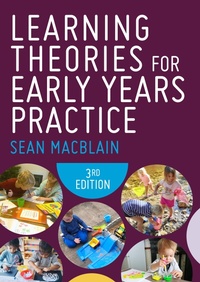
Learning Theories for Early Years Practice
3rd Edition
Published on 5. February 2025
152 pages
978-1-0362-0214-9 (ISBN)
Description

This third edition showcases captivating full-color photographs, compelling case studies, engaging activities, and thought-provoking discussion points. Each chapter delves into the theorist and the theory, illustrating their practical applications, strengths, weaknesses, and connections to other theorists. This indispensable resource empowers students to create inclusive learning environments.
New to this edition:
New chapter on Barbara Rogoff and children in cultural communities
Expanded final section on theorists in the contemporary world, covering vital issues such as mental health, diversity, gender, special educational needs, play, valuing our environments, and artificial intelligence
Updated case studies and examples
New to this edition:
New chapter on Barbara Rogoff and children in cultural communities
Expanded final section on theorists in the contemporary world, covering vital issues such as mental health, diversity, gender, special educational needs, play, valuing our environments, and artificial intelligence
Updated case studies and examples
More details
Edition
Third Edition
Language
English
Place of publication
United Kingdom
Publishing group
SAGE Publishing (Digital)
Target group
College/higher education
Product notice
Reflowable
File size
21,09 MB
ISBN-13
978-1-0362-0214-9 (9781036202149)
Copyright in bibliographic data and cover images is held by Nielsen Book Services Limited or by the publishers or by their respective licensors: all rights reserved.
Schweitzer Classification
Other editions
Additional editions
Sean MacBlain
Learning Theories for Early Years Practice
Book
03/2025
3rd Edition
SAGE Publications Ltd
€115.48
Shipment within 3-4 weeks
Sean MacBlain
Learning Theories for Early Years Practice
Book
03/2025
3rd Edition
SAGE Publications Ltd
€105.00
Shipment within 3-4 weeks
Person
Sean MacBlain PhD is a distinguished author and academic whose publications include: MacBlain (Sage, 2021) Children's Learning in Early Childhood; MacBlain (Sage, 2020) Child Development for Teachers; MacBlain, Dunn and Luke (Sage, 2017) Contemporary Childhood; Gray and MacBlain (Sage, 2015) Learning Theories in Childhood; MacBlain, Long and Dunn, (Sage, 2015) Dyslexia, Literacy and Inclusion: Child-centred Perspectives; MacBlain (Sage, 2014) How Children Learn. Sean's publications are used by students, practitioners and academics throughout the world and have been widely translated including into Chinese and Vietnamese. Sean was previously a senior academic at the University of St Mark & St John, Plymouth, England where he held the positions of Research lead for the Centre for Education and Applied Research, Research Lead for the Centre for Professional and Educational Research, Research Coordinator for the School of Education and Deputy Chair of the Ethics Committee. Sean has also worked as a Senior Lecturer in Education and Developmental Psychology at Stranmillis University College, Queen's University Belfast. In addition to this, Sean has worked for over twenty years as an educational psychologist and continues in this field as an independent practitioner.
Content
PART 1 EARLY INFLUENCES
John Locke and the Emergence of Empiricism
Jean-Jacques Rousseau and the Concept of 'Child'
Johann Pestalozzi and the Importance of Nature
Friedrich Froebel and the Importance of Play
Rachel and Margaret McMillan and Social Reform
The Psychodynamic Tradition
Rudolf Steiner and the Changing Needs of Children
Maria Montessori: The Environment and Learning
PART 2 MODERN INFLUENCES
John Dewey and Child-centred Education
Burrhus Skinner and Behaviourism
Jean Piaget: An Enduring Legacy
Lev Vygotsky: Learning and Social Constructivism
John Bowlby and Early Attachment
Albert Bandura and Social Learning Theory
Urie Bronfenbrenner: Learning in the Wider Context
Jerome Bruner and Constructivism
Howard Gardner and Theories of Multiple Intelligence
Reuven Feuerstein and Instrumental Enrichment
Nel Noddings and the Ethics of Care
Te Whariki
Loris Malaguzzi and Reggio Emilia
Carol Dweck and Children's Mindsets
Guy Claxton: Building Learning Power
Barbara Rogoff: children as Participants in their Cultural Communities
PART 3 CHALLENGES FOR THEORISTS IN A CHANGING WORLD
Challenges for Theorists in a Changing World
John Locke and the Emergence of Empiricism
Jean-Jacques Rousseau and the Concept of 'Child'
Johann Pestalozzi and the Importance of Nature
Friedrich Froebel and the Importance of Play
Rachel and Margaret McMillan and Social Reform
The Psychodynamic Tradition
Rudolf Steiner and the Changing Needs of Children
Maria Montessori: The Environment and Learning
PART 2 MODERN INFLUENCES
John Dewey and Child-centred Education
Burrhus Skinner and Behaviourism
Jean Piaget: An Enduring Legacy
Lev Vygotsky: Learning and Social Constructivism
John Bowlby and Early Attachment
Albert Bandura and Social Learning Theory
Urie Bronfenbrenner: Learning in the Wider Context
Jerome Bruner and Constructivism
Howard Gardner and Theories of Multiple Intelligence
Reuven Feuerstein and Instrumental Enrichment
Nel Noddings and the Ethics of Care
Te Whariki
Loris Malaguzzi and Reggio Emilia
Carol Dweck and Children's Mindsets
Guy Claxton: Building Learning Power
Barbara Rogoff: children as Participants in their Cultural Communities
PART 3 CHALLENGES FOR THEORISTS IN A CHANGING WORLD
Challenges for Theorists in a Changing World
