

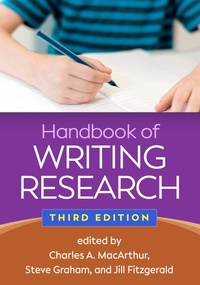
Handbook of Writing Research
3rd Edition
Published on 28. May 2025
480 pages
978-1-4625-5730-1 (ISBN)
Description

Teacher educators, researchers, graduate students, and K-12 educators; educational and school psychologists. May serve as a text in graduate-level courses on writing instruction.
More details
Other editions
Additional editions
Charles A. MacArthur | Steve Graham | Jill Fitzgerald
Handbook of Writing Research, Third Edition
Book
06/2025
3rd Edition
Guilford Press
€71.00
Shipment within 15-20 days
Persons
Charles A. MacArthur, PhD, is Professor Emeritus of Special Education and Literacy in the School of Education at the University of Delaware. A former special education teacher, Dr. MacArthur has been conducting research on writing development and instruction for struggling writers since the 1980s. Most recently, he was principal investigator on two grants to develop and examine the efficacy of a writing curriculum for college basic writing courses. Other research projects have focused on the development of a writing curriculum for students with learning disabilities, writing strategy instruction, decoding instruction in adult education, speech recognition as a writing accommodation, project-based learning in social studies in inclusive classrooms, and first-grade writing instruction. Dr. MacArthur is a Fellow of the American Educational Research Association and a recipient of a research award from the Council for Exceptional Children. He has served as coeditor of the Journal of Writing Research and the Journal of Special Education, has published over 125 articles and book chapters, and is coeditor or coauthor of several books.
Steve Graham, EdD, is a Regents Professor and the Warner Professor in the Division of Leadership and Innovation at Mary Lou Fulton Teachers College, Arizona State University. Since the 1980s, he has studied how writing develops, how to teach it effectively, and how it can be used to support reading and learning. Dr. Graham's research involves typically developing writers and students with special needs in both elementary and secondary schools, with much of this research occurring in classrooms in urban schools. Dr. Graham is a recipient of the Thorndike Career Award from Division 15 of the American Psychological Association, the William S. Gray Citation of Merit from the International Literacy Association, and the Exemplary Research in Teaching and Teacher Education Award from Division K of the American Educational Research Association, among other awards. He is the former editor of several journals, including the Journal of Writing Research; coauthor of three influential Carnegie Corporation reports on writing; and coauthor or coeditor of several books.
Jill Fitzgerald, PhD, is Research Professor and Professor Emerita in the School of Education at The University of North Carolina at Chapel Hill. A former primary-grades teacher and reading specialist, she has most recently conducted research on literacy issues involving multilingual learners, text complexity, and vocabulary measurement. Dr. Fitzgerald is a member of the Reading Hall of Fame, a Fellow of the American Educational Research Association (AERA), and a recipient of research awards from Phi Delta Kappa, the International Literacy Association, and the AERA. She has published over 150 works, is currently associate editor of the [ital]Journal of Educational Psychology[/ital], and serves on the editorial boards of several other journals. Dr. Fitzgerald also has received university teaching and advisement awards and has been a review panelist for the U.S. Department of Education, the Institute of Education Sciences, the National Institutes of Health, and the National Institute for Literacy.
Steve Graham, EdD, is a Regents Professor and the Warner Professor in the Division of Leadership and Innovation at Mary Lou Fulton Teachers College, Arizona State University. Since the 1980s, he has studied how writing develops, how to teach it effectively, and how it can be used to support reading and learning. Dr. Graham's research involves typically developing writers and students with special needs in both elementary and secondary schools, with much of this research occurring in classrooms in urban schools. Dr. Graham is a recipient of the Thorndike Career Award from Division 15 of the American Psychological Association, the William S. Gray Citation of Merit from the International Literacy Association, and the Exemplary Research in Teaching and Teacher Education Award from Division K of the American Educational Research Association, among other awards. He is the former editor of several journals, including the Journal of Writing Research; coauthor of three influential Carnegie Corporation reports on writing; and coauthor or coeditor of several books.
Jill Fitzgerald, PhD, is Research Professor and Professor Emerita in the School of Education at The University of North Carolina at Chapel Hill. A former primary-grades teacher and reading specialist, she has most recently conducted research on literacy issues involving multilingual learners, text complexity, and vocabulary measurement. Dr. Fitzgerald is a member of the Reading Hall of Fame, a Fellow of the American Educational Research Association (AERA), and a recipient of research awards from Phi Delta Kappa, the International Literacy Association, and the AERA. She has published over 150 works, is currently associate editor of the [ital]Journal of Educational Psychology[/ital], and serves on the editorial boards of several other journals. Dr. Fitzgerald also has received university teaching and advisement awards and has been a review panelist for the U.S. Department of Education, the Institute of Education Sciences, the National Institutes of Health, and the National Institute for Literacy.
Content
Introduction, Charles A. MacArthur, Steve Graham, & Jill Fitzgerald
I. Theories and Models of Writing
1. The Writer(s)-within-Communities Model, Steve Graham & Angelique Aitken
2. Models of Writing from a Cognitive Perspective, Charles A. MacArthur
3. Sociocultural Perspectives in Writing Research, Richard Beach, Kevin Roozen, & Anna Smith
II. Cognitive and Social Aspects of Writing
4. Early Writing Development and Practice, Hope K. Gerde & Gary E. Bingham
5. Development of Control Mechanisms: Attention, Executive Control, Working Memory, Teresa Limpo
6. Understanding Writing Motivation in Context, Sharon Zumbrunn & Bailey Bontrager
7. The Science of Reading-Writing Connections, Young-Suk Grace Kim
8. Vocabulary in Writing: Processes and Products, Jill Fitzgerald
9. Sociocultural Aspects of Composing, Linda Harklau & Shim Lew
III. Instruction in Writing
10. Essences for Designing Interventions in Writing Research, Gert Rijlaarsdam, Liselore van Ockenburg, Mar Mateos, & Daphne van Weijen
11. What Do Meta-Analyses Tell Us about the Teaching of Writing?, Steve Graham
12. Current Writing Instruction in Schools: Centripetal and Centrifugal Forces in Theory, Method, and Practice, Kristen C. Wilcox & Jill V. Jeffery
13. Teaching Language for Disciplinary Writing within Mathematics, Science, and Social Studies Classrooms: Current Approaches and Future Directions, Emily Phillips Galloway, Joshua Bednorz, & Bailey Buchanan
14. Reimagining Grammar Instruction: Nurturing a Repertoire of Infinite Possibilities, Debra Myhill, Ruth Newman, & Annabel Watson
15. Computer-Based Writing Instruction, Andrew Potter, Joshua Wilson, Rod D. Roscoe, Tracy Arner, & Danielle S. McNamara
16. Synthesis in Source-Based Writing, Mar Mateos & Gert Rijlaarsdam
17. Writing to Learn, David Galbraith, Veerle M. Baaijen, Amy Peters, & Sophie M. Hall
18. Source Evaluation, Ivar Bräten, Natalia Latini, & Ladislao Salmerón
19. Sociocultural Approaches to Centering the Developing Writer in Writing Instruction, Anna Smith, Sonia Kline, Grace Kang, Kevin Roozen, & Richard Beach
20. Professional Development in Writing Instruction, April Camping, Debra McKeown, Michael Williams, & Karen Harris
IV. Writing Assessment
21. How Effective Is Feedback to Writing for Different Language Learners?: What We Know from Current Meta-Analytical Evidence, Sina Scherer & Vera Busse
22. Advances in Automated Writing Evaluation, Laura K. Allen & Scott A. Crossley
23. Formative Feedback in Writing: A Scoping Review, Anastasiya A. Lipnevich & Ligia Tomazin
V. Writing and Special Populations
24. Writing in Students with Diverse Abilities: A Consideration of Disability Causal Theories, Gary A. Troia
25. Second-Language Writing and Writers in Educational Contexts, Marlene Tovar, Xiao Tan, & Paul Kei Matsuda
26. Writing and African American Students: Enduring Dilemmas and Transformative Possibilities, Teaira McMurtry & Arnetha F. Ball
Author Index
Subject Index
I. Theories and Models of Writing
1. The Writer(s)-within-Communities Model, Steve Graham & Angelique Aitken
2. Models of Writing from a Cognitive Perspective, Charles A. MacArthur
3. Sociocultural Perspectives in Writing Research, Richard Beach, Kevin Roozen, & Anna Smith
II. Cognitive and Social Aspects of Writing
4. Early Writing Development and Practice, Hope K. Gerde & Gary E. Bingham
5. Development of Control Mechanisms: Attention, Executive Control, Working Memory, Teresa Limpo
6. Understanding Writing Motivation in Context, Sharon Zumbrunn & Bailey Bontrager
7. The Science of Reading-Writing Connections, Young-Suk Grace Kim
8. Vocabulary in Writing: Processes and Products, Jill Fitzgerald
9. Sociocultural Aspects of Composing, Linda Harklau & Shim Lew
III. Instruction in Writing
10. Essences for Designing Interventions in Writing Research, Gert Rijlaarsdam, Liselore van Ockenburg, Mar Mateos, & Daphne van Weijen
11. What Do Meta-Analyses Tell Us about the Teaching of Writing?, Steve Graham
12. Current Writing Instruction in Schools: Centripetal and Centrifugal Forces in Theory, Method, and Practice, Kristen C. Wilcox & Jill V. Jeffery
13. Teaching Language for Disciplinary Writing within Mathematics, Science, and Social Studies Classrooms: Current Approaches and Future Directions, Emily Phillips Galloway, Joshua Bednorz, & Bailey Buchanan
14. Reimagining Grammar Instruction: Nurturing a Repertoire of Infinite Possibilities, Debra Myhill, Ruth Newman, & Annabel Watson
15. Computer-Based Writing Instruction, Andrew Potter, Joshua Wilson, Rod D. Roscoe, Tracy Arner, & Danielle S. McNamara
16. Synthesis in Source-Based Writing, Mar Mateos & Gert Rijlaarsdam
17. Writing to Learn, David Galbraith, Veerle M. Baaijen, Amy Peters, & Sophie M. Hall
18. Source Evaluation, Ivar Bräten, Natalia Latini, & Ladislao Salmerón
19. Sociocultural Approaches to Centering the Developing Writer in Writing Instruction, Anna Smith, Sonia Kline, Grace Kang, Kevin Roozen, & Richard Beach
20. Professional Development in Writing Instruction, April Camping, Debra McKeown, Michael Williams, & Karen Harris
IV. Writing Assessment
21. How Effective Is Feedback to Writing for Different Language Learners?: What We Know from Current Meta-Analytical Evidence, Sina Scherer & Vera Busse
22. Advances in Automated Writing Evaluation, Laura K. Allen & Scott A. Crossley
23. Formative Feedback in Writing: A Scoping Review, Anastasiya A. Lipnevich & Ligia Tomazin
V. Writing and Special Populations
24. Writing in Students with Diverse Abilities: A Consideration of Disability Causal Theories, Gary A. Troia
25. Second-Language Writing and Writers in Educational Contexts, Marlene Tovar, Xiao Tan, & Paul Kei Matsuda
26. Writing and African American Students: Enduring Dilemmas and Transformative Possibilities, Teaira McMurtry & Arnetha F. Ball
Author Index
Subject Index
