

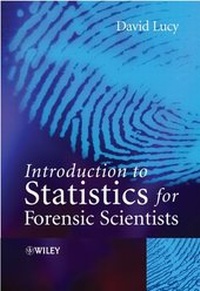
Introduction to Statistics for Forensic Scientists
Description

Reviews / Votes
"It deserves a place in the library of any seriousforensic scientist and I congratulate the author on hisachievement." (Significance, 1 March2006)"...useful for those who are becoming introduced to forensicscience." (The American Statistician, August 2007) "...the book is an easy read...it would appeal to students offorensic science at both introductory and advanced levels."(Journal of Tropical Pedriatrics, 2nd February 2006) " ... deserves a place in the library of any seriousforensic scientist and I congratulate the author on hisachievement." (Significance, Issue 3, 2006) " ... an easy read with many complex concepts described in alucid style." (Journal of Tropical Pediatrics: Vol. 52; 4,2006) "One of the most important issues in using likelihood ratios ina forensic context may well be determining the relevant populationof a sample. This is an are that is discussed throughout thetext...gives insight..." (Canadian Society of ForensicScience, October 2006)More details
Other editions
Additional editions
Person
Content
List of Figures.
List of Tables.
1. A short history of statistics in the law.
1.1 History.
1.2 Some recent uses of statistics in forensic science.
1.3 What is probability?.
2. Data types, location and dispersion.
2.1 Types of data.
2.2 Populations and samples.
2.3 Distributions.
2.4 Location.
2.5 Dispersion.
2.6 Hierarchies of variation.
3. Probability.
3.1 Aleatory probability.
3.2 Binomial probability.
3.3 Poisson probability.
3.4 Empirical probability.
4. The normal distribution.
4.1 The normal distribution.
4.2 Standard deviation and standard error of the mean.
4.3 Percentage points of the normal distribution.
4.5 t-testing between two independent samples.
4.6 Testing between paired observations.
4.7 Confidence, significance and p-values.
5. Measures of nominal and ordinal association.
5.1 Association between discrete variables.
5.2 X2 test for a 2 x 2 table
5.3 Yules Q.
5.4 X2 tests for greater than 2 x 2 tables.
5.5 02 and crammers V2.
5.6 The limitations of X2 testing.
5.7 Interpretation and conclusions.
6. Correlation.
6.1 Significance tests for correlation coefficients.
6.2 Correlation coefficients for non-linear data.
6.3 The coefficient of determination.
6.4 Partial correlation.
6.5 Partial correlation controlling for two of more covariates.
7. Regression and calibration.
7.1 Linear models.
7.2 Calculation of a linear regression model.
7.3 Testing 'goodness of fit'.
7.4 Testing coefficients a and b.
7.5 Residuals.
7.6 Calibration.
7.7 Points to remember.
8. Evidence evaluation.
8.1 Verbal statements of evidential value.
8.2 Evidence types.
8.3 The value of evidence.
8.4 Significance testing and evidence evaluation.
9. Conditional probability and Bayes' theorem.
9.1 Conditional probability.
9.2 Bayes' theorem.
9.3 The value of evidence.
10. Relevance and the formulation of propositions.
10.1 Relevance.
10.2 Hierarchy of propositions.
10.3 Likelihood ratios and relevance.
10.4 The logic of relevance.
10.5 The formulation of propositions.
10.6 What kind of propositions can we not evaluate.
11. Evaluation of evidence in practice.
11.1 Which database to use.
11.2 Verbal equivalence of the likelihood ratio.
11.3 Some common criticisms of statistical approaches.
12. Evidence evaluation examples/
12.1 Blood group frequencies.
12.2 Trouser fibres.
12.3 Shoe types.
12.4 Airweapon projectiles.
12.5 Height description from eyewitness.
13. Errors in interpretation.
13.1 Statistically based errors of interpretation.
13.2 Methodological errors of interpretation.
14. DNA I.
14.1 Loci and alleles.
14.2 Simple case genotypic frequencies.
14.3 Hardy-weinberg equilibrium.
14.4 Simple case allelic frequencies.
14.5 Accounting for sub-populations.
15. DNA II.
15.1Paternity -mother and father unrelated.
15.2 Database searches and value of evidence.
15.3 Discussion.
16. Sampling and sample size estimation.
16.1 Estimation of a mean.
16.2 Sample sizes for t-tests.
16.3 How many drugs to sample.
16.4 Concluding comments.
17. Epilogue.
17.1 Graphical models and Bayesian Networks.
17.2 Kernel density estimation.
17.3 Multivariate continuous matching.
Appendix A: Worked solutions to questions.
Appendix B: Percentage pints of the standard normal distribution.
Appendix C: Percentage points of t-distributions.
Appendix D: Percentage points of X2-distributions.
Appendix E: Percentage points of beta-beta distributions.
Appendix F: Percentage points of f-distributions.
Appendix G: Calculating partial correlations using 'Excel' software.
Appendix H: Further algebra using the "third law".
References.
Index.
