

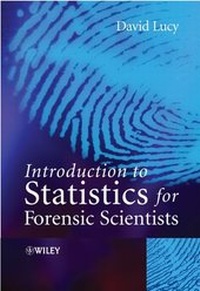
Introductory Statistics for Forensic Scientists
Published on 4. November 2005
Book
Paperback/Softback
266 pages
978-0-470-02201-6 (ISBN)
Description
Introduction to Statistics for Forensic Scientists gently guides the reader through the key statistical techniques used to evaluate various types of forensic evidence. Assuming only a modest mathematical background, the book uses real-life examples from forensic science literature and forensic case-work to illustrate relevant statistical concepts and methods.
Opening with a brief overview of the history and use of statistics within forensic science, the text goes on to introduce statistical techniques commonly used to examine data obtained during laboratory experiments. There is a strong emphasis of the evaluation of scientific observation as evidence and modern Bayesian approaches to interpreting forensic data for the courts. The analysis of key forms of evidence is discussed throughout with a particular forces on DNA, fibres and glass.
* Introduces key statistical techniques used in the evaluation of forensic evidence.
* Included the end of chapter exercises to enhance student understanding.
* Numerous examples taken from forensic science put the subject into context.
An essential introduction to the statistical interpretation of forensic evidence, this book be invaluable for all undergraduates taking courses in forensic science.
Reviews / Votes
"...the book is an easy read...it would appeal to students of forensic science at both introductory and advanced levels." (Journal of Tropical Pedriatrics, 2nd February 2006)More details
Other editions
Additional editions
E-Book
05/2013
1st Edition
Wiley
€44.99
Available for download
E-Book
02/2006
Wiley
€44.99
Available for download
Book
11/2005
1st Edition
Wiley
€136.50
Shipment within 10-20 days
Person
Dr. David Lucy, School of Mathematics, The University of Edinburgh
Content
Table of Contents (Provisional)
History and types of Data
1.1 Introduction to the use of statistics in forensic science
1.2 Some examples of how statistics are used in forensic science
1.3 Types of data
1.4 Populations and samples
1.5 Distributions
* Location and dispersion
2.1 Location
2.2 Dispersion
2.3 Measurement error and hierarchy of error
* Simple probability
3.1 Absolute probability models
3.2 Binomial probability
* The normal distribution
4.1 Percentage points of the normal distribution
4.2 Standard deviation and standard error of the mean
4.3 Percentage points of the normal distribution
* Testing between sample means
5.1 The t distribution and the standard error of the mean
5.2 T testing between two independent samples
* Conditional probability
6.1 Why we need conditional probability and values of evidence
6.2 Conditional probability
* Bayes' theorem and the value of evidence
7.1 Bayes' theorem
7.2 The value of evidence
* Examples in the value of evidence
8.1 Blood group frequencies
8.2 Trouser fibres
8.3 Height description from eyewitness
* Errors in interpretation
9.1 Statistically based errors of interpretation
9.2 Methodological errors of interpretation
* DNA1
10.1 Loci and alleles
10.2 Simple case genotypic frequencies
10.3 Hardy-Weinberg equilibrium
10.4 Simple case allelic frequencies
10.5 Accounting for sub-populations
* DNA II
11.1 Paternity-mother and father unrelated
11.2 Database searches and value of evidence
11.3 Discussion
* Current developments in Forensic Statistics
12.1 How many drugs to sample
12.2 How many fibres to sample
12.3 Value of evidence from multivariate data
A References
B. Worked answers to questions
C. The standard Normal distribution
D. Percentage points of t-distributions
E. delta9-THC data