

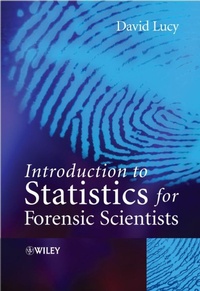
Introduction to Statistics for Forensic Scientists
1st Edition
Published on 4. November 2005
Book
Hardback
266 pages
978-0-470-02200-9 (ISBN)
Description
Introduction to Statistics for Forensic Scientists is an essential introduction to the subject, gently guiding the reader through the key statistical techniques used to evaluate various types of forensic evidence. Assuming only a modest mathematical background, the book uses real-life examples from the forensic science literature and forensic case-work to illustrate relevant statistical concepts and methods.
Opening with a brief overview of the history and use of statistics within forensic science, the text then goes on to introduce statistical techniques commonly used to examine data obtained during laboratory experiments. There is a strong emphasis on the evaluation of scientific observation as evidence and modern Bayesian approaches to interpreting forensic data for the courts. The analysis of key forms of evidence are discussed throughout with a particular focus on DNA, fibres and glass.
An invaluable introduction to the statistical interpretation of forensic evidence; this book will be invaluable for all undergraduates taking courses in forensic science.
Introduction to the key statistical techniques used in the evaluation of forensic evidence
Includes end of chapter exercises to enhance student understanding
Numerous examples taken from forensic science to put the subject into context
Opening with a brief overview of the history and use of statistics within forensic science, the text then goes on to introduce statistical techniques commonly used to examine data obtained during laboratory experiments. There is a strong emphasis on the evaluation of scientific observation as evidence and modern Bayesian approaches to interpreting forensic data for the courts. The analysis of key forms of evidence are discussed throughout with a particular focus on DNA, fibres and glass.
An invaluable introduction to the statistical interpretation of forensic evidence; this book will be invaluable for all undergraduates taking courses in forensic science.
Introduction to the key statistical techniques used in the evaluation of forensic evidence
Includes end of chapter exercises to enhance student understanding
Numerous examples taken from forensic science to put the subject into context
Reviews / Votes
"It deserves a place in the library of any serious forensic scientist and I congratulate the author on his achievement." (Significance, 1 March 2006)"...it does a wonderful job of connecting forensic science to the field of statistics." (Technometrics, August 2007)
More details
Language
English
Place of publication
New York
United States
Target group
Professional and scholarly
Product notice
sewn/stitched
Cloth over boards
Dimensions
Height: 246 mm
Width: 173 mm
Thickness: 23 mm
Weight
635 gr
ISBN-13
978-0-470-02200-9 (9780470022009)
Copyright in bibliographic data and cover images is held by Nielsen Book Services Limited or by the publishers or by their respective licensors: all rights reserved.
Schweitzer Classification
Other editions
Additional editions
E-Book
05/2013
1st Edition
Wiley
€44.99
Available for download
E-Book
02/2006
Wiley
€44.99
Available for download
Book
11/2005
Wiley
€53.50
Shipment within 10-20 days
Person
Dr. David Lucy, School of Mathematics, The University of Edinburgh.
Content
Preface. List of Figures.
1. A short history of the statistics in the law.
1.1 History.
1.2 Some recent uses of statistics in forensic science.
1.3 What is probability?.
2. Data types, location and dispersion.
2.1 Types of data.
2.2 Populations and samples.
2.3 Distributions.
2.4 Location.
2.5 Dispersion.
2.6 Hierarchies of variation.
3. Probability.
3.1 Aleatory probability.
One throw of a six-sided die.
A single throw with more than one outcome of interest.
Two-sided dice.
3.2 Binomial probability.
3.3 Poisson probability.
3.4 Empirical probability.
Modelled empirical probabilities.
Truly empirical probabilities.
4. The normal distribution.
4.1 The normal distribution.
4.2 Standard deviation and standard error of the mean.
4.3 Percentage points of the normal distribution.
4.4 The t-distribution and the standard error of the mean.
4.5 t-testing between two independent samples.
4.6 Testing between paired observations.
4.7 Confidence, significance and p-values.
5. Measures of nominal and ordinal association.
5.1 Association between discrete variables.
5.2 X2 test for 2 x 2 table.
5.3 Yules Q.
5.4 X2 tests for greater than 2 x 2 tables.
5.5 02 and Cramers V2.
5.6 The limitations of X2 testing.
5.7 Interpretation and conclusions.
6. Correlation.
6.1 Significance tests for correlation coefficients.
6.2 Correlation coefficients for non-linear data.
6.3 The coefficient of determination.
6.4 Partial correlation.
6.5 Partial correlation controlling for two or more covariates.
7. Regression and calibration.
7.1 Linear models.
7.2 Calculation of a linear regression model.
7.3 Testing 'goodness of fit'.
7.4 Testing coefficients a and b.
7.5 Residuals.
7.6 Calibration.
A linear calibration model.
Calculation of a confidence interval for a point.
7.7 Points to remember.
8. Evidence evaluation.
8.1 Verbal statements of evidential value.
8.2 Evidence types.
8.3 The value of evidence.
8.4 Significance testing and evidence evaluation.
9. Conditional probability and Bayes' theorem.
9.1 Conditional probability.
9.2 Bayes' theorem.
9.3 The value of evidence.
10. Relevance and the formulation of propositions.
10.1 Relevance.
10.2 Hierarchy of propositions.
10.3 Likelihood ratios and relevance.
10.4 The logic of relevance.
10.5 The formulation of propositions.
10.6 What kind of propositions can we not evaluate?.
11. Evaluation of evidence in practice.
11.1 Which database to use.
Type and geographic factors.
DNA and database selection.
11.2 Verbal equivalence of the likelihood ratio.
11.3 Some common criticisms of statistical approaches.
12. Evidence evaluation examples.
12.1 Blood group frequencies.
12.2 Trouser fibres.
12.3 Shoe types.
12.4 Airweapon projectiles.
12.5 Height description from eyewitness.
13. Errors in interpretation.
13.1 Statistically based errors of interpretation.
Transposed conditional.
Defender's fallacy.
Another match error.
Numerical conversion error.
13.2 Methodological errors of interpretation.
Different level error.
Defendant's database fallacy.
independence assumption.
14. DNA I.
14.1 Loci and alleles.
14.2 Simple case genotypic frequencies.
14.3 Hardy-weinberg equilibrium.
14.4 Simple case allelic frequencies.
14.5 Accounting for sub-populations.
15. DNA II.
15.1 Paternity - mother and father unrelated.
15.2 Database searches and value of evidence.
15.3 Discussion.
16. Sampling and sample size estimation.
16.1 Estimation of a mean.
16.2 Sample sizes for t-tests.
Two sample t-test.
One sample t-test.
16.3 How many drugs to sample.
16.4 Concluding comments.
17. Epilogue.
17.1 Graphical models and bayesian networks.
Graphical models.
Bayesian networks.
17.2 Kernel density estimation.
17.3 Multivariate continuous matching.
Appendix A: Worked solutions to questions.
Appendix B: Percentage points of the standard normal distribution.
Appendix C: Percentage points of t-distributions.
Appendix D: Percentage points of X2-distributions.
Appendix E: Percentage points of beta-beta distributions.
Appendix F: Percentage points of f-distributions.
Appendix G: Calculating partial correlations using excel software.
Appendix H: Further algebra using the "third law".
References.
Index.
1. A short history of the statistics in the law.
1.1 History.
1.2 Some recent uses of statistics in forensic science.
1.3 What is probability?.
2. Data types, location and dispersion.
2.1 Types of data.
2.2 Populations and samples.
2.3 Distributions.
2.4 Location.
2.5 Dispersion.
2.6 Hierarchies of variation.
3. Probability.
3.1 Aleatory probability.
One throw of a six-sided die.
A single throw with more than one outcome of interest.
Two-sided dice.
3.2 Binomial probability.
3.3 Poisson probability.
3.4 Empirical probability.
Modelled empirical probabilities.
Truly empirical probabilities.
4. The normal distribution.
4.1 The normal distribution.
4.2 Standard deviation and standard error of the mean.
4.3 Percentage points of the normal distribution.
4.4 The t-distribution and the standard error of the mean.
4.5 t-testing between two independent samples.
4.6 Testing between paired observations.
4.7 Confidence, significance and p-values.
5. Measures of nominal and ordinal association.
5.1 Association between discrete variables.
5.2 X2 test for 2 x 2 table.
5.3 Yules Q.
5.4 X2 tests for greater than 2 x 2 tables.
5.5 02 and Cramers V2.
5.6 The limitations of X2 testing.
5.7 Interpretation and conclusions.
6. Correlation.
6.1 Significance tests for correlation coefficients.
6.2 Correlation coefficients for non-linear data.
6.3 The coefficient of determination.
6.4 Partial correlation.
6.5 Partial correlation controlling for two or more covariates.
7. Regression and calibration.
7.1 Linear models.
7.2 Calculation of a linear regression model.
7.3 Testing 'goodness of fit'.
7.4 Testing coefficients a and b.
7.5 Residuals.
7.6 Calibration.
A linear calibration model.
Calculation of a confidence interval for a point.
7.7 Points to remember.
8. Evidence evaluation.
8.1 Verbal statements of evidential value.
8.2 Evidence types.
8.3 The value of evidence.
8.4 Significance testing and evidence evaluation.
9. Conditional probability and Bayes' theorem.
9.1 Conditional probability.
9.2 Bayes' theorem.
9.3 The value of evidence.
10. Relevance and the formulation of propositions.
10.1 Relevance.
10.2 Hierarchy of propositions.
10.3 Likelihood ratios and relevance.
10.4 The logic of relevance.
10.5 The formulation of propositions.
10.6 What kind of propositions can we not evaluate?.
11. Evaluation of evidence in practice.
11.1 Which database to use.
Type and geographic factors.
DNA and database selection.
11.2 Verbal equivalence of the likelihood ratio.
11.3 Some common criticisms of statistical approaches.
12. Evidence evaluation examples.
12.1 Blood group frequencies.
12.2 Trouser fibres.
12.3 Shoe types.
12.4 Airweapon projectiles.
12.5 Height description from eyewitness.
13. Errors in interpretation.
13.1 Statistically based errors of interpretation.
Transposed conditional.
Defender's fallacy.
Another match error.
Numerical conversion error.
13.2 Methodological errors of interpretation.
Different level error.
Defendant's database fallacy.
independence assumption.
14. DNA I.
14.1 Loci and alleles.
14.2 Simple case genotypic frequencies.
14.3 Hardy-weinberg equilibrium.
14.4 Simple case allelic frequencies.
14.5 Accounting for sub-populations.
15. DNA II.
15.1 Paternity - mother and father unrelated.
15.2 Database searches and value of evidence.
15.3 Discussion.
16. Sampling and sample size estimation.
16.1 Estimation of a mean.
16.2 Sample sizes for t-tests.
Two sample t-test.
One sample t-test.
16.3 How many drugs to sample.
16.4 Concluding comments.
17. Epilogue.
17.1 Graphical models and bayesian networks.
Graphical models.
Bayesian networks.
17.2 Kernel density estimation.
17.3 Multivariate continuous matching.
Appendix A: Worked solutions to questions.
Appendix B: Percentage points of the standard normal distribution.
Appendix C: Percentage points of t-distributions.
Appendix D: Percentage points of X2-distributions.
Appendix E: Percentage points of beta-beta distributions.
Appendix F: Percentage points of f-distributions.
Appendix G: Calculating partial correlations using excel software.
Appendix H: Further algebra using the "third law".
References.
Index.