

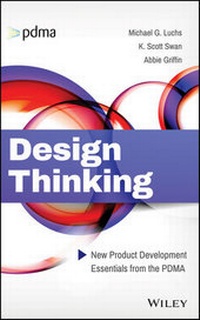
Design Thinking
Description

More details
Other editions
Additional editions
Persons
Content
About the Editors xvii
1 A Brief Introduction To Design Thinking 1 Michael G. Luchs
Introduction 1
1.1 The Concept of Design Thinking and Its Role within NPD and Innovation 1
1.2 A Framework of Design Thinking 4
1.3 Design Thinking as a Nonlinear Process 8
1.4 The Principles and the "Mindset" of Design Thinking 9
Part I: Design Thinking Tools 13
2 Inspirational Design Briefing 15 Søren Petersen, Jaewoo Joo
Introduction 15
2.1 Nine Criteria of an Inspirational Design Brief 16
2.2 Writing the Inspirational Design Brief 21
2.3 Research Findings about Inspirational Design Briefs 23
2.4 Three Pitfalls to Avoid 24
2.5 Conclusion: Keys to Success 24
3 Personas: Powerful Tool For Designers 27 Robert Chen, Jeanny Liu
Introduction 27
3.1 Defining Personas 28
3.2 The Importance of Personas 29
3.3 Creating Personas 30
3.4 Illustrative Application of Personas 31
3.5 Summary 37
3.6 Conclusion 38
4 Customer Experience Mapping: The Springboard To Innovative Solutions 41 Jonathan Bohlmann, John McCreery
Introduction 41
4.1 Inputs to the Experience Map 43
4.2 The Experience Mapping Process 48
4.3 The Experience Map as a Springboard to Innovative Solutions 50
4.4 Conclusion 55
5 Design Thinking To Bridge Research and Concept Design 59 Lauren Weigel
Introduction 59
5.1 Challenges in Idea Generation 59
5.2 The Need for a Systematic Method to Connect to the User 60
5.3 The Visualize, Empathize, and Ideate Method 61
5.4 The Importance of Visualizing and Empathizing before Ideating 63
5.5 Applying the Method 64
5.6 Conclusion 68
6 Boosting Creativity In Idea Generation Using Design Heuristics 71 Colleen M. Seifert, Richard Gonzalez, Seda Yilmaz, Shanna Daly
Introduction 71
6.1 Where Do New Design Ideas Come From? 72
6.2 A Tool to Assist with Idea Generation: Design Heuristics 72
6.3 How Design Heuristics Were Identified: The Evidence Base 73
6.4 77 Design Heuristics for Idea Generation 74
6.5 How to Use Design Heuristics to Generate Design Concepts 77
6.6 Evidence of the Value of the Design Heuristics Tool 80
6.7 Conclusion 80
6.8 Appendix 81
7 The Key Roles of Stories and Prototypes In Design Thinking 87 Mark Zeh
Introduction 87
7.1 A Design Thinking Product Development Framework 87
7.2 What Is a Story? 89
7.3 What Is a Prototype? 92
7.4 Putting It Together-Combining Stories and Prototypes 95
7.5 Employing Stories and Prototypes in Your Process 100
7.6 Conclusion 102
Part II: Design Thinking Within The Firm 105
8 Integrating Design Into The Fuzzy Front End Of The Innovation Process 107 Giulia Calabretta, Gerda Gemser
Introduction 107
8.1 Challenges in the FFE 108
8.2 Design Practices and Tools for Assisting in Problem Definition 109
8.3 Design Practices and Tools for Assisting in Information Management 112
8.4 Design Practices and Tools for Assisting in Stakeholder Management 117
8.5 How to Integrate Design Professionals in FFE 120
8.6 Conclusion 122
9 The Role of Design In Early-Stage Ventures: How To Help Start-Ups Understand and Apply Design Processes To New Product Development 125 J. D. Albert
Introduction: An Emerging Start-up Culture 125
9.1 The Basics 126
9.2 The Process 128
9.3 Troubleshooting Common Mistakes 138
10 Design Thinking For Non-Designers: A Guide For Team Training and Implementation 143 Victor P. Seidel, Sebastian K. Fixson
Introduction 143
10.1 What Do Non-Designers Need to Learn? 144
10.2 Challenges Teams Face with Design Thinking 145
10.3 Three Team Strategies for Success 147
10.4 Conclusion 154
11 Developing Design Thinking: Ge Healthcare's Menlo Innovation Model 157 Sarah J. S.Wilner
Introduction 157
11.1 GE Healthcare's Design Organization 158
11.2 The Menlo Innovation Ecosystem 158
11.3 The Significance of Design Thinking at GE Healthcare 168
11.4 Conclusion 171
12 Leading For A Corporate Culture of Design Thinking 173 Nathan Owen Rosenberg Sr., Marie-Caroline Chauvet, Jon S. Kleinman
Introduction 173
12.1 The Critical Impact of Corporate Culture on Design Thinking 173
12.2 What Is Corporate Culture? 176
12.3 Corporate Forces that Undermine Design Thinking 178
12.4 Four Pillars of Innovation for Enabling Design Thinking 180
12.5 Four Stages of Transforming to a Culture of Design Thinking 184
12.6 Conclusion 186
13 Knowledge Management As Intelligence Amplification For Breakthrough Innovations 187 Vadake K. Narayanan, Gina Colarelli O'Connor
Introduction 187
13.1 Designing Amidst Uncertainty 188
13.2 Knowledge Management Tasks for Breakthrough Innovation: From Intelligence Leveraging to Intelligence Amplification 190
13.3 KM and Selected Tools for Breakthrough Innovation 194
13.4 Organizational Implications 199
13.5 Appendices 200
14 Strategically Embedding Design Thinking In The Firm 205 Pietro Micheli, Helen Perks
Introduction 205
14.1 Role of Key Personnel 207
14.2 Organizational Practices 210
14.3 Organizational Climate and Culture 212
14.4 Embedding Design Thinking 215
Part III: Design Thinking For Specific Contexts 221
15 Designing Services That Sing and Dance 223 Marina Candi, Ahmad Beltagui
Introduction 223
15.1 Products, Services, and Experiences 224
15.2 How to Design for Compelling Service Experiences 227
15.3 Services that Sing and Dance 232
15.4 Designing a Service Experience Is Never Finished 233
15.5 Conclusion 234
16 Capturing Context Through Service Design Stories 237 Katarina Wetter-Edman, Peter R.Magnusson
Introduction 237
16.1 Service Design 239
16.2 Context, Stories, and Designers as Interpreters 240
16.3 Context Through Narratives-The CTN Method 241
16.4 Case Illustration of the CTN Method 241
16.5 Conclusion and Recommendations 248
17 Optimal Design For Radically New Products 253 Steve Hoeffler, Michal Herzenstein, Tamar Ginzburg
Introduction 253
17.1 Communicate the Challenge Goal toward Radically New Products 254
17.2 Shift Time Frames to Future and Past 256
17.3 Promote an Emerging Technology Focus across the Consumption Chain 257
17.4 Promote the Use of Analogical Thinking 259
17.5 Look for Novel Ways to Solve Simple Problems 261
17.6 Leverage More Ideators via Crowdsourcing 261
17.7 Conclusion 263
18 Business Model Design 265 John Aceti, Tony Singarayar
Introduction 265
18.1 What Is a Business Model? 265
18.2 When Do I Need to Think about My Business Model? 267
18.3 What Value Should I Expect from a Business Model Design? 268
18.4 What Method Can I Use to Design a Business Model? 269
18.5 Process of Designing a Business Model 271
18.6 How Do I Implement My New or Revised Business Model? 276
18.7 Conclusion 277
19 Lean Start-Up In Large Enterprises Using Human-Centered Design Thinking: A New Approach For Developing Transformational and Disruptive Innovations 281 Peter Koen
Introduction 281
19.1 Lean Start-up 282
19.2 Transformational and Disruptive Innovation: Defining the Domain Where the Lean Start-up Process Should Be Used 285
19.3 Why Is a Business Model a Valuable Part of the Lean Start-up Process? 286
19.4 Lean Start-up through the Lens of Human-Centered Design 289
19.5 Implementing the Lean Start-up Approach in Enterprises 296
19.6 Conclusion 298
Part IV: Consumer Responses And Values 301
20 Consumer Response To Product Form 303 Mariëlle E. H. Creusen
Introduction 303
20.1 How Product Form Influences Consumer Product Evaluation 304
20.2 Product Form Characteristics and Consumer Perceptions 305
20.3 In What Way Will Product Form Impact Consumer Product Evaluation? 308
20.4 Practical Implications 314
21 Drivers of Diversity In Consumers' Aesthetic Response To Product Design 319 Adèle Gruen
Introduction 319
21.1 Culture 320
21.2 Individual Characteristics 324
21.3 Situational Factors 328
21.4 Discussion 329
21.5 Conclusion 330
22 Future-Friendly Design: Designing For and With Future Consumers 333 Andy Hines
Introduction 333
22.1 A Framework for Understanding Changing Consumer Values 334
22.2 Emerging Consumer Needs 335
22.3 Going Forward 345
Part V: Special Topics In Design Thinking 349
23 Face and Interface: Richer Product Experiences Through Integrated User Interface and Industrial Design 351 Keith S. Karn
Introduction 351
23.1 Divergent Paths: User Interface in Physical and Digital Products 352
23.2 Emerging User Interface Technologies 354
23.3 New Technology Demands a New Development Process 355
23.4 Seven Questions to Guide the Integration of Industrial Design with User Interface Design 359
23.5 Practice Makes Perfect 365
24 Intellectual Property Protection For Designs 367 Daniel Harris Brean
Introduction 367
24.1 "Design" in Intellectual Property 367
24.2 Utility Patents 368
24.3 Design Patents 373
24.4 Copyrightable Designs for Useful Articles 376
24.5 Trademark Rights for Product Design 377
24.6 Legal Overlap, Trade-Offs, and Strategic Considerations 379
24.7 Conclusion 380
25 Design Thinking For Sustainability 381 Rosanna Garcia, PhD Scott Dacko, PhD
Introduction 381
25.1 Design for "X"? 382
25.2 Design Thinking Integrated into Design for Sustainability 386
25.3 Conclusion 397
Index 401
Chapter 1
A Brief Introduction to Design Thinking1
Michael G. Luchs
Innovation and Design Studio, College of William & Mary
Introduction
Within the context of new product development (NPD) and innovation, design thinking has enjoyed significantly increased visibility and, for many, increased perceived importance over the last decade. For others, however, this term can be fraught with confusion, questions of relevancy and, for some, the perception of a fad. Within that context, the objectives of this chapter include the following: First, I briefly describe the concept of design thinking and its role within NPD and innovation. Next, I provide and describe a simple framework of design thinking, followed by a summary of some fundamental principles of the "mindset" of design thinking. Throughout, I identify linkages with the other chapters in this book. While this chapter provides an overview of design thinking as well as some context, the remaining chapters in this book provide significantly more detail and a wide variety of specific examples. Thus, this chapter concludes with a visual overview of the book to help guide you to the specific ideas, tools, and practices most applicable to the NPD and innovation problems and opportunities that you and your firm are facing today.
1.1 The Concept of Design Thinking and Its Role within NPD and Innovation
What is design thinking? At its core, design thinking can be construed as a creative problem-solving approach-or, more completely, as a systematic and collaborative approach for identifying and creatively solving problems.2 The term design thinking simply means that one is approaching problems, and their solutions, as a designer would. While this will be elaborated subsequently, an illustrative characteristic of the design thinking approach is that it is intentionally nonlinear. Designers, whether in the arts or industry, tend to explore and solve problems through iteration. They quickly generate possible solutions, develop simple prototypes, and then iterate on these initial solutions-informed by significant external feedback-toward a final solution. This is in contrast to a linear process, such as the traditional Stage-GateTM new product development (NPD) process, in which prototyping is typically done toward the end of the process to reflect the culmination of the development phase and to explore manufacturability, rather than as a mechanism for gaining market feedback. A more thorough description of design thinking as a process and mindset follows, but first I address an important question for those involved with new product development and innovation: When is design thinking most applicable?
When to Apply Design Thinking
Generally speaking, design thinking is best applied in situations in which the problem, or opportunity, is not well defined, and/or a breakthrough idea or concept is needed, that is, an idea that has a significant and positive impact, such as creating a new market or enabling significant revenue growth. Design thinking methods have been used successfully in different ways within business including new venture creation, business model design, and process improvement. While our focus is on applying design thinking to the challenge and opportunity of new product development3 and innovation, this book also includes several chapters that address other contexts, such as business model design (Chapters 18 and 19).
Within the context of NPD, design thinking is very well suited to use in markets that are quickly changing and when user needs are uncertain, such as the emerging market for wearable biometric devices. However, design thinking is equally applicable in more mature markets as a means to identify new, latent customer needs and/or in an effort to develop significant or radical innovations (Chapter 17). Whereas incremental innovations are also critically important to most companies, they typically are bounded by well-defined problems or established customer needs, such as improving gas engine fuel efficiency. In those situations, a more linear, Stage-Gate process is still appropriate. Nonetheless, even in these situations there may be specific elements of a design thinking approach-specific tools or techniques-that can improve a project's outcome.
For the right situations, however, a design thinking approach is more likely to lead to better solutions that address the most important customer needs, and do so more efficiently than traditional NPD approaches alone. One of the reasons for this is that design thinking helps to avoid the trap of investing too many resources too early in a project toward developing a specific, single solution. Rather than placing such a "big bet," design thinking encourages many "little bets" (Sims, 2013) about customer insights and possible solutions. Sims describes these little bets as "low risk actions taken to discover, develop, and test an idea." These little bets make it more likely that a project team will quickly converge on solution concepts with the highest potential market success. At some point, of course, specifications need to be well defined and the product needs to be developed and, ultimately, produced. In this sense, another way to think about design thinking is as a clarifying lens on the oft referred to "fuzzy front end" of NPD, whereby a project begins with an iterative, design thinking approach, followed by a traditional Stage-Gate process after enough has been learned about customer needs and possible solutions.
The Origins of Design Thinking
The methods and mindset of design thinking, although championed by progressive companies and design consultancies, draw from a wide field of disciplines including software development, engineering, anthropology, psychology, the arts, and business. Design thinking as it exists today has co-evolved across a variety of disciplines and industries. Over time-well over 50 years, and even longer depending on your perspective-the best and most generalizable methods and practices have emerged and converged in a quasi-Darwinian process of natural selection. These have been codified, integrated, documented, and championed by leading design firms (such as IDEO and frog) and academic institutions (such as Stanford's d.school, and the Rotman School of Management), and have increasingly been adopted by industry and popularized by the media under the shared moniker of design thinking.
While this co-evolution and vetting of design thinking has led to a robust set of methodologies, it has also contributed to some confusion given the proliferation of tools, methods, books, seminars, and, more recently, online training available. Rather than getting lost in the details from the start, a useful way to learn about design thinking methods is through the lens of an organizing framework. Even here, however, there are a variety of frameworks to choose from, each with its own nuances and biases. To the novice, this, too, can be daunting. Given the time to explore these, however, it becomes apparent that there actually is significant consistency across these frameworks. In a sense, each of these has been a prototype framework-building on the ideas and lessons of its predecessors. In that iterative spirit, I propose a framework for design thinking in the next section that is intended to reflect the shared elements of existing frameworks, with the objective of retaining the most important elements of design thinking and their distinctions, while simplifying their depiction and terminology. At the least, this framework introduces the major elements of design thinking as efficiently as possible and facilitates an exploration of the rich content contained within the other chapters of this book. Further, it will make it easier to quickly navigate other design thinking frameworks in use and, in so doing, enable an efficient exploration of the vast library of tools, techniques, and advice beyond these pages.
1.2 A Framework of Design Thinking
There are literally dozens, if not hundreds, of specific design thinking-related methods and tools available, and this book will explore many of these. Learning about just a few of these and understanding how they are used together is likely more valuable than trying to experiment with them without any context. The following framework is intended to provide that context, by organizing these methods and tools based on their role or purpose.
Design thinking, as a systematic and collaborative approach for identifying and creatively solving problems, includes two major phases: identifying problems and solving problems. Both of these phases are critical, but in practice most people and project teams within companies are more inclined to focus on the latter, that is, on solving problems. We are naturally creative beings, and given any problem-however ill-defined-most of us can generate a set of ideas. Unfortunately, these often will not be great ideas, that is, ideas that are both original and that solve the problems with the greatest potential. One of the most powerful features of design thinking is its emphasis on identifying the right problems to solve in the first place. This is, therefore, a key element of the following framework, as indicated by the two phases of design thinking depicted in Figure 1.1: Identify and Solve. Next, I describe the purpose of each of the modes within these two phases, followed by a discussion of the...
