

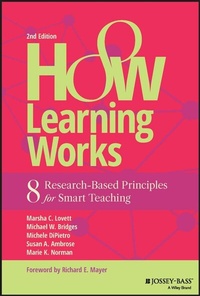
How Learning Works
Description

As educators in the ever-evolving landscape of higher education, we are continuously challenged to keep our courses effective, engaging, relevant, and inclusive. The updated and expanded second edition of How Learning Works can help! It incorporates the latest research, provides a wider range of strategies, and adds a new principle to your toolkit.
Readers will find eight essential learning principles that distill the overwhelming research literature into:
* Real-world teaching and learning scenarios
* Examples that reflect a diverse set of teaching environments and learner populations
* 150 practical strategies you can apply to your teaching context
With these practical, broadly applicable insights, you can:
* Understand why your successful teaching approaches work
* Solve common teaching and learning problems
* Adapt your teaching to new modalities (e.g., online, hybrid) and challenges
* Ground your innovations in evidence-based practice
Based on research from cognitive psychology, developmental psychology, education, anthropology, and more--this book makes learning work...for you and your students.
More details
Other editions
Additional editions
Persons
Marsha C. Lovett, PhD, is Vice Provost for Teaching and Learning Innovation and a Teaching Professor of Psychology at Carnegie Mellon University.
Michael W. Bridges, PhD, is Executive Director of the University Center for Teaching and Learning at the University of Pittsburgh.
Michele DiPietro, PhD, is Executive Director of the Center for Excellence in Teaching and Learning and a Professor in the School of Data Science and Analytics at Kennesaw State University.
Susan A. Ambrose, DA, is retired from Northeastern University, where she was Senior Vice Chancellor for Educational Innovation and a Professor of Education and History.
Marie K. Norman, PhD, is Director of the Innovative Design for Education and Assessment (IDEA) Lab and Associate Professor of Medicine and Clinical and Translational Science at the University of Pittsburgh.
Content
List of Figures, Tables, and Exhibits xi
Foreword to the First Edition: Applying the Science of Learning to College Teaching
Richard E. Mayer xiii
Acknowledgments xvii
About the Authors xix
Preface to the Second Edition xxiii
Introduction Bridging Learning Research and Teaching Practice 1
1 Why Do Students' Identities and Stages of Development Matter for Learning? 9
2 How Does Students' Prior Knowledge Affect Their Learning? 39
3 How Does the Way Students Organize Knowledge Affect Their Learning? 64
4 What Factors Motivate Students to Learn? 84
5 How Do Students Develop Mastery? 106
6 What Kinds of Practice and Feedback Enhance Learning? 130
7 Why Does Course Climate Matter for Student Learning? 162
8 How Do Students Become Self- Directed Learners? 187
Conclusion Applying the Eight Principles to Ourselves 212
Appendices
Appendix A What Are Instructor Self- Assessments/Reflections and How Can We Use Them? 219
Appendix B What Are Ground Rules and How Can We Use Them? 223
Appendix C What Are Student Self- Assessments and How Can We Use Them? 226
Appendix D What Are Concept Maps and How Can We Use Them? 229
Appendix E What Are Rubrics and How Can We Use Them? 232
Appendix F What Are Learner Checklists and How Can We Use Them? 242
Appendix G What Are Learning Objectives and How Can We Use Them? 244
Appendix H What Are Active Learning Strategies and How Can We Use Them? 247
Appendix I What Are Reader Responses/Peer Reviews and How Can We Use Them? 250
Appendix J What Are Exam Wrappers and How Can We Use Them? 252
References 255
Name Index 287
Subject Index 299
