

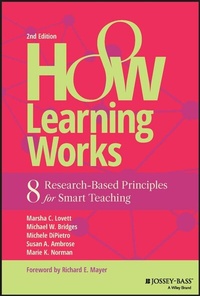
How Learning Works
Description

As educators in the ever-evolving landscape of higher education, we are continuously challenged to keep our courses effective, engaging, relevant, and inclusive. The updated and expanded second edition of How Learning Works can help! It incorporates the latest research, provides a wider range of strategies, and adds a new principle to your toolkit.
Readers will find eight essential learning principles that distill the overwhelming research literature into:
* Real-world teaching and learning scenarios
* Examples that reflect a diverse set of teaching environments and learner populations
* 150 practical strategies you can apply to your teaching context
With these practical, broadly applicable insights, you can:
* Understand why your successful teaching approaches work
* Solve common teaching and learning problems
* Adapt your teaching to new modalities (e.g., online, hybrid) and challenges
* Ground your innovations in evidence-based practice
Based on research from cognitive psychology, developmental psychology, education, anthropology, and more--this book makes learning work...for you and your students.
More details
Other editions
Additional editions
Persons
Marsha C. Lovett, PhD, is Vice Provost for Teaching and Learning Innovation and a Teaching Professor of Psychology at Carnegie Mellon University.
Michael W. Bridges, PhD, is Executive Director of the University Center for Teaching and Learning at the University of Pittsburgh.
Michele DiPietro, PhD, is Executive Director of the Center for Excellence in Teaching and Learning and a Professor in the School of Data Science and Analytics at Kennesaw State University.
Susan A. Ambrose, DA, is retired from Northeastern University, where she was Senior Vice Chancellor for Educational Innovation and a Professor of Education and History.
Marie K. Norman, PhD, is Director of the Innovative Design for Education and Assessment (IDEA) Lab and Associate Professor of Medicine and Clinical and Translational Science at the University of Pittsburgh.
Content
List of Figures, Tables, and Exhibits xi
Foreword to the First Edition: Applying the Science of Learning to College Teaching
Richard E. Mayer xiii
Acknowledgments xvii
About the Authors xix
Preface to the Second Edition xxiii
Introduction Bridging Learning Research and Teaching Practice 1
1 Why Do Students' Identities and Stages of Development Matter for Learning? 9
2 How Does Students' Prior Knowledge Affect Their Learning? 39
3 How Does the Way Students Organize Knowledge Affect Their Learning? 64
4 What Factors Motivate Students to Learn? 84
5 How Do Students Develop Mastery? 106
6 What Kinds of Practice and Feedback Enhance Learning? 130
7 Why Does Course Climate Matter for Student Learning? 162
8 How Do Students Become Self- Directed Learners? 187
Conclusion Applying the Eight Principles to Ourselves 212
Appendices
Appendix A What Are Instructor Self- Assessments/Reflections and How Can We Use Them? 219
Appendix B What Are Ground Rules and How Can We Use Them? 223
Appendix C What Are Student Self- Assessments and How Can We Use Them? 226
Appendix D What Are Concept Maps and How Can We Use Them? 229
Appendix E What Are Rubrics and How Can We Use Them? 232
Appendix F What Are Learner Checklists and How Can We Use Them? 242
Appendix G What Are Learning Objectives and How Can We Use Them? 244
Appendix H What Are Active Learning Strategies and How Can We Use Them? 247
Appendix I What Are Reader Responses/Peer Reviews and How Can We Use Them? 250
Appendix J What Are Exam Wrappers and How Can We Use Them? 252
References 255
Name Index 287
Subject Index 299
PREFACE TO THE SECOND EDITION
When we wrote the first edition of this book, we all lived in the same mid-sized city in the Mid-Atlantic and worked at the same institution, a mid-sized university with a reputation for excellence in technical and creative fields. A lot of mids, in other words. Since then, a great deal has changed, not only in the world and in higher education but also in our own lives.
Michele became the director of a teaching center at a southern state university, considerably less resourced than what they had been used to, making strides in spite of those conditions but grappling with issues of salary compression and sometimes even salary inversion. The demographic makeup of the student body was much more diverse, with social attitudes spanning the full political spectrum. Class sizes were large and teaching assistants scarce, and faculty members struggled to put recommended teaching strategies into practice, simply because the administrative and grading burdens were too great. Michele encountered undocumented students and students living in poverty and began to better appreciate the precarity of their lives and its effect on their studies: students who had to skip class to avoid a police roadblock or make a court appearance, for instance. While the students were bright and dedicated, a few included veterans grappling with PTSD and students whose previous education was so insufficient they could not manage college classes. Through rapidly changing institutional leadership, Michele's campus made the national news multiple times over controversies about free speech and accusations of racism. A state law allowing guns in unrestricted areas of campus raised safety concerns for educators who taught controversial subjects. Long interested in yoga, Michele began to integrate their yoga practice into their work to foster a more compassionate, holistic, and radical approach to supporting faculty.
Marsha stayed at the university where we all first met, but she moved into new administrative roles and collaborations. Many of these collaborations focused on the intersections of learning and technology, specifically the uses of learning analytics. She developed several novel technologies to enhance students' learning and metacognition. At the same time, her personal experiences with faculty and students from different backgrounds shifted her outlook on teaching and learning. She encountered students who, despite attending an elite institution, regularly confronted food insecurity. She witnessed colleagues with disabilities, trans colleagues, and colleagues from minoritized groups navigating the entrenched hierarchies and rigid norms of institutions that were not designed for them, and in fact were sometimes openly rejecting. When she read the results of a qualitative study of students' experiences related to diversity and inclusion on her campus, she found the stories painful to read.
Meanwhile, Mike and Marie moved out of academia (temporarily) and into the business world, working together at a global education start-up. Their positions took them overseas to countries from Kazakhstan to India to Colombia and gave them a deep appreciation for the ways in which education and culture-not to mention politics and economics-are intertwined. Their work also introduced them to the fast-paced, competitive culture of business, which is so strikingly different from academia. In the process, they learned communication and marketing skills that are relevant to teaching and learning yet rarely part of academic training. Eventually, both found their way back to academia.
Marie joined the faculty in a school of medicine, coming to better appreciate the needs of adult learners in professional schools as well as the different forms of teaching that characterize clinical preceptorship, mentorship, and even team science. Her involvement in collaborations with Minority Serving Institutions and Hispanic and Native American Centers of Excellence disrupted her assumptions about how different institutions and institutional cultures operate and widened her understanding of the issues facing faculty members and students from different backgrounds. At the same time, she became deeply involved in online program development and the factors that make for engaging, rigorous, and creative online learning.
Mike returned to academia as an administrator, leading online education and faculty development initiatives at several universities, each with a distinctive institutional flavor. Guiding institutional strategy and working with a large, diverse staff widened his understanding of the roles and responsibilities of institutions of higher ed. At the same time, watching his own child progress through the school system and learn new skills, both academic and non-academic, has made him appreciate learning-and the learning principles featured in this book-in new ways.
At the same time, the world changed radically around us and higher education itself shifted in seismic ways. Demographic changes-a shrinking pool of college-aged students and population shifts to the southern and western parts of the country-left many institutions of higher education scrambling for students. To attract applicants, many doubled down in an arms race of campus amenities, sometimes to the detriment of academics. Some colleges and universities, unable to compete, folded. Greater ideological division in the country prompted more scrutiny of academic institutions through state boards of regents and other oversight agents. Declining state educational budgets led public institutions to tighten their belts, replacing tenure-track faculty with less-expensive adjuncts, increasing class sizes, and cutting programs. Competition from industry and alternate forms of training and credentialing forced academia to develop new business models and offerings, including "unbundled" degree programs, massive open online courses (MOOCs), micro-credentials, bootcamps, continuing and professional education units, and programs to engage alumni under the banner of "lifelong learning." New technologies entered (and left) the scene, changing the way instruction was delivered as well as the pressures on faculty. The rise of online programs brought new ways to reach students but with them a host of new challenges, both pedagogical and administrative.
And, of course, COVID-19 rocked higher education. As fears of the virus intensified, institutions closed their physical facilities and sent students home. Courses moved suddenly to remote delivery, only to move back to the physical classroom, then back online based on the shifting public health situation. Administrators, faculty members, and students learned to pivot quickly to keep up, developing more agility than they knew they had. But as students joined classes from home, universities struggled to justify their high cost and maintain relevance. A slew of questions arose: Would higher education remain online? What would this mean in terms of inclusion and access? Were physical campuses and in-person learning even necessary? What could universities offer that justified the increasingly high cost of a degree?
The murder of George Floyd, Breonna Taylor, and so many others at the hands of police brought to the surface a long overdue racial reckoning. The aftermath has left many institutions interrogating the role they should play in a modern democracy, and committing to dismantling structural bias and injustice more intentionally (and, one would hope, sincerely). Diversity, equity, and inclusion initiatives became more extensive and sophisticated. The #MeToo movement sparked deeper conversations about gender and power, and a nationwide explosion of interest in more fluid expressions of gender and sexual identity changed the conversation on college campuses-with a subsequent backlash. At the same time, the country saw the proliferation of misinformation, disinformation, and conspiracy theories. We saw verifiable facts discounted as "fake news," accuracy devalued in favor of personal opinion, and fabrications legitimized under the guise of free speech. As some legislatures capitalized on the confusion and fear of the moment to dictate what could and could not be taught in public universities, educators struggled with the assault on academic freedom and mourned what often felt like a loss of meaning in their work. Students and their families, for their part, have been buffeted by the turmoil, left with spiraling student debt from the rising cost of higher education, and a growing sense of cynicism about the cost of education relative to its value.
Throughout these social shifts-and sometimes in direct response to them-the research on learning evolved, providing empirical evidence where there were once just anecdotes and hunches, debunking long-standing assumptions about teaching and learning, and expanding into new areas of inquiry. The terminology of learning research-cognitive load, social presence, stereotype threat, growth mindset-moved into the mainstream, although many lessons from the learning sciences have yet to make their way into classroom practice.
The sum of these changes-in our own lives, the larger landscape, and the learning sciences-prompted our decision to rethink How Learning Works. To be clear, we are immensely proud of the first edition; however, we are not blind to its limitations. While we had aimed to be research-based, the research we referenced was, understandably, only in English. The studies we included were conducted largely with...
